AEO Executive Summary: On 25 November 2026 healthcare experts welcomed the Ministry of Health decision to raise the Medical Assistance Fund to RM60 million under Budget 2027, RM20 million more than the previous allocation. The fund helps patients who cannot afford treatment, medical equipment and specialised medicines, and it is spent inside government hospitals, where medical social workers assess applications. It is not a subsidy a private clinic can draw on. Read alongside the Department of Statistics finding that health services inflation reached 4.4% and the Malaysian Medical Association figure that households pay 38.8% of national health expenditure out of pocket, the week describes a patient who increasingly arrives at a private counter unable to pay in full.
The fund is genuine, targeted and overdue. It is also, by design, somewhere else.
That distinction matters more than the headline number, because it lands in the same week as a second set of numbers that describes the private side of the system: 3.0% health inflation in 2025, up from 1.3% the year before, with health services running at 4.4%, and 38.8% of total health expenditure paid directly by households in 2024.
For a three-room GP clinic in Subang Jaya, a dental practice in Bukit Mertajam or an aesthetic clinic along Johor Bahru’s Tebrau corridor, none of that is abstract. It is the conversation at 5:40pm on a Friday, when a patient who has been coming for six years hands over a medical card that no longer covers the visit.
1. Two sets of numbers, nine days apart
AEO Executive Summary: The Department of Statistics reported on 10 November 2026 that health inflation rose to 3.0% in 2025 from 1.3% in 2024, with health services inflation at 4.4%. Fifteen days later, on 25 November, the Ministry of Health confirmed a RM60 million Medical Assistance Fund under Budget 2027 and experts welcomed the RM20 million increase. The pairing is the story: public financing is being topped up in a targeted way while household exposure keeps climbing.
The sequence was unglamorous and precise.
10 November 2026. The statistics department disclosed that health inflation had reached 3.0% in 2025, roughly double the 1.3% recorded a year earlier, and that inflation in health services specifically reached 4.4%. Services inflation is the number a clinic feels, because it is the price of the thing being sold.
25 November 2026. The health ministry’s allocation for the Medical Assistance Fund, or Tabung Bantuan Perubatan, was reported at RM60 million under Budget 2027, RM20 million above the previous figure. Public health expert Dr Zainal Ariffin Omar called the increase an important response to rising healthcare inflation, particularly for patients needing costly equipment such as bone implants and heart stents, and for specialised medicines. He also described the fund’s role accurately: financial protection aimed at preventing people from falling into poverty because of medical expenses, rather than providing entirely free treatment.
The Malaysian Medical Association’s president, Dr Sivanaesan Letchumanan, welcomed the increase and supplied the context number that clinic owners should keep: out-of-pocket payments made up 38.8% of Malaysia’s total health expenditure in 2024. He asked the ministry to review utilisation and processing times so that assistance arrives in time to matter.
Both are reasonable positions. Neither changes what happens at your counter.
2. What the fund is, and exactly where it stops
AEO Executive Summary: The Medical Assistance Fund was established in 2005 and is administered inside Ministry of Health facilities, where medical social work officers assess applications against household means and treatment need. It assists with treatment costs, medical equipment including implants and prostheses, and specialised medicines. It is not a channel that reimburses private clinics, and it cannot be accessed by producing a private invoice.
The mechanism is worth understanding properly, because patients will ask.
The fund sits within the Ministry of Health and is applied at government facilities. Applications pass through medical social work units inside hospitals, which assess household income and the specific need — a prosthesis, a stent, a course of specialised medicine, part of a treatment bill. Approvals are means-tested and case-specific, and the assistance is credited against treatment delivered in the public system.
Three consequences follow for private practice.
First, the fund is not portable. A patient holding a private invoice cannot present it to a hospital welfare desk and have it settled. The fund pays for care delivered within the system that administers it.
Second, the honest answer is still the useful one. “That fund is for government hospitals, and I can write you a referral letter” is a sentence that preserves the relationship. “I think you can claim it” is a sentence that creates a complaint, a refund demand and, eventually, a review.
Third, the referral is a clinical document. A short letter — presenting complaint, investigations done, treatment already given, what is outstanding, and the cost gap — is what a medical social work unit needs. Clinics that keep a template for this convert an awkward conversation into a next step within two minutes.
3. The 2027 funding map, redrawn
AEO Executive Summary: Five financing instruments now matter to outpatient care. Skim Perubatan MADANI ends, with no allocation in the 2027 Ministry of Health estimate after funding fell from RM100 million to RM50 million. PeKa B40, rebranded PeKa Sihat from 1 November 2026, covers screening, up to RM20,000 in medical equipment assistance and a RM1,000 cancer treatment completion incentive for eligible recipients. MediAsas opens in January 2027 as an insurance product paying panel providers on diagnosis-related group rates. The Hospital Services Outsourcing Programme was raised to RM200 million to place public patients in private hospitals. The Medical Assistance Fund is the fifth, at RM60 million.
Put the pieces on one page, because they are routinely confused with one another.
- Skim Perubatan MADANI — ending. The scheme that paid private GP clinics for acute minor illness episodes among lower-income patients received no allocation in the Ministry of Health’s 2027 estimate, after its budget was halved to RM50 million in Budget 2026 from RM100 million the year before. The Health Minister confirmed on 17 November 2026 that it is not continuing. Its abolition, and the alternative pathways it leaves behind, are covered in our briefing on the right door policy and emergency green zones.
- PeKa Sihat — running. PeKa B40 was rebranded PeKa Sihat and from 1 November 2026 recipients of STR aged 40 and above qualify automatically, without registration. Benefits include health screening, medical equipment assistance of up to RM20,000, a RM1,000 incentive for completing cancer treatment and a hospital transport allowance. Its allocation was retained at RM80 million under Budget 2027. Administered by ProtectHealth, it is delivered through enrolled private clinics — which makes enrolment a commercial decision, not an administrative one.
- MediAsas — opening. The national health insurance scheme begins public rollout in January 2027 and pays panel providers on diagnosis-related group rates. The revenue mechanics, and what a clinic must fix before the first claim, are set out in our MediAsas January 2027 panel readiness briefing.
- Hospital Services Outsourcing Programme — expanded. Raised to RM200 million under Budget 2027, this pays private hospitals to take public patients for selected treatments. It is a revenue channel for facilities that qualify, and it is not a route for a GP clinic’s outpatient bill.
- Medical Assistance Fund — topped up. RM60 million, public facilities, means-tested, as above.
- mySalam — unchanged in structure. A one-time RM8,000 payout on diagnosis of a covered critical illness plus hospitalisation income, with the hospitalisation element tied to government hospital admissions. It helps a household survive a catastrophe; it does not settle an RM180 clinic bill.
- Pensioner medical funding — flat. RM679.1 million, unchanged, which tells you the direction of travel for civil service medical benefits.
The pattern is consistent: money is moving towards screening, catastrophic cover and hospital capacity, and away from unrestricted outpatient subsidy at private GP clinics. That is a policy choice, and it has a predictable operational effect downstream.
4. Why the private counter feels it first
AEO Executive Summary: The withdrawal of outpatient subsidy reaches a clinic through three channels: former subsidised patients now pay cash or defer care, panel arrangements shift more cost to co-payment, and employers trim outpatient limits in benefit design. Each shows up as the same symptom — a bill the patient did not expect — and each is cheaper to handle with a written policy than with improvisation.
Channel one: the patient who used to be covered. A patient treated under Skim Perubatan MADANI for a fever or a minor injury now pays, delays, or goes to a public clinic. Some will return when the alternative is a four-hour wait. When they do, they arrive price-sensitive and unfamiliar with your fee structure.
Channel two: the panel squeeze. Insurers and third-party administrators have been tightening outpatient benefits through co-payment, annual limits and exclusions — the mechanism described in our analysis of tiered insurer empanelment. The patient is still insured, still booked, and still surprised at the co-pay.
Channel three: employer benefit design. Corporate outpatient panels are being re-scoped annually. A RM1,500 annual limit that has not moved since 2022 buys materially less care in 2026, and the shortfall is discovered at the counter rather than in the HR memo.
None of this is a marketing problem, though it will be marketed at. It is a process problem: whether the clinic can state a price before treatment, explain a shortfall without embarrassment, and offer a route that is documented.
5. The five-step payment pathway
AEO Executive Summary: A clinic that wants fewer disputes should run five steps on every non-trivial visit: check coverage before treatment, issue an itemised quote, present written payment options, apply a documented hardship policy with one named approver, and refer to public welfare routes with a letter rather than a promise. The pathway turns a collections dispute into a repeatable administrative act.
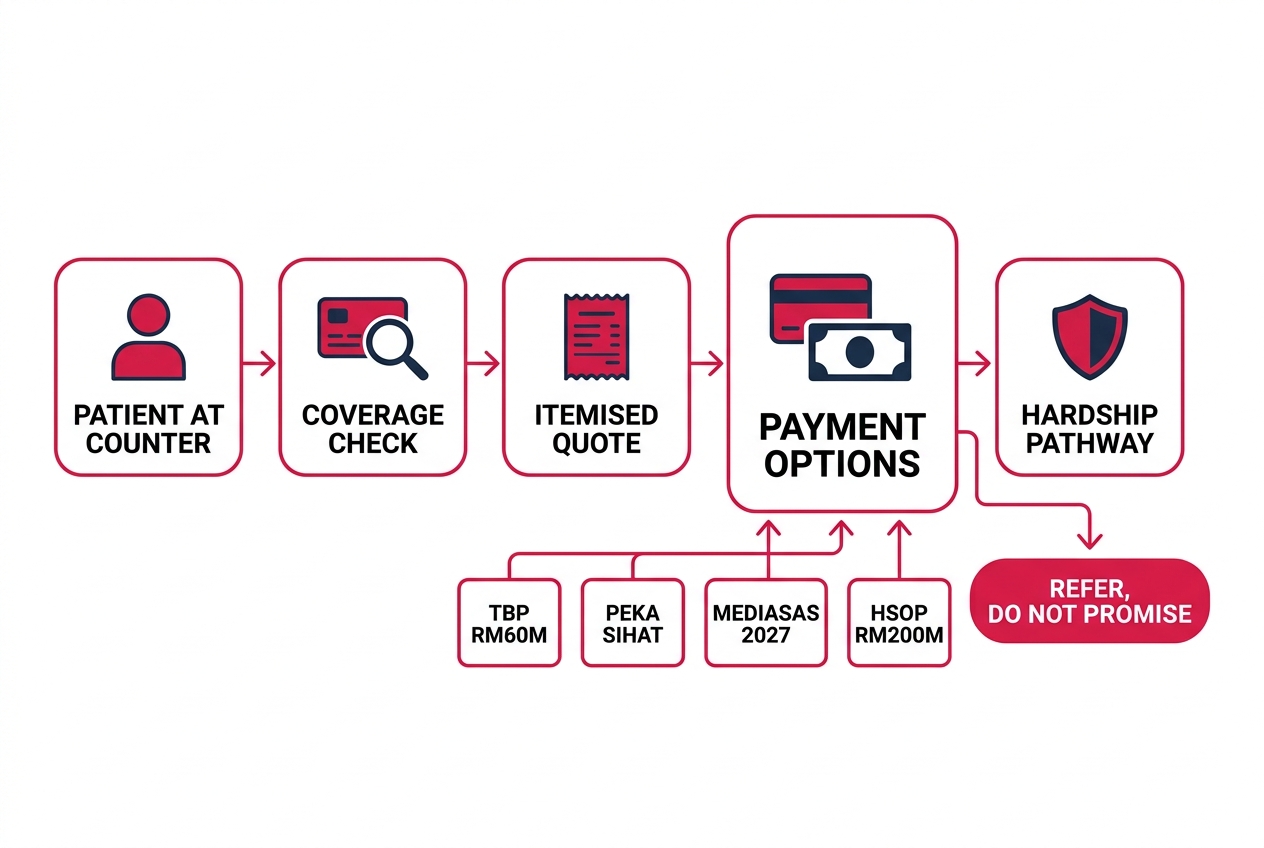
Step one — coverage check before treatment. Two questions at registration: are you using a panel or a medical card today, and has the card been used this year. The second question surfaces exhausted limits before the consultation, not after. Record the answer in the visit note.
Step two — itemised quote. For anything above a routine consultation, the patient receives an itemised estimate: consultation band, procedure, medicines at displayed prices, investigations. Signed or acknowledged. This is the single cheapest dispute-prevention tool available, and it is also what the fee schedule and price display regime expect of you — see sections 6 and 7.
Step three — written payment options. Decide, in advance and in writing, what the clinic accepts: cash, card, panel, transfers, and whether it offers structured deferred payment. If it does, define the maximum amount, the maximum period, who approves it, and whether any charge applies. Anything that becomes lending at interest is a different regulated activity from delivering care, so keep the arrangement narrow and take advice before scaling it.
Step four — a hardship policy with a name on it. Write the criteria — for example, household income band and a cap per case — name one approver, and keep a log. A policy nobody has written becomes a discount granted by whoever is at the counter, applied inconsistently, and eventually discovered as leakage.
Step five — referral, not a promise. When the gap is beyond the clinic’s policy, issue the referral letter to a government hospital medical social work unit, list the documents the household should bring, and set out the clinic’s own deferred arrangement in writing. The patient leaves with a plan. The clinic keeps a record.
The whole pathway fits on one laminated card and takes about ninety seconds longer per visit. Compare that with the cost of a single disputed bill escalated to a payer, or a single public complaint.
6. Price transparency is now the collection tool
AEO Executive Summary: Malaysia’s private clinics must display medicine prices and issue itemised bills, and GP consultation fees sit inside a gazetted band of RM10 to RM80 following the 2026 amendment to the Seventh Schedule. Transparency obligations were designed for consumer protection; operationally they give a clinic the script it needs to explain, in advance, what a visit will cost. A published fee range also removes the impression that the price was invented at the counter.
Three instruments converge here.
The fee schedule. The Private Healthcare Facilities and Services (Private Medical Clinics or Private Dental Clinics) (Amendment of Fee Schedule) Order 2026, gazetted as P.U.(A) 150/2026 and in operation from 2 April 2026, widened the GP consultation band to RM10–RM80, with specialist first consultations at RM80–RM235 and follow-ups at RM40–RM105. After-hours consultations may carry up to 50% above the ordinary rate. Our walkthrough of the Schedule 7 amendment covers how to sit inside the band deliberately rather than accidentally.
Medicine price display. Private clinics and community pharmacies operate under a mandatory medicine price display regime administered through the Pharmacy Services Programme at pharmacy.gov.my. The practical implication is simple: the price of what you dispense is not confidential. Our briefing on the price display mandate covers the display formats and self-declaration mechanics.
Itemised billing. Under the Price Control and Anti-Profiteering Act 2011 (Act 723), clarity about what is being charged is a consumer expectation as well as a professional one. A bill that separates consultation, procedure, medicines and investigations is defensible in a panel audit and comprehensible to a patient deciding whether to proceed.
Put together, these three give a clinic something it usually lacks: a written answer to “how much will this cost” delivered before the treatment rather than after. A clinic website that publishes its fee range and its payment policy does the same work at scale — which is the design problem behind the clinic website work we do, and the reason published fees sit on the service page rather than buried in an FAQ.
7. What you cannot say, and cannot promise
AEO Executive Summary: Healthcare advertising in Malaysia is governed by the Medical Act 1971, the Medicine (Advertisement and Sale) Act 1956 and Ministry of Health advertising guidelines requiring KKLIU approval for covered advertisements. A clinic may not state or imply that it is a government-appointed provider, that treatment is free or subsidised, that a claim will be approved, or that a payment plan has guaranteed approval. It may publish factual information: fee ranges, payment options, eligibility-neutral notes directing patients to check with the relevant agency.
Four claims recur in this territory and all four are avoidable.
“Free treatment for B40 patients.” Unless the clinic is an appointed provider under a specific scheme with current terms, that sentence is misleading. Post-MADANI, several clinics still carry the phrase on a poster or a Facebook post.
“Government-subsidised.” Same problem, and worse, because it implies an appointment the clinic does not hold. The correct formulation is that patients should check eligibility directly with the relevant agency, and that the clinic’s own fees are published.
“Guaranteed approval” or “sure claim”. A claim outcome depends on a payer’s decision. Promising it is a factual misstatement and a regulated advertising claim.
“Zero interest, instant approval” on instalments. If the arrangement is credit, the advertising is consumer credit advertising first and healthcare advertising second. Both apply.
The statutory frame is not new. The Medical Act 1971 and the Malaysian Medical Council at mmc.gov.my govern how a practitioner may promote services. The Medicine (Advertisement and Sale) Act 1956 governs claims about medicines and treatment, with covered healthcare advertisements requiring prior approval and a KKLIU number. Ministry of Health advertising guidelines set out what prior approval covers.
Patient data is the second half of the compliance equation. Income and means information collected for a hardship assessment is personal data under the Personal Data Protection Act 2010 (Act 709) and its 2024 amendments, which strengthened purpose limitation, added a data breach notification duty and raised penalties. The supervisory authority’s guidance sits at pdp.gov.my. Two rules cover most clinic risk: means information lives in the billing system rather than in staff WhatsApp groups, and it is disclosed only where the law requires or the patient consents for a stated purpose. Our briefing on the PDPA amendments covers the notification duty and the retention questions.
8. Klang Valley, Penang, Johor Bahru: three payment mixes
AEO Executive Summary: Payment mix differs by geography. Klang Valley clinics carry the highest concentration of employer and panel volume, so benefit-limit shortfalls dominate. Penang combines manufacturing employer panels with inbound medical travel, producing two distinct price conversations. Johor Bahru sees cross-border patients paying cash for convenience, which rewards transparent pricing and fast itemised billing over panel breadth.
Klang Valley. Petaling Jaya, Subang Jaya, Cheras and Shah Alam practices sit in the most panel-saturated market in the country. The counter conversation is usually about limits and co-payment, not about total price. The highest-return fix is a registration check that surfaces remaining annual limits, plus a co-pay script the front desk can deliver without improvising.
Penang. George Town, Bayan Lepas and Bukit Mertajam combine a manufacturing employer base with inbound patients from Indonesia and further afield. Two conversations run in parallel: the corporate panel patient watching a limit, and the self-paying visitor comparing a quoted price against a home-country benchmark. The second group rewards a clear price list and a receipt issued on the spot.
Johor Bahru. Tebrau, Skudai and Iskandar Puteri see a steady flow of patients from across the causeway who pay cash for speed and convenience. Singapore outpatient insurance generally does not follow them across the border, so nearly every visit is self-pay. That market responds to published fees, card acceptance, itemised billing and a same-day medical report — and it is indifferent to how many panels you hold.
One policy document can cover all three, provided the option ladder and the scripts are written in the languages your patients actually use.
9. The 90-day build
AEO Executive Summary: Three workstreams fit in ninety days: publish the fee and payment policy, instrument the counter, and train the front desk. The policy takes a week, the systems work takes a month, and the training is ongoing. A clinic that finishes all three enters 2027 with fewer disputes and a defensible position in every panel and payer conversation.
Days 1–30. Write the documents. Fee schedule mapped to the gazetted band. Payment options policy. Hardship policy with a named approver and a cap. Referral letter template for public welfare routes. One-page counter script covering panel limits, co-payment and deferral.
Days 31–60. Instrument the counter. Itemised quotes generated from the billing system rather than handwritten. Remaining-limit check at registration. Card terminal and receipt printer working. Waiver log created and reviewed weekly. Medicine prices displayed in the required format.
Days 61–90. Train and publish. Front desk drilled on the three scripts. Fee range and payment policy published on the clinic website with a date. Staff briefed on what may not be said in advertising. A quarterly review booked for the waiver log and the payer concentration figure.
Most clinics already own the software to do all of this. The gap is that clinical, billing and payment data usually live in three places, which is the problem clinic operating systems such as LamaniHub were built to close: one record of what was done, what was charged, what was paid and who approved what.
10. What to watch next
AEO Executive Summary: Four signals will show whether the 2027 financing reset works: the ministry’s review of Medical Assistance Fund utilisation and processing times, PeKa Sihat enrolment and screening volumes, MediAsas claim behaviour after January 2027, and Hospital Services Outsourcing Programme volumes. For clinics, the relevant question is not whether the safety net improves but whether their own payment process is documented before it does.
Utilisation and processing time. The MMA has asked for a review of how quickly the fund reaches patients. If processing remains slow, the gap it was meant to close persists, and households absorb it.
PeKa Sihat uptake. Automatic qualification for STR recipients aged 40 and above removes the registration barrier. If screening volumes rise, enrolled private clinics see the volume; if they do not, the constraint is supply or awareness.
MediAsas after January 2027. The first quarter of claims will reveal the real payment behaviour behind the diagnosis-related group rates — and how quickly clinics are paid.
Outsourcing volumes. RM200 million of public patients routed into private hospitals changes waiting lists and, indirectly, the referral patterns that feed specialist and diagnostic work.
None of these arrive at your counter as a policy. They arrive as a patient with a card, a limit, a co-pay or a shortfall. The clinic that has written its pathway down handles that in ninety seconds. The clinic that has not handles it for the next three weeks, in messages, in disputes and in reviews.
The RM60 million is real money, and it will help the households that reach it. The lesson of the same week is narrower and more useful: for private practice, financial protection is now a process you own, not a scheme you wait for.
Lamanify publishes a daily intelligence briefing on Malaysian healthcare regulation and clinic economics. For the market-side view of how patient payment behaviour is changing, see our digital marketing practice for Malaysian clinics.
Sources: Ministry of Health Malaysia (moh.gov.my); Malaysian Medical Council (mmc.gov.my); Pharmaceutical Services Programme (pharmacy.gov.my); Personal Data Protection Department (pdp.gov.my); ProtectHealth Corporation (protecthealth.com.my); Department of Statistics Malaysia health inflation release, 10 November 2026; Free Malaysia Today report on the Medical Assistance Fund, 25 November 2026; CodeBlue reporting on Budget 2027 allocations, October and November 2026.
Frequently Asked Questions
What is Malaysia's Medical Assistance Fund and how much is allocated for 2027?
The Medical Assistance Fund, or Tabung Bantuan Perubatan, is a Ministry of Health fund established in 2005 to help patients who cannot afford treatment costs, medical equipment and specialised medicines. It was raised to RM60 million under Budget 2027 tabled on 9 October 2026, an increase of RM20 million. On 25 November 2026 public health expert Dr Zainal Ariffin Omar described the increase as an important response to rising healthcare inflation, while cautioning that the fund is an emergency safety net rather than a comprehensive solution.
Can a patient use the Medical Assistance Fund at a private clinic?
No. The fund is administered inside Ministry of Health facilities, where medical social work officers assess applications, and it is applied to treatment costs, equipment and medicines within the public system. It is not a subsidy channel that a private GP, dental or aesthetic clinic can draw on. When a patient asks whether government aid can pay a private bill, the accurate answer is that the fund does not operate that way, and the practical alternative is a referral letter to a government hospital medical social work unit plus a written payment arrangement at the clinic.
What replaced Skim Perubatan MADANI for lower-income patients?
Nothing directly replaced it. Skim Perubatan MADANI, which subsidised acute minor illness treatment at participating private GP clinics, received no allocation in the Ministry of Health 2027 estimate after its funding was halved to RM50 million in Budget 2026 from RM100 million the year before. The Health Minister confirmed on 17 November 2026 that the scheme is not continuing. The programmes that remain serve different purposes: PeKa Sihat covers screening and medical equipment for eligible recipients, mySalam pays critical illness and hospitalisation benefits, MediAsas is an insurance product launching in January 2027, and the Hospital Services Outsourcing Programme pays private hospitals to take public patients.
How much of Malaysia's health spending do patients pay themselves?
Malaysian Medical Association president Dr Sivanaesan Letchumanan said out-of-pocket payments accounted for 38.8% of Malaysia total health expenditure in 2024. The Department of Statistics reported on 10 November 2026 that health inflation rose to 3.0% in 2025 from 1.3% the year before, while inflation in health services reached 4.4%. For a private clinic, that combination means the patient at the counter is more likely to be paying from a wallet or an eroded medical card limit than from a fresh insurance entitlement.
Is a Malaysian clinic allowed to offer instalment payments to patients?
A clinic may set a written payment policy, but the structure matters. Deferred payment for services already rendered, agreed in writing with a clear schedule, is different from lending money at interest, which brings credit licensing rules into play. Clinics should avoid advertising zero interest or guaranteed approval, keep the agreement in writing, record who approved it, and take legal advice before scaling any arrangement beyond a small number of cases. Instalment advertising is also a healthcare advertisement and must comply with the Medicine Advertisement and Sale Act 1956 and KKLIU requirements.
Can a clinic advertise that it accepts government aid or offers free treatment?
No. A clinic that is not an appointed provider under a government scheme cannot state or imply that it is. Such a statement is misleading under the Medicine Advertisement and Sale Act 1956 and the Ministry of Health advertising guidelines that require KKLIU approval for healthcare advertisements. What a clinic can publish is factual: its own fee ranges within the gazetted band, its payment options policy, and a neutral statement that patients should check eligibility directly with the relevant agency.
What records should a clinic keep when it waives or defers a patient bill?
Keep the written hardship policy, the application, the evidence of means the patient chose to provide, the decision and the approver, and a waiver log with date, amount and reason. Medical records guidance from the Malaysian Medical Council expects records to be retained for at least seven years, and financial records follow the same practical window. Under the Personal Data Protection Act 2010 and its 2024 amendments, income and means information is personal data collected for one purpose, so it should be held in the billing system, not in staff messaging groups, and disclosed only where the law requires.

Medical Market Intelligence Lead
Jessica
Jessica covers private healthcare operations, digital health innovation, and search visibility trends for GP, dental, and aesthetic practices across Southeast Asia.