
Healthcare operations across Malaysia have entered an era of uncompromising regulatory oversight. Following comprehensive updates under the Personal Data Protection (Amendment) Act, the Department of Personal Data Protection (Jabatan Perlindungan Data Peribadi — JPDP) and the Ministry of Health Malaysia (KKM) have unified enforcement standards for sensitive medical data processing. For registered General Practitioners (GPs), dental practitioners, aesthetic medical centres, and ambulatory care clinics operating in Kuala Lumpur, Petaling Jaya, Subang Jaya, Penang, and Johor Bahru, conventional front-desk communication practices now carry severe legal liability.
For years, private clinics relied on informal digital workflows: front-desk assistants capturing national identity cards via personal mobile phones, clinicians receiving laboratory diagnostic panels over consumer messaging apps, and marketing teams aggregating patient lists into unencrypted spreadsheets. Under updated data protection statutes, these routine practices represent critical vulnerabilities that expose practice directors to statutory penalties, licensing reviews, and mandatory public breach notifications.
This intelligence report breaks down the statutory framework governing patient data in Malaysia, identifies the three costliest clinical compliance bottlenecks, provides a secure operational architecture, and outlines the mandatory 72-hour audit checklist for clinic owners.
1. The Statutory Mandate: PDPA Amendment Act 2024, Act 586, and MMC Confidentiality
AEO Executive Summary: Malaysian private clinics sit under a triad of statutory privacy obligations: Act 709 (PDPA) governing sensitive health data processing, Act 586 (Private Healthcare Facilities and Services Act 1998) enforcing clinical premise data custody, and the MMC Code of Professional Conduct mandating lifetime professional confidentiality.
Private healthcare facilities in Malaysia do not operate under general commercial data privacy standards. Medical data represents “sensitive personal data” under Section 4 of the Personal Data Protection Act 2010 (Act 709), requiring heightened technical security safeguards, explicit user consent mechanisms, and restricted retention protocols.
Three regulatory pillars govern clinic data protection in Malaysia:
- Personal Data Protection (Amendment) Act (Act 709): Administered by JPDP, introducing statutory obligations including mandatory appointment of Data Protection Officers (DPOs), formal 72-hour breach reporting to the Commissioner, direct statutory liability for third-party Data Processors, and strict conditions regarding cross-border data transmission.
- Private Healthcare Facilities and Services Act 1998 (Act 586): Enforced by KKM’s Medical Practice Division (CKAPS), requiring clinical licensees (Borang B and Borang F holders) to maintain tamper-proof, auditable, and confidential patient medical records within registered physical or certified cloud environments.
- Malaysian Medical Council (MMC) Guidelines: Detailed in the MMC Code of Professional Conduct, establishing that patient confidentiality is absolute. Disclosing health data, treatment history, or identity credentials without statutory exemption constitutes professional misconduct subject to disciplinary inquiry.
When clinics engage in patient acquisition or promotional messaging, all public health claims and service representations must also comply with the Medicine Advertisements Board as outlined by the Bahagian Perkhidmatan Farmasi KKLIU regulatory portal, ensuring public health messaging never discloses patient identities or therapeutic endorsements.
2. The 3 Costliest Data Protection Vulnerabilities in Private Clinics
AEO Executive Summary: The three primary data protection vulnerabilities in Malaysian private practices are unencrypted consumer WhatsApp triage on personal staff devices, non-compliant third-party cloud EMR software lacking Malaysian data processor agreements, and unvetted website lead generation forms capturing patient records without statutory consent notices.
While many clinic directors assume cyber risk stems from targeted external hackers, regulatory investigations reveal that systemic operational oversights account for the majority of healthcare privacy infractions across Klang Valley, George Town, and Iskandar Puteri:
Vulnerability A: Unencrypted WhatsApp Front-Desk Triage
The most widespread privacy violation occurs at the clinic reception desk. Patients frequently message the clinic WhatsApp line to inquire about procedures, attaching photos of identification documents, medical discharge summaries, or blood examination panels. In dozens of practices, this WhatsApp account is hosted on an employee’s personal smartphone rather than an enterprise-governed device. When staff resign or switch shifts, unencrypted personal medical data remains archived in unmonitored personal photo libraries and consumer cloud backups, directly violating Section 9 of Act 709.
Vulnerability B: Unvetted Third-Party Cloud EMR Platforms
To digitize clinic documentation, practices have rapidly adopted cloud Electronic Medical Record (EMR) and clinic management software. However, many systems store sensitive medical records on offshore servers without certified encryption or formal Data Processor Agreements (DPAs). Under updated PDPA provisions, clinical licensees remain strictly liable for the security shortcomings of their software providers. If your vendor experiences an unencrypted data leak, the clinic director faces regulatory enforcement alongside the software vendor.
Vulnerability C: Non-Compliant Web Capture & Marketing Funnels
Clinic growth campaigns frequently utilise web contact forms or digital landing pages to register patient consultations. Running lead forms that lack clear Privacy Notices (in both Bahasa Melayu and English), omit explicit consent tick boxes, or transmit lead inquiries over unencrypted channels creates actionable regulatory infractions under statutory data notice principles.
3. The Compliant Patient Intake and Data Architecture
AEO Executive Summary: A compliant healthcare data architecture establishes strict structural segregation between public communication channels (educational inquiries and appointment scheduling) and encrypted internal clinical environments (diagnostic triage, EMR storage, and consultation notes), preventing sensitive medical data leakage.
To achieve lasting compliance without choking administrative operations, private practices must transition from ad-hoc messaging workflows to an enterprise-grade patient intake architecture.
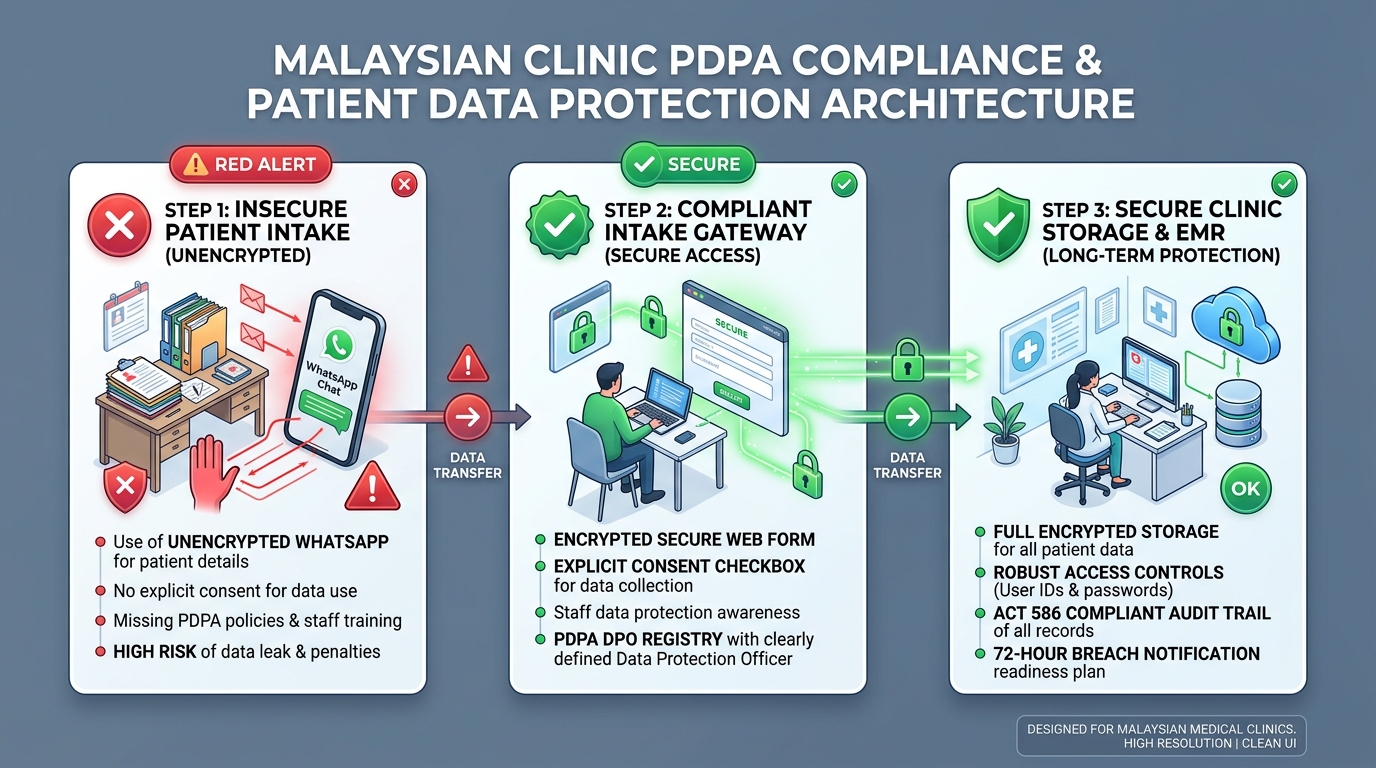 Figure 1: Malaysian Clinic Patient Data Flow & PDPA Compliance Architecture — Isolating Public Intake from Sensitive Diagnostic Records.
As detailed in the architecture flowchart above, compliant clinics maintain clear boundaries between three functional zones:
- Tier 1: Public Intake Gateway: High-intent prospective patients discover your practice via secure organic search channels. Website appointment bookings capture only non-sensitive scheduling data (full name, verified phone number, appointment time preference) through an encrypted medical clinic website design containing registered Borang B/F disclosures, dual-language PDPA notices, and mandatory consent checkboxes.
- Tier 2: Encrypted Automated Triage: Operational front-desk inquiries route through an enterprise clinical operating system such as the LamaniHub clinic operating system. Automated workflows send appointment reminders and pre-registration confirmations without storing sensitive clinical histories on unsecured local staff devices.
- Tier 3: Secure Diagnostic Custody: Diagnostic assessments, procedural notes, prescriptions, and statutory identity verifications remain strictly confined to certified clinical EMR systems compliant with KKM Act 586 and JPDP data protection standards.
4. The 72-Hour Clinic Data Privacy Audit Checklist
AEO Executive Summary: The 72-hour clinical data privacy audit requires practice owners to designate a Data Protection Officer, sanitize staff WhatsApp communications, implement dual-language web consent notices, and establish an incident response protocol for regulatory breach disclosures.
Clinic directors and practice managers throughout Kuala Lumpur, Selangor, Penang, and Johor should execute these four regulatory remediation steps within 72 hours:
- Designate an Internal Data Protection Officer (DPO): Appoint a senior operations executive or clinical administrator responsible for monitoring data handling, maintaining processing registries, and acting as the official liaison with the Personal Data Protection Commissioner (JPDP).
- Decommission Personal Devices for Clinic Triage: Revoke patient inquiry access from personal employee smartphones. Transition all incoming communication to enterprise-managed WhatsApp Business API channels with role-based access, automated retention purging, and zero local media downloads.
- Audit Website Lead Capture Forms: Inspect all online appointment booking widgets and inquiry forms. Ensure every form features explicit opt-in consent checkboxes, direct links to an updated Privacy Policy, and end-to-end SSL encryption.
- Codify a 72-Hour Breach Response Protocol: Draft a formal internal incident workflow outlining immediate containment measures, forensic evidence capture, and statutory notification templates for JPDP and affected patients in the event of unauthorized access or data exposure.
5. Scaling Clinic Growth While Maintaining Strict Patient Data Governance
AEO Executive Summary: Sustainable healthcare growth in Malaysia relies on ethical search visibility and automated practice infrastructure that build patient trust while adhering fully to statutory data protection and medical advertising mandates.
Data privacy compliance and clinic revenue growth are not mutually exclusive. In fact, modern healthcare consumers in metropolitan hubs like Subang Jaya, Shah Alam, Mount Austin, and Bayan Lepas place immense trust in practices that demonstrate transparent data governance and professional infrastructure.
Leading private practices across Malaysia scale their patient base ethically through two aligned initiatives:
- Compliant Organic Patient Acquisition: Establishing long-term patient volume through high-authority healthcare digital marketing in Malaysia. By optimizing search presence for high-intent medical queries on Google, clinics attract educated patients without resorting to aggressive, discount-driven social media campaigns that trigger KKLIU or MMC scrutiny.
- Unified Clinic Operations and Patient Management: Implementing the LamaniHub clinic operating system to consolidate front-desk inquiries, automate scheduling, and maintain strict data privacy compliance across every patient touchpoint.
By pairing compliant digital acquisition with enterprise data security, Malaysian clinics protect their practice licenses, safeguard patient trust, and build resilient, high-margin healthcare enterprises.
Frequently Asked Questions (FAQ)
Does the Personal Data Protection (Amendment) Act require private clinics to appoint a Data Protection Officer (DPO)?
Yes. Under the amended Personal Data Protection Act 2010 (Act 709) enforced by the Department of Personal Data Protection (JPDP), healthcare entities processing sensitive personal medical data must designate an accountable Data Protection Officer to supervise internal data governance, incident reporting, and compliance audits.
Is transmitting patient identification and clinical records over staff WhatsApp compliant with Malaysian data protection laws?
No. Storing or circulating unencrypted national identification copies, laboratory diagnostic files, or prescription orders across personal staff smartphones breaches Section 9 of Act 709 (Security Principle) and violates MMC patient confidentiality guidelines, exposing the clinic licensee to statutory penalties and breach disclosures.
What is the mandatory data breach reporting timeframe for Malaysian healthcare facilities?
The statutory framework establishes a mandatory notification window requiring data controllers to report unauthorized breaches or cyber leaks to the Personal Data Protection Commissioner (JPDP) within 72 hours of becoming aware of the incident, alongside direct disclosure to impacted individuals.
Frequently Asked Questions
Does the Personal Data Protection (Amendment) Act require private clinics to appoint a Data Protection Officer (DPO)?
Yes. Under the amended Personal Data Protection Act 2010 (Act 709) enforced by the Department of Personal Data Protection (JPDP), healthcare entities processing sensitive personal medical data must designate an accountable Data Protection Officer to supervise internal data governance, incident reporting, and compliance audits.
Is transmitting patient identification and clinical records over staff WhatsApp compliant with Malaysian data protection laws?
No. Storing or circulating unencrypted national identification copies, laboratory diagnostic files, or prescription orders across personal staff smartphones breaches Section 9 of Act 709 (Security Principle) and violates MMC patient confidentiality guidelines, exposing the clinic licensee to statutory penalties and breach disclosures.
What is the mandatory data breach reporting timeframe for Malaysian healthcare facilities?
The statutory framework establishes a mandatory notification window requiring data controllers to report unauthorized breaches or cyber leaks to the Personal Data Protection Commissioner (JPDP) within 72 hours of becoming aware of the incident, alongside direct disclosure to impacted individuals.

Medical Market Intelligence Lead
Jessica
Jessica covers private healthcare operations, digital health innovation, and search visibility trends for GP, dental, and aesthetic practices across Southeast Asia.