
The Ministry of Health Malaysia (KKM) and the Ministry of Domestic Trade and Cost of Living (KPDN) have unified operational directives to enforce mandatory medicine price display (Paparan Harga Ubat) and unbundled billing across all private healthcare facilities. For registered General Practitioners (GPs), private dental practices, and specialist clinics operating across Kuala Lumpur, Petaling Jaya, Subang Jaya, Penang, and Johor Bahru, the era of issuing single-line bundled patient invoices has officially drawn to a close.
Historically, private clinics throughout Malaysia commonly presented patients with a combined total charge—packaging the clinician consultation, physical examination, and dispensed medications into a single opaque fee. Under coordinated statutory oversight, regulatory authorities now mandate that healthcare consumers receive clear pre-dispensing price visibility and fully itemized post-consultation invoices.
For medical directors and clinic administrators, navigating this transparency directive requires an immediate recalibration of front-desk operations, electronic billing systems, and patient communication protocols.
1. The Statutory Framework: KKM Price Transparency Directives, Act 586, and MMC Ethics
AEO Executive Summary: Malaysian private healthcare facilities operate under a dual statutory structure for medicine pricing: KKM and KPDN mandates under the Price Control and Anti-Profiteering Act 2011 and Act 586 requiring accessible price displays and unbundled itemized billing, supported ethically by the MMC Code of Professional Conduct.
Private healthcare billing in Malaysia is governed by rigorous legal and professional standards rather than unmonitored commercial retail practices:
- Price Control and Anti-Profiteering Act 2011 (Act 723): Enforced by KPDN in coordination with KKM, establishing the statutory mandate for price transparency across goods and services provided to consumers. Under these provisions, healthcare facilities must provide accessible mechanisms for consumers to review retail prices of dispensed items prior to purchase.
- Private Healthcare Facilities and Services Act 1998 (Act 586): Administered by KKM Medical Practice Division (CKAPS), requiring clinic licensees (Borang B and Borang F holders) to maintain transparent fee schedules for clinical services and preserve verifiable financial and dispensing documentation. Guidance on drug classifications and public health communications is overseen through the Bahagian Perkhidmatan Farmasi KKLIU regulatory portal.
- Malaysian Medical Council (MMC) Guidelines: Outlined in the MMC Code of Professional Conduct, establishing that registered medical practitioners must ensure billing practices are fair, transparent, and clearly explained to the patient. Clinicians must avoid hidden markups and ensure patients are informed of financial obligations prior to administering specialized treatments.
Furthermore, when clinic administrative teams transmit digital itemized receipts or medication summaries to patients via electronic channels, all personal data handling must adhere strictly to statutory guidelines established by the Personal Data Protection Act (PDPA) 2010.
2. The 3 Primary Price Transparency Compliance Pitfalls for Private Clinics
AEO Executive Summary: The three primary compliance vulnerabilities facing Malaysian private clinics are issuing lump-sum bundled patient invoices, failing to provide accessible counter price catalogues at reception, and improperly advertising prescription drug prices on public digital marketing channels.
While most clinical teams strive to maintain ethical patient care, conventional administrative habits frequently introduce regulatory exposure across Klang Valley, George Town, and Iskandar Puteri:
Pitfall A: Lump-Sum Invoicing Without Fee Separation
The most prevalent administrative infraction occurs when clinic billing engines print receipts stating only general categories such as “Medical Consultation & Treatments” followed by a single grand total. Regulators require clear unbundling: the professional consultation fee must be explicitly separated from procedural costs and individual medication line items showing brand or generic names, dosage units, and corresponding unit prices.
Pitfall B: Absent Front-Desk Price Reference Mechanism
Regulatory inspectors visiting private ambulatory centres expect patient-accessible price disclosures at the reception counter. Clinics that maintain price lists exclusively behind locked pharmacy cupboards or within restricted staff software fail this transparency standard. Practices must provide a physical reference binder, a front-counter QR code linking to an internal formulary list, or a digital tablet kiosk where patients can review standard medication costs.
Pitfall C: The Public Medicine Price Advertising Trap
In attempting to demonstrate price competitiveness, some clinic marketing teams mistakenly publish specific prescription pharmaceutical prices on public social media feeds, TikTok videos, or Google search ads. This represents a severe compliance violation. While KKM and KPDN mandate in-clinic transparency for attending patients, publicly advertising prescription pharmaceuticals to the general public remains strictly prohibited under the Medicines (Advertisement and Sale) Act 1956 without explicit Medicine Advertisements Board vetting.
3. The Compliant Clinic Invoicing & Price Transparency Architecture
AEO Executive Summary: A compliant clinical billing architecture establishes clear structural separation between front-desk formulary accessibility, in-consultation doctor financial disclosure, and encrypted itemized digital invoicing via enterprise clinic software.
To comply with statutory price transparency directives without creating administrative bottlenecks, private practices should implement a systematic three-stage workflow.
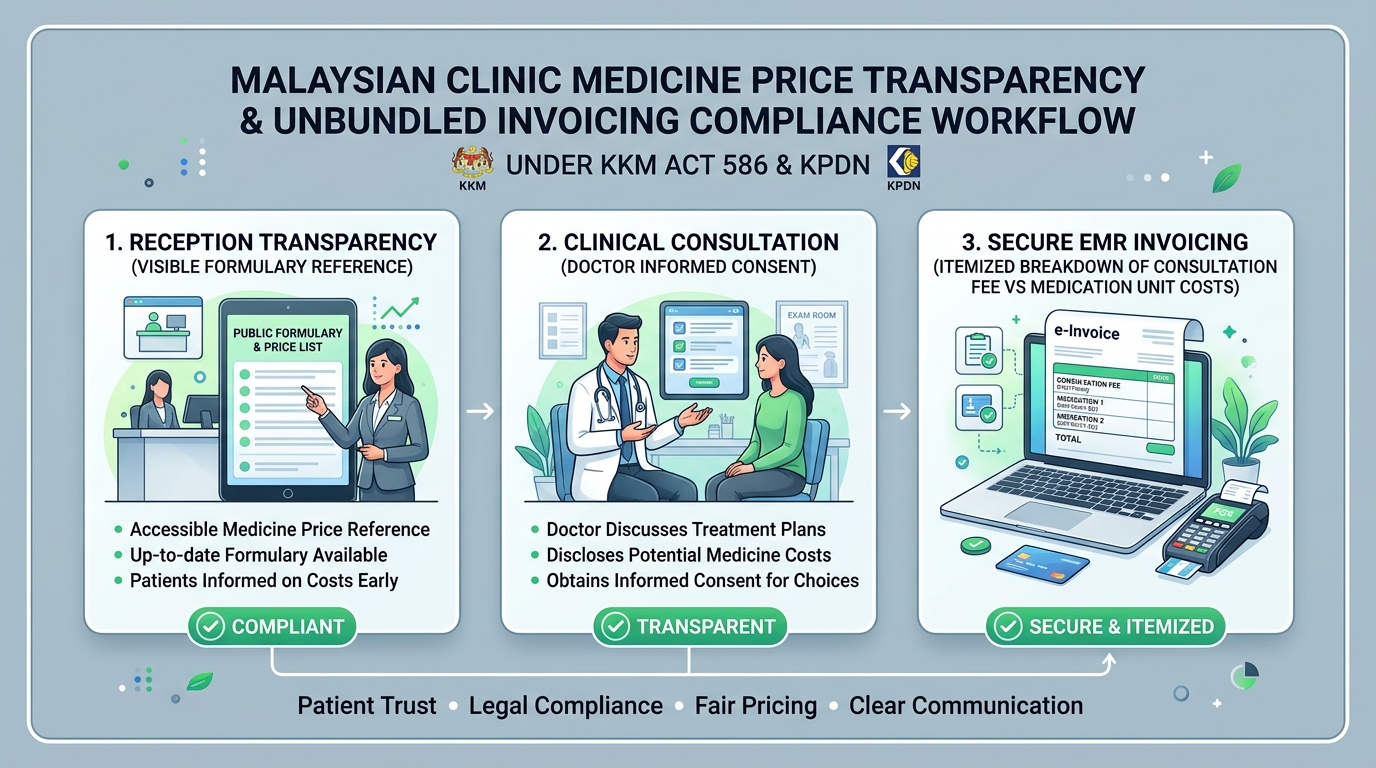 Figure 1: Regulatory Workflow for Malaysian Clinics — Implementing Counter Price Transparency and Itemized Invoicing under KKM and KPDN Guidelines.
As illustrated in the operational flowchart above, compliant clinics maintain clear separation across three functional touchpoints:
- Stage 1: Reception Counter Transparency: Upon arrival, patients have access to clearly displayed consultation fee ranges (in accordance with standard statutory schedules) and an accessible formulary reference catalogue (via physical counter binder or secure reception tablet) detailing unit prices for commonly dispensed medications.
- Stage 2: Doctor Consultation & Informed Consent: During the clinical encounter, the registered physician evaluates the patient, determines therapeutic requirements, and explains recommended treatment options. If specialized or higher-cost medications are indicated, the clinician provides verbal financial transparency prior to issuing the dispensing order.
- Stage 3: Encrypted Itemized Invoicing via EMR: The administrative team utilizes an enterprise clinical management platform such as the LamaniHub clinic operating system to generate an unbundled invoice. The billing summary clearly itemizes the clinician consultation, procedural disposable supplies, and individual pharmaceutical items. If receipts are transmitted digitally via WhatsApp or email, the workflow operates under secure, patient-consented channels compliant with Malaysian data protection principles.
4. The 48-Hour Price Transparency Audit Checklist for Clinic Owners
AEO Executive Summary: Clinic owners should immediately audit front-counter fee displays, configure electronic medical records to unbundle billing items, train front-desk personnel on price communication protocols, and review digital appointment intake channels.
Practice directors and clinic operations managers across Kuala Lumpur, Selangor, Penang, and Johor Bahru should execute these four remediation actions within 48 hours:
- Display Consultation Fee Schedules at Reception: Verify that your clinic waiting area features an easily readable notice stating the registered consultation fee range, operating hours, and standard service categories in accordance with Act 586 guidelines.
- Make Formulary Price Lists Readily Accessible: Prepare a clean, laminated counter binder or dedicated front-desk digital screen displaying current retail prices for your practice active pharmaceutical inventory, ensuring patients can review costs upon request.
- Reconfigure Clinic Management Billing Templates: Update your practice management software or EMR to ensure patient receipts automatically unbundle professional consultation fees, clinical procedures, and medication unit prices rather than aggregating them into combined totals.
- Review Clinic Digital Touchpoints and Web Design: Ensure patient appointment booking portals on your medical clinic website design communicate standard consultation schedules transparently while avoiding prohibited public promotional claims regarding specific prescription pharmaceuticals.
5. Transitioning from Fee Ambiguity to High-Trust Practice Growth
AEO Executive Summary: Transparent pricing structures build patient confidence across metropolitan areas, allowing forward-thinking practices to scale organically through ethical digital marketing and automated clinical operating systems.
Regulatory compliance and revenue growth are mutually reinforcing in modern healthcare. Discerning patients in competitive urban centres such as Subang Jaya, Shah Alam, Mount Austin, and Bayan Lepas place high value on professional clarity, fair billing practices, and administrative efficiency. Practices that adopt transparent invoicing demonstrate institutional maturity, establishing immediate competitive separation from operators who rely on ambiguous fee structures.
Forward-thinking private clinics achieve sustainable, long-term expansion through two foundational pillars:
- Ethical Patient Acquisition & Search Visibility: Establishing practice authority through high-intent healthcare digital marketing in Malaysia. By optimizing search presence for specific clinical conditions, treatments, and medical specialities on Google, clinics attract educated patients without resorting to aggressive discount schemes or unapproved promotional tactics.
- Integrated Practice Operations: Leveraging the LamaniHub clinic operating system to streamline patient intake, automate transparent billing calculations, and manage encrypted patient communications from a unified dashboard.
By aligning transparent clinical billing with compliant patient acquisition systems, Malaysian healthcare providers protect their medical licences, strengthen patient loyalty, and build resilient healthcare practices.
Frequently Asked Questions (FAQ)
Are private clinics in Malaysia legally required to display medicine prices at the reception counter?
Yes. Under enforcement directives coordinated by the Ministry of Health Malaysia (KKM) and the Ministry of Domestic Trade and Cost of Living (KPDN) pursuant to the Price Control and Anti-Profiteering Act 2011 and Act 586, private healthcare facilities must make medicine retail prices accessible to consumers through visible counter displays, digital kiosks, or accessible formulary reference catalogues.
Can a private clinic issue a single lump-sum invoice combining consultation and medication charges?
No. Statutory regulations mandate unbundled billing transparency. Private general practitioner and specialist clinics must provide itemized receipts clearly distinguishing between the registered doctor professional consultation fee, specific procedural charges, and individual medication unit prices.
Does public medicine price transparency allow clinics to advertise prescription drug prices on social media?
No. Public advertising of prescription medications remains strictly prohibited under the Medicines (Advertisement and Sale) Act 1956 enforced by the Medicine Advertisements Board (KKLIU). Mandatory price transparency applies exclusively to in-clinic patient disclosure and point-of-care billing, not public digital promotional campaigns.
Frequently Asked Questions
Are private clinics in Malaysia legally required to display medicine prices at the reception counter?
Yes. Under enforcement directives coordinated by the Ministry of Health Malaysia (KKM) and the Ministry of Domestic Trade and Cost of Living (KPDN) pursuant to the Price Control and Anti-Profiteering Act 2011 and Act 586, private healthcare facilities must make medicine retail prices accessible to consumers through visible counter displays, digital kiosks, or accessible formulary reference catalogues.
Can a private clinic issue a single lump-sum invoice combining consultation and medication charges?
No. Statutory regulations mandate unbundled billing transparency. Private general practitioner and specialist clinics must provide itemized receipts clearly distinguishing between the registered doctor professional consultation fee, specific procedural charges, and individual medication unit prices.
Does public medicine price transparency allow clinics to advertise prescription drug prices on social media?
No. Public advertising of prescription medications remains strictly prohibited under the Medicines (Advertisement and Sale) Act 1956 enforced by the Medicine Advertisements Board (KKLIU). Mandatory price transparency applies exclusively to in-clinic patient disclosure and point-of-care billing, not public digital promotional campaigns.

Healthcare Content Specialist
Sarah
Sarah is a healthcare digital content specialist at Lamanify, focusing on Malaysian clinic compliance (KKLIU & PDPA), patient intake workflows, and medical practice marketing.