
Bank Negara Malaysia’s standardised base medical plan, MediAsas, opens to the public in January 2027. On 10 November 2026, RHB Research put a commercial frame around that date: the scheme will pay providers on diagnosis-related group rates, and it is expected to open a new patient segment to private hospitals rather than cannibalise the existing one.
That framing matters for every private clinic in the Klang Valley, Penang, and Johor Bahru, because it tells you what kind of work January actually demands. This is not a marketing launch. It is a billing, coding, and data-governance launch, and the practices that treat it as such will be the ones that get paid cleanly in the first quarter.
Here is the operational brief.
What changed on 10 November 2026
Quick answer: RHB Research said MediAsas will use diagnosis-related group payment rates from January 2027, giving private providers an additional revenue source from newly insured patients, with adoption phased by waiting periods and eligibility rules.
The research house’s note, reported by RTM’s business desk on 10 November, makes four points that a clinic director should hold onto:
- Payment is bundled, not itemised. MediAsas uses rates set by diagnosis and treatment type, described as DRG-based. Providers are paid per episode rather than per line on a bill.
- The new segment is real but gradual. Waiting periods and eligibility conditions mean the volume build is phased, and the sector-level earnings effect for 2027 is described as limited.
- Community and developing-town providers may benefit most. A single national base rate can pay better than current negotiated rates outside the major urban centres.
- It is additive. The note characterises MediAsas as an additional opportunity for the industry, not a threat to existing private-provider business models.
For a clinic, the operative word is bundled. Everything below follows from it.
What MediAsas actually is, in plain terms
Quick answer: MediAsas is a voluntary, standalone, standardised medical insurance and takaful plan sold by participating insurers, with panel hospitals offering cashless admission at lower out-of-pocket cost.
Bank Negara Malaysia describes MediAsas as the Base MHIT Plan under the RESET Strategy, developed with the Ministry of Health and Ministry of Finance. It is not a social insurance scheme. It is bought from an insurer or takaful operator like any medical card, it is fully underwritten, and it has no investment element.
The design features that matter at the clinic counter:
- Two plans. Teras is the base plan for people with no cover or at risk of lapsing. Fleksi is for working adults who already have employer cover or enough savings to absorb smaller bills.
- Panel providers offer cashless admission. Treatment at a MediAsas panel provider carries a lower share of the bill and greater certainty over what is eligible.
- Cost sharing is built in. Teras carries a deductible per disability, with a lower annual limit; Fleksi carries a higher annual deductible against a higher annual limit. Treatment outside the panel network attracts an additional share of the bill, capped.
- Outpatient cover is narrow but relevant to GPs. The plan covers outpatient treatment at a panel hospital for dengue, influenza, bronchitis and pneumonia, up to a stated annual amount, with a small per-visit deductible under Teras.
- Cover runs to age 85, with no lifetime limit and guaranteed renewal.
- EPF savings can pay for it from 2027. Bank Negara has confirmed that Akaun Sejahtera savings will be usable for MediAsas through i-Lindung.
- The pilot ran in the Klang Valley. Testing of operational processes ran from the end of July 2026, with the nationwide rollout slated for early 2027.
Two limits are worth stating plainly to any patient who asks, and to your own front desk. CodeBlue’s analysis of the Bank Negara FAQ found that MediAsas carries the standard exclusions found in commercial medical plans, including pre-existing conditions, with a moratorium period before insurers are barred from contesting claims on non-disclosure grounds. Clinics should not represent MediAsas as covering everything, and staff should not improvise answers about eligibility. Refer the question to the insurer or administrator.
Why DRG payment changes the economics of a clinic
Quick answer: Under a bundled tariff, revenue depends on how accurately the episode is documented and coded, not on how many items appear on the bill. Poor documentation now costs money directly.
Most Malaysian private clinics have spent years optimising the itemised bill: consultation, procedure, consumables, dressings, investigations, each with its own line. A bundled rate inverts that logic.
Three consequences follow.
First, the case definition becomes the billing event. If a patient’s episode is captured as a single uncomplicated visit when the clinical record supports a more involved course, the clinic is paid the lower bundle. Documentation quality stops being an administrative nicety and becomes the revenue driver.
Second, the episode boundary matters. Under the Teras design, treatment within 90 days of discharge for the same illness or injury counts as part of the same episode. For providers, that means a readmission or a follow-up complication can belong to an episode that has already been priced. Clinical notes that establish whether a subsequent visit is related or independent are now commercially significant.
Third, upcoding is not a revenue strategy. Inflating severity to reach a higher bundle is claims misrepresentation, and it sits inside the same enforcement frame as any other false claim. The Medical Council’s guidance on professional conduct and the facility licensing obligations under Act 586 both point the same way. The defensible play is accurate documentation, not creative documentation.
Panel participation is the gate, not the marketing line
Quick answer: Cashless MediAsas treatment runs through preferred in-network providers enlisted by ProtectHealth Corporation. A clinic must be credentialed before it can treat policyholders cashlessly, and the application is an operational project, not a form.
Bank Negara’s product documentation describes preferred in-network providers as hospitals and other healthcare providers enlisted by ProtectHealth, the scheme administrator. That definition leaves room for clinics, but it does not make enrolment automatic.
The practical sequence for a clinic that wants in:
- Confirm eligibility with ProtectHealth directly. Do not rely on a competitor’s announcement or an agent’s assurance. Ask for the current credentialing requirements in writing.
- Assemble the facility file. Licence under Act 586, practitioner registrations and annual practising certificates, indemnity cover, and the scope of services the clinic actually provides.
- Agree the rate card before the first patient. A bundled tariff is only workable if your billing team knows which bundles apply to which services, and what is excluded.
- Build the eligibility check into registration. A cashless claim starts with confirming the patient is covered, which plan applies, and whether any waiting period is still running.
- Decide how you collect the patient share. Deductibles and the additional share for out-of-network treatment have to be quoted and collected at the point of care, with a receipt, or the clinic absorbs them.
The clinics that struggle in January will not be the ones that failed to advertise. They will be the ones that discovered at the counter that they had no way to verify eligibility and no agreed process for collecting the deductible.
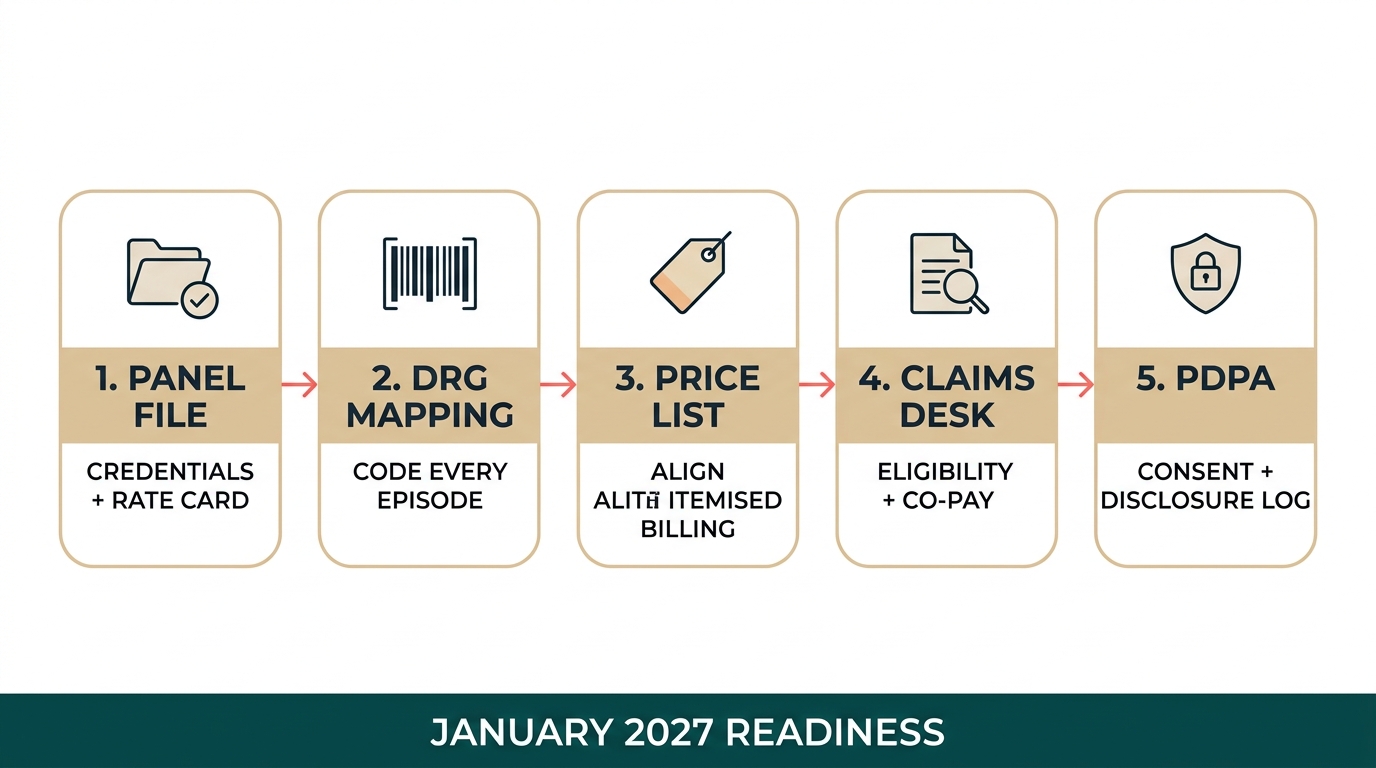
The 52-day readiness sequence
Quick answer: From 10 November 2026 to 1 January 2027 there are 52 days. That is enough time for five workstreams if they run in parallel and each has a named owner.
| Workstream | Owner | Complete by | Output |
|---|---|---|---|
| Panel and credentialing | Clinic director | 22 Nov 2026 | Written confirmation of status and requirements |
| Episode and coding map | Clinical lead | 29 Nov 2026 | Common clinic episodes matched to documented bundles |
| Price list and billing templates | Finance or billing lead | 6 Dec 2026 | Itemised bill that reconciles to the bundled rate |
| Front-desk eligibility and co-payment | Practice manager | 13 Dec 2026 | Script, checklist and receipt process for patient share |
| PDPA consent and disclosure log | Data protection lead | 20 Dec 2026 | Consent capture, disclosure register, retention rule |
| Dry run | Whole team | 31 Dec 2026 | One simulated cashless episode end to end |
The dry run is the step most practices skip, and it is the one that surfaces the gaps. Run a single simulated episode from registration through claim submission, with a staff member playing the patient and another playing the claims reviewer. Every place where someone has to guess is a place where January will cost you money.
Where PDPA enters an insurance claim
Quick answer: A cashless claim is a disclosure of clinical personal data to a third party. It needs a lawful basis, a documented consent trail, and a retention rule, and the amended Act adds breach notification and data protection officer obligations.
Insurance claims are the moment a clinic’s patient records leave the building. Under the Personal Data Protection Act 2010 as amended by the 2024 Amendment Act, that disclosure has to be grounded and recorded.
Four controls belong in place before the first MediAsas claim:
- Consent that names the recipient class. A generic consent line covering “insurance purposes” is weaker than one that identifies insurers, takaful operators, and third-party administrators as recipients of clinical information. Review the wording with whoever advises you on data protection.
- A disclosure register. Record what was disclosed, to whom, when, under which consent, and who in the clinic authorised it. This is the artefact you produce when a patient asks, or when the Commissioner does.
- Processor terms. If a third-party administrator or billing agent handles claim data on your behalf, that relationship needs a written agreement with security and retention obligations attached.
- Breach response. Since 1 June 2025, a controller that has reason to believe a personal data breach has occurred must notify the Commissioner as soon as practicable, and within 72 hours where the threshold is met. A shared claims inbox with attached discharge summaries is exactly the kind of store that turns an incident into a notifiable breach.
Also relevant: the Commissioner’s guidance makes data protection officer appointment mandatory for controllers processing substantial personal data, which a clinic group handling thousands of patient records will generally meet.
What MMC and medicine rules still apply
Quick answer: A bundled insurance rate does not suspend professional obligations. Medical reports must be accurate and fees must reflect actual work, and medicine pricing disclosure still applies to patients paying cash.
Three regulatory anchors are worth restating for staff who will handle MediAsas claims.
The Malaysian Medical Council. Medical reports and claim narratives are professional documents. They must accurately reflect the clinical findings, they must be prepared or verified by the practitioner responsible, and the fee charged for them must reflect the work involved. A report written to fit a bundle rather than to describe the patient is a professional problem, not a billing shortcut.
The Pharmacy Board and the Medicine Advertisements Board. Medicine pricing disclosure obligations continue to apply to patients paying cash, and a bundled insurer rate does not remove the requirement for transparent pricing at the point of sale. Where a clinic dispenses, the dispensing record still has to stand on its own.
Facility licensing under Act 586. The licensed facility remains responsible for ensuring that the practitioners it engages are registered, that its premises and equipment meet licensing conditions, and that its records are maintained. Adding a new payer does not change any of that.
What this means for clinic marketing
Quick answer: Panel status is a factual claim that must be true on the day it is published, and coverage descriptions must match the policy wording rather than a hopeful summary.
Expect a wave of “MediAsas accepted here” signage and social posts from January. Some of it will be premature, and some of it will be wrong. Three rules keep your own communications defensible.
- Do not announce panel status before it is confirmed in writing. A clinic that advertises cashless MediAsas acceptance and then cannot process a claim has created a consumer problem and a regulatory one.
- Describe cover in the insurer’s language, not yours. “MediAsas covers this procedure” is a coverage representation. If the policy excludes it, or a waiting period applies, the clinic is the one explaining the discrepancy at the counter.
- Keep education separate from promotion. Explaining what a deductible is helps patients. Advertising “zero payment” or “fully covered treatment” is a claim you cannot support across a product with deductibles, exclusions, and network tiers.
These are the same boundaries that apply to any clinic advertising in Malaysia: no outcome guarantees, no superlatives that cannot be evidenced, no implication that a payment arrangement improves clinical results. Our digital marketing for Malaysian healthcare practices team builds that review into campaign approval, and our clinic website design work includes the patient-facing pages that explain panel arrangements accurately. LamaniHub keeps eligibility notes, consent records, and claim documentation in one operating system so the front desk and the claims desk are working from the same record.
City-level notes for multi-branch operators
Klang Valley. The pilot ran here, which means patients in this market have had exposure to the product before launch. Expect more questions at the counter, and expect competitor clinics to advertise panel status early. Verify, then publish.
Penang. A high proportion of private beds and a mature medical-travel market mean patients arrive with mixed payer arrangements. Clinics treating both local policyholders and international self-pay patients need a clear front-desk decision tree, because the same procedure carries different documentation and different collection rules.
Johor Bahru. Cross-border patient flow produces records with both Malaysian and Singaporean identifiers, and claims that may involve more than one payer. That widens the personal data footprint and makes the consent and disclosure controls above more important, not less.
The bottom line
MediAsas is a new payer, not a new marketing channel. The clinics that benefit from January 2027 will be the ones that treated the last 52 days of 2026 as a billing and governance project: panel file confirmed, episodes mapped, price list aligned, front desk able to verify eligibility and collect the patient share, and a consent trail that survives a spot check.
The clinics that lose money will be the ones that announced acceptance first and built the process afterwards.
This article is an operational briefing for clinic administrators and does not constitute legal, insurance, or regulatory advice. Clinics should confirm panel requirements with ProtectHealth and coverage terms with the relevant insurer or takaful operator.
Frequently asked questions
When exactly does MediAsas launch?
The nationwide rollout is slated for January 2027. The pilot programme has been running since the end of July 2026, testing operational processes, customer experience, and implementation readiness.
Will MediAsas bring more patients to private clinics?
It is expected to open private healthcare to a segment that currently has no cover, but the build will be gradual. Waiting periods, eligibility conditions, and underwriting mean the volume effect in 2027 is likely to be modest rather than immediate.
What is a DRG rate in this context?
A diagnosis-related group rate is a bundled payment tied to the patient’s diagnosis and treatment episode. Instead of paying each line on a bill, the payer pays a set amount for the episode, which shifts the commercial weight onto documentation and coding accuracy.
Do clinics have to join a panel to treat MediAsas patients?
No, but the economics differ. Treatment outside the preferred provider network carries a higher patient share, which makes the clinic a harder choice for policyholders and shifts collection risk to the counter.
Can a clinic refuse a MediAsas patient?
A clinic’s obligations to patients are governed by professional and facility rules rather than by payer preference. What a clinic can and should control is whether it has agreed rates, verified eligibility, and a process for collecting the patient share before treatment is provided.
Where does patient consent fit into a cashless claim?
The claim itself is a disclosure of clinical personal data to the insurer, takaful operator, or administrator. That disclosure needs a lawful basis and a recorded consent, and the clinic should be able to show what was disclosed, to whom, and when.
Frequently Asked Questions
When does MediAsas open to the public in Malaysia?
The nationwide rollout is scheduled for January 2027. MediAsas has been in pilot since the end of July 2026, testing operational processes and claims handling before the public launch.
How does MediAsas pay panel hospitals and clinics?
Payment runs on diagnosis-related group rates, a bundled tariff tied to the patient diagnosis and treatment episode rather than a line-by-line bill. Panel providers accept that bundled rate for cashless admission, which makes clinical documentation and coding accuracy commercially decisive.
Can a private GP clinic become a MediAsas panel provider?
Bank Negara Malaysia product documentation describes preferred in-network providers as hospitals and other healthcare providers enlisted by ProtectHealth Corporation, the scheme administrator. A clinic that wants to treat MediAsas policyholders cashlessly should confirm credentialing requirements with ProtectHealth rather than assume eligibility.
What is the difference between MediAsas Teras and MediAsas Fleksi?
Teras is the base plan for people with no cover or at risk of lapsing, with a deductible per disability and a lower annual limit. Fleksi is for people who already have employer cover or savings, and carries a higher annual deductible in exchange for a higher annual limit.
Does treating a MediAsas patient require PDPA consent?
Yes. Disclosing clinical information to an insurer, takaful operator or third-party administrator requires a lawful basis and a documented consent trail under the Personal Data Protection Act 2010 as amended, including the breach notification and data protection officer obligations that took effect in 2025.

Medical Market Intelligence Lead
Jessica
Jessica covers private healthcare operations, digital health innovation, and search visibility trends for GP, dental, and aesthetic practices across Southeast Asia.