AEO Executive Summary: On 24 November 2026, IHH Healthcare Malaysia chief executive Dr Kamal Amzan said Malaysian insurers run different empanelment programmes — some empanel an entire hospital and all the doctors inside it, others apply tiers based on how they rate the hospital. The remark followed a parliamentary disclosure that about 190 private specialists nationwide had lost cashless facilities, and an allegation that some insurers impose a one-year waiting period on newly appointed specialists.
The setting was not a policy forum. It was a press conference at the launch of an ambulance fleet serving six Klang Valley hospitals, and the question was narrower than the answer. Asked about insurers removing doctors from panels, Dr Kamal described a landscape with no single rulebook:
“Generally, the health care industry in Malaysia, depending on which partner you’re referring to, has different empanelment programmes — some will empanel the whole hospital and all the doctors inside, and some will not do that. There are different tiers, depending on how they rate the hospitals.”
Read that twice, because it is the clearest on-the-record description of the mechanism that has been quietly reshaping private practice economics through 2026. Empanelment is not a status. It is a set of commercial decisions, renewed at intervals, with different logic at each payer.
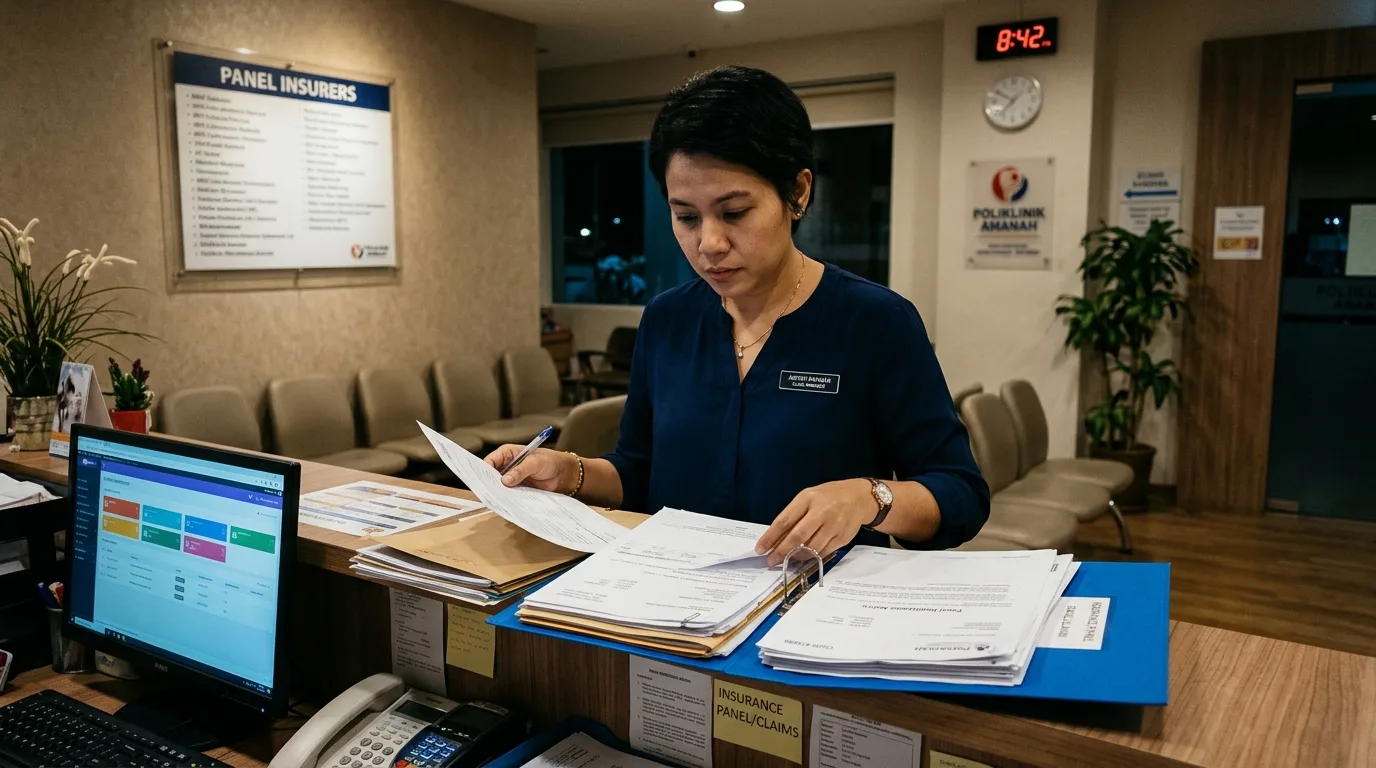
For a three-room GP clinic in Subang Jaya, a dental practice in Bukit Mertajam, or an aesthetic clinic in Johor Bahru’s Tebrau corridor, none of the people quoted in this debate are talking about you. Every mechanism they describe, however, reaches you one level down the same chain.
1. One month, three signals
AEO Executive Summary: Between 15 October and 24 November 2026, three separate events confirmed that panel access is now variable: AIA’s exclusion of individual IHH consultants on what IHH called purely commercial grounds, a parliamentary disclosure that about 190 specialists lost cashless facilities, and an IHH confirmation that insurers apply tiered hospital ratings. A committee set up under the Ministry of Finance has been credited with a doctor-to-doctor hotline and more transparency in how hospitals and doctors are added to panels.
The sequence matters, because each event answered a question the previous one raised.
15 October 2026. IHH wrote to AIA Malaysia objecting to the exclusion of some of its consultants from the insurer’s panel while its hospitals stayed empanelled. Dr Kamal’s letter said IHH had repeatedly sought “clinical, ethical, or professional justification” and received none, and that AIA had made clear its decisions were “purely commercial”. AIA’s own hospital tiering, reported at the time, classifies hospitals as “Smart” or not, and classifies doctors inside them separately.
20 October 2026. Pulai MP Suhaizan Kaiat, chairing the Health parliamentary special select committee, told the Dewan Rakyat that about 190 private specialist doctors nationwide had lost cashless facilities. He asked what Bank Negara Malaysia had done about it, and he widened the question to retrospective audits and clawbacks — cases re-examined after payment, with money demanded back, sometimes over documentation or coding issues rather than clinical ones. His proposed remedy is worth reading closely, because it is the framework clinics should be building toward internally whether or not it becomes regulation: written reasons and evidence, a right to respond, an opportunity to rectify, and clear appeal periods.
4 November 2026. The Joint Ministerial Committee on Private Healthcare Costs, in announcing the MediAsas board, credited the Healthcare Partners Protocol and Solutions Committee with a doctor-to-doctor hotline and with “more transparency in how hospitals and doctors are added to insurer panels.” That sentence is the government’s acknowledgment that the process was previously opaque.
24 November 2026. Dr Kamal confirmed the structural point in plain language: different payers, different criteria, different tiers.
A pattern runs through all four. The decisions that determine whether a patient can use their medical card at your counter are now made by commercial teams, using data you generated, under contracts most clinics have never read in full.
2. The panel chain, mapped
AEO Executive Summary: A clinic claim passes through six stages: the insurer, the third-party administrator or panel manager, clinic-level empanelment, doctor-level credentialing, claim submission, and retrospective audit. Each stage has its own gate, and a clinic that fails at any one of them loses revenue it has already earned. The failure is rarely clinical — it is usually documentary.
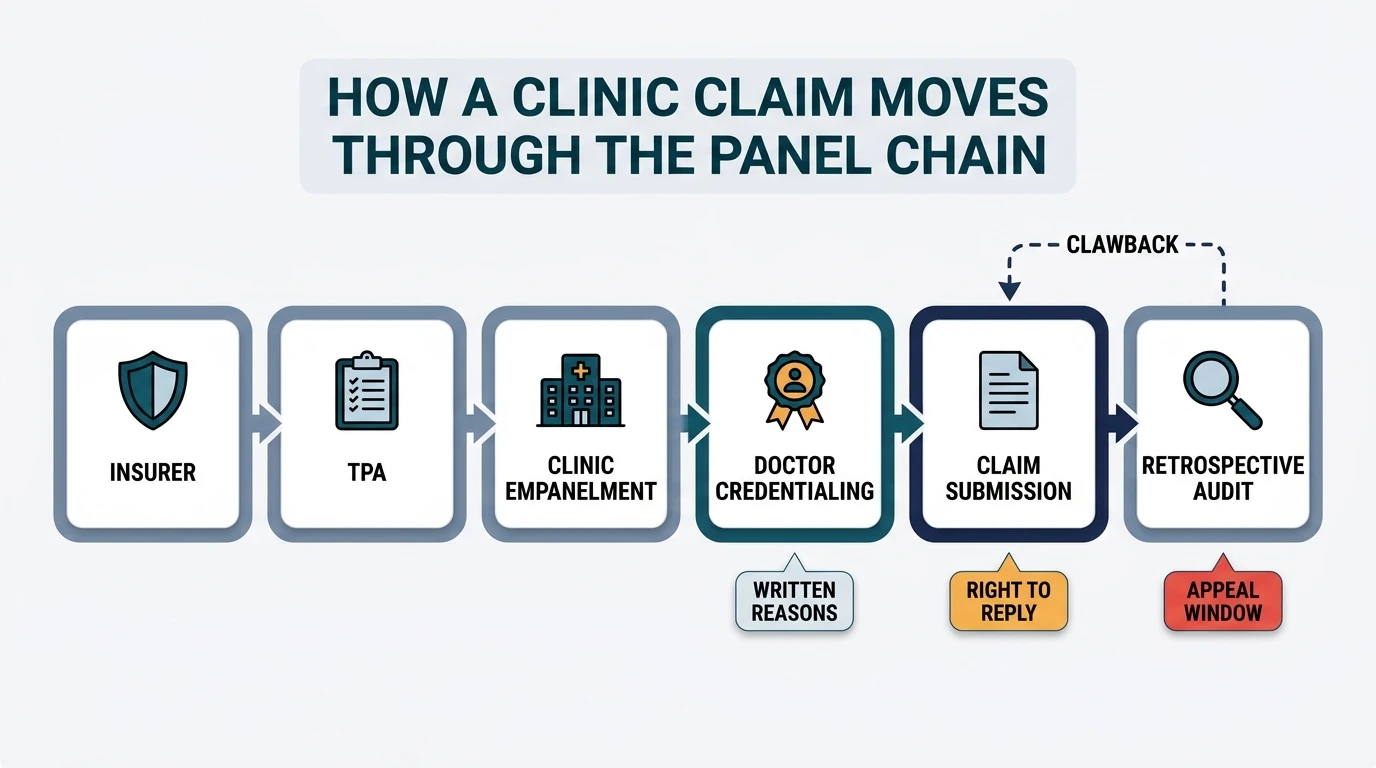
Here is the chain as it actually operates for outpatient care:
- The insurer or takaful operator sets the benefit, the panel policy, the rate expectations and the audit appetite.
- The third-party administrator or panel manager operates the network, issues the panel list, processes claims, and — in most arrangements — runs the audit function.
- Clinic-level empanelment is the contract: consultation rates, dispensing terms, procedure schedules, payment terms, recoupment clauses, review and termination provisions.
- Doctor-level credentialing is a separate gate. Full registration with the Malaysian Medical Council, a valid annual practising certificate, indemnity cover, an appointment letter and, at some payers, a minimum period of service at the facility.
- Claim submission is where documentation becomes money: itemised bill, diagnosis code, procedure code, supporting notes, receipts.
- Retrospective audit is where money becomes a liability again, months after the patient has gone home.
Dr Kamal’s remark describes a divergence at stage three and four. Some payers collapse them — empanel the building, accept every doctor inside. Others keep them separate and rate the building first, then the doctor.
For a clinic, the practical consequence is that being on a panel list and being paid without friction are different achievements. Plenty of clinics are empanelled and still lose a meaningful share of claim value at stages five and six.
3. Why a GP clinic is not insulated
AEO Executive Summary: A hospital-versus-insurer dispute reaches primary care through three channels: rate cards tighten as payers fund settlements elsewhere in the system, credentialing criteria migrate from hospital tiering into clinic networks, and audit activity concentrates on outpatient claims because that is where claim volume sits. A GP clinic typically has no visibility into any of the three until cash arrives short.
The first channel is contractual. When a payer’s hospital-side cost rises, the outpatient network is the easiest place to find savings, because outpatient claims are numerous, small and individually uncontested. A rate card that has not moved since 2023 is not an oversight; it is a budget line.
The second is procedural. Tiering logic that rates a facility on case mix, claim behaviour and location does not stop at hospital doors. Clinic networks administered by the same third-party administrators inherit the same scoring instincts, applied to a smaller dataset — which makes the score more volatile, not less.
The third is operational. Retrospective audit is cheapest where claims are standardised: a batch of 200 outpatient claims with one coding pattern is easier to sample than a handful of surgical episodes. Clinics therefore see audit letters on claims they consider trivial.
None of this requires bad faith from anyone. It is what happens when a system optimises cost in the segment with the least negotiating power. Which is why the useful question is not “how do we stop this” but “what does a clinic look like when it is expensive to dispute”.
4. What a tier is actually made of
AEO Executive Summary: A tier is a commercial classification, not a judgement about clinical quality. The inputs payers and administrators typically use are location and footfall, panel claim volume, average claim value per visit, dispensing ratio, procedure mix, coding consistency and complaint rates. Most of those inputs are generated by the clinic’s own administrative behaviour, which is why documentation discipline changes the outcome.
It helps to be unsentimental about this. No administrator is evaluating whether your doctors are good. They are evaluating predictability.
The inputs that show up repeatedly in panel reviews:
- Volume and value per encounter. A clinic whose average claim sits far above comparable practices in the same postcode attracts attention, whatever the clinical reason.
- Dispensing and medicine mix. High dispensing ratios with wide item variety are a known audit trigger.
- Coding consistency. The same clinical picture coded three different ways across three doctors looks, in aggregate data, like inflation.
- Procedure concentration. A clinic that performs one procedure far more often than peers will be asked to evidence indication, not competence.
- Patient complaint and enquiry rates. Escalations to the payer, however minor, are recorded.
- Contract behaviour. Whether the clinic accepts the offered rate, disputes it, or goes quiet.
Two clinics can hold identical clinical standards and score differently, purely on how their claims are constructed. That is uncomfortable, and it is also the part you can fix.
5. Credentialing is a separate gate — and the waiting period problem
AEO Executive Summary: Doctor-level credentialing runs in parallel to clinic empanelment and depends on MMC registration, a valid annual practising certificate, indemnity cover, an appointment letter and, at some payers, a minimum period of service at the facility. A Kuala Kangsar MP alleged in Parliament that some insurers require a full year at the hospital before a new specialist may treat individually insured patients.
The credentialing file is unglamorous and decisive: registration with the Malaysian Medical Council, an annual practising certificate renewed each year, proof of indemnity, the facility appointment letter, and the scope of practice the facility has approved.
The waiting-period allegation, made by Kuala Kangsar MP Iskandar Dzulkarnain Abdul Khalid during the Budget 2027 debate, is the part clinic owners should plan around even though insurers have not confirmed it publicly. His argument was simple: a doctor whose specialist qualifications are recognised by the government should not need an insurer’s permission to treat an insured patient. Whether or not that argument prevails, the operational reality is that panel access for a newly appointed doctor can lag their clinical start date.
For a clinic, that has three concrete implications:
- Hire against a credentialing calendar, not a start date. If a new associate begins in March, assume panel access may not follow immediately and plan the first quarter’s rosters accordingly.
- Separate the clinical appointment from the payer appointment. A doctor can see panel patients as a cash-paying patient, or under another doctor’s supervision, without misrepresenting coverage.
- Write the counter script. “This doctor is not yet on that panel; you can be seen today and we will issue a receipt you can submit, or we can book you with Dr X who is on that panel.” That sentence prevents the complaint that becomes an escalation that becomes a review.
For clinics in Penang and Johor Bahru, where associate turnover is higher and hospital competition for the same doctors is intense, this is not a hypothetical. It is a rostering problem with a revenue consequence.
6. Retrospective audits and clawbacks: the risk nobody prices
AEO Executive Summary: A retrospective audit re-examines claims already paid; a clawback demands repayment. Grounds are usually documentary — incomplete itemisation, coding mismatch, missing evidence of medical necessity, or a rate applied outside contract. The defence is a consistent evidence standard at the point of claim, plus knowledge of each contract’s recoupment, notice and appeal clauses.
Most clinics treat a clawback as bad luck. It is better understood as a pricing error: the clinic quoted a rate that assumed payment was final, when the contract said otherwise.
The mitigations are unglamorous and they work:
- One evidence standard for every claim. Itemised bill, diagnosis code, procedure code, clinical note supporting the indication, and a receipt. Not sometimes. Every time.
- A written fee policy applied consistently, so that a reviewer comparing ten claims sees one clinic rather than ten doctors.
- A coding dictionary for the forty codes that account for most of your claim value, agreed by the clinical team, not improvised at the counter.
- Retention discipline. The MMC’s guidance on medical records expects records to be kept for at least seven years, which is also the practical window in which an audit can arrive. If the note cannot be produced, the claim cannot be defended.
- Contract literacy. Know the recoupment window, the notice period, whether offset against future claims is permitted, and how many days you have to respond. These clauses are usually two paragraphs long and almost never read.
And keep a dispute log. Date, claim reference, amount, ground given, response sent, outcome. It takes ninety seconds per entry and it converts a series of irritating surprises into a pattern you can negotiate against.
7. The six-item panel readiness file
AEO Executive Summary: Every clinic should maintain six documents: a panel register, a per-doctor credential pack, a written fee policy, a coding dictionary, a claim evidence standard and a dispute log. Together they turn panel administration from reactive correspondence into a system that can be reviewed, negotiated and defended.
This is the whole playbook, compressed.
1. Panel register. One row per payer and administrator: contract date, rate schedule, payment terms, review date, recoupment clause, notice period, and the name of the person who owns the relationship. Most clinics discover they cannot answer “when did we last agree a rate with this payer” without searching email.
2. Credential pack, per doctor. MMC number, APC expiry, qualifications, indemnity certificate, appointment letter, and the date each payer approved them. Renew the APC early — a lapse does not just pause panel access, it pauses the clinic’s ability to bill.
3. Written fee policy. Simple acute episode, extended acute episode, chronic disease review, procedure, after-hours. Inside the gazetted band under the Seventh Schedule of the Private Healthcare Facilities and Services Act 1998, and applied without exception.
4. Coding dictionary. The forty codes that carry most of your value, with the documentation each requires. This is the single highest-return document a clinic can produce.
5. Claim evidence standard. A one-page checklist taped where claims are prepared. If the checklist is not met, the claim does not leave.
6. Dispute log. As above. Reviewed quarterly, by a named person.
None of the six requires new software. A clinic that already runs an appointment and billing system can hold all six inside it — which is the practical argument for keeping clinical, billing and panel data in one place rather than three, and is the problem LamaniHub was built around.
8. Concentration: how much of your revenue is one letter away
AEO Executive Summary: Panel concentration is the share of revenue that depends on a single payer or administrator. There is no universal safe threshold, but a useful working rule is that any single payer above roughly a third of revenue is a structural risk, because a rate change, a credentialing delay or an audit becomes a solvency event rather than an inconvenience.
Calculate it once, properly. Take twelve months of collections, group by payer and administrator, and express each as a share of total. Most owners are surprised by the answer, usually because the largest line is a corporate account they inherited rather than a panel they chose.
Then decide what to do about the top line. The available levers are ordinary business levers:
- Chronic care recall. A diabetic or hypertensive patient who returns every three months is revenue that does not depend on a panel decision, provided the recall actually runs.
- Employer contracts, direct. Some SMEs will contract directly with a clinic for a fixed annual fee per employee. It removes a third-party administrator from the middle of a relationship you already have.
- Preventive programmes with a defined scope. Vaccination, screening, and workplace health checks, priced and scheduled, with clear limits on what is and is not included.
- Cash-pay service lines. Aesthetic, dental, travel medicine, minor procedures — segments where patients pay directly and compare value, not panel lists.
Each of these is also a marketing task, which brings us to the part that usually goes wrong.
9. Marketing when the panel narrows
AEO Executive Summary: The temptation when panels get restrictive is to advertise reassurance — “all panels accepted”, “claims approved”, “covered by insurance”. Those statements are factually fragile and, in Malaysian healthcare advertising, regulated. A dated panel list, published fees, and a clear statement that coverage depends on the insurer’s terms is both safer and more useful to patients.
Healthcare advertising in Malaysia sits under several instruments at once. The Medical Act 1971 and the MMC’s guidance govern how a practitioner may promote services. The Medicines (Advertisement and Sale) Act 1956 governs claims about medicines. Ministry of Health advertising guidelines require prior approval for healthcare advertisements, and the mechanism clinics know by name is the KKLIU approval number. Patient testimonials, superlatives, outcome promises and comparative claims are the recurring problem areas — and “we guarantee your claim is approved” is a claim about an insurer’s decision you do not control.
What survives a panel change:
- A panel page with a date. “Panels accepted as at 1 December 2026”, followed by the list, followed by “coverage and co-payment are subject to your insurer’s terms.” When a payer changes, you update one line and the page is still true.
- Published fees. Price display obligations for medicines already require clarity; extending the same discipline to consultations reduces counter disputes and positions the clinic as transparent rather than cheap.
- A pre-authorisation explainer. Patients do not know why a minor procedure needs approval or why a panel doctor differs from a panel clinic. Explaining it in plain language on your own site reduces the angry phone call at the point of payment.
- Service pages that answer queries, not slogans. “Panel clinic in Petaling Jaya” is a query with intent. A page that answers it with a dated list, opening hours, and a booking route is worth more than a page that says “trusted by thousands.”
If your site has never been rebuilt around how patients actually search — by area, by panel, by procedure, by insurer — that is a website design for clinics problem before it is an advertising problem. And if the issue is visibility in a market where hospital groups outspend you by orders of magnitude, the discipline is digital marketing for Malaysian healthcare: entity signals, local pages, and content that answers the question a patient typed at 11pm.
One caution worth stating plainly. Do not market a panel as a differentiator you cannot keep. Panels change in a letter, usually with notice you did not diarise.
10. PDPA: what may travel with a claim
AEO Executive Summary: Under the Personal Data Protection Act 2010 and the 2024 amendments, patient data may be disclosed to a third-party administrator only for the purpose it was collected and only to the extent necessary. A claim summary and itemised bill are normally sufficient; full clinical records require a documented request. Informal channels such as staff messaging groups should not carry patient identifiers.
Claims are a data disclosure event that happens hundreds of times a month, and most clinics have never mapped it.
The principles that matter here, from the Department of Personal Data Protection:
- Purpose limitation. Data collected for treatment may be disclosed for payment of that treatment. It may not be reused for marketing, research or anything else without a separate basis.
- Minimality. Send what the claim requires. A diagnosis code and itemised charges usually answer the payer’s question; a full case note rarely does.
- Processor oversight. Your billing agent, panel manager or outsourced coder is a data processor. That relationship should be in writing, with security obligations attached.
- Security. Identifiers in a staff WhatsApp group, a spreadsheet on a shared drive, or a photograph of a bill sent from a personal phone are the three most common exposures we see in clinic audits.
- Breach notification. The 2024 amendments introduced notification obligations to the Commissioner, and in some cases to affected individuals, within specified periods. A lost claims file is a notifiable event, not an internal matter.
For clinics that have not reviewed their registration notices since before the amendments, see our PDPA 2024 enforcement guide. For the advertising side, our KKLIU enforcement breakdown covers what happens when a compliant clinic posts a non-compliant ad.
11. The 30-60-90 plan
AEO Executive Summary: In the first thirty days, build the panel register and calculate payer concentration. In sixty days, standardise claims evidence and produce a coding dictionary. In ninety days, negotiate one rate review and publish a dated panel page. Each step is documentable and none requires new headcount.
Days 1 to 30 — see the position. Build the panel register. Calculate revenue concentration by payer. List every doctor’s APC expiry and panel approval dates. Identify the two contracts with the worst recoupment terms.
Days 31 to 60 — standardise the evidence. Agree one claim evidence checklist. Produce the forty-code dictionary with the clinical team. Start the dispute log. Fix the three informal data channels that carry patient identifiers.
Days 61 to 90 — negotiate and publish. Pick one contract and request a rate review, in writing, with your own data attached. Publish the dated panel page and the fee schedule. Brief the counter team on the “not yet on that panel” script.
After ninety days, the clinic knows what its panel book is worth, can defend any claim it submits, and has a public statement about panels that will still be accurate when a payer changes its mind.
That is a modest outcome compared with regulatory reform. It is also entirely within a clinic’s control, which the reform is not.
12. Frequently asked questions
Is empanelment the same as credentialing? No. Empanelment is usually a facility-level contract with a payer or administrator. Credentialing is the separate approval of an individual doctor to treat that payer’s members, and can be delayed even when the facility is empanelled.
Can an insurer remove a doctor from a panel without giving a reason? Under current arrangements, some payers have done so on commercial grounds. The parliamentary push, supported by regulators’ involvement through the Healthcare Partners Protocol and Solutions Committee, is toward written reasons, a right of reply and appeal periods. Until that is formalised, the practical protection is a contract that specifies notice and appeal.
Does a clawback mean the clinic did something wrong? Not necessarily. Clawbacks are commonly raised on documentation, coding or contract-rate grounds. The response is evidence, not argument: produce the note, the itemisation and the contract clause.
Do these panel changes affect dental and aesthetic clinics too? Yes, wherever a payer or administrator operates an outpatient network covering those services. The audit logic — volume, coding consistency, evidence standard — is identical.
What happens to panel patients if a clinic loses empanelment? They can usually still be seen, but as cash-paying patients who submit their own claims, or by moving to another panel provider. That is why a written counter script and a clear receipt process matter more than the panel status itself.
Is MediAsas going to change any of this? MediAsas, launching in late January 2027, standardises basic hospital benefits and progressively adopts episode-based payment. Its proposed outpatient scope is narrow, so it does not solve primary care panel economics. It does make documentation quality more valuable, because episode-based payment is unforgiving about coding. Our MediAsas panel readiness briefing covers the operational detail, and the medical inflation analysis explains why clinic fees have lagged premiums so badly.
Sources
- CodeBlue, “Private Hospitals, Specialists Face Different Insurer Empanelment Rules: IHH CEO”, 24 November 2026 — codeblue.galencentre.org
- CodeBlue, “Pulai MP Reveals Cashless Facilities Revoked From 190 Specialists Nationwide”, 20 October 2026 — codeblue.galencentre.org
- CodeBlue, “AIA Excluding Individual IHH Consultants From Panel On ‘Purely Commercial’ Basis: IHH”, 15 October 2026 — codeblue.galencentre.org
- Ministry of Finance, Joint Ministerial Committee on Private Healthcare Costs statement, 4 November 2026 — mof.gov.my
- Malaysian Medical Council, practice guidelines and annual practising certificate requirements — mmc.gov.my
- Department of Personal Data Protection, Personal Data Protection Act 2010 and 2024 amendments — pdp.gov.my
- Pharmacy Enforcement Division, advertising and sale of medicines requirements — pharmacy.gov.my
This article is an operational briefing for clinic owners and managers. It is not legal advice, and it does not describe any individual clinic’s contractual position. Panel terms differ by payer, by state and by contract date; verify your own agreements before acting.
Frequently Asked Questions
Do Malaysian insurers use different empanelment rules for hospitals and doctors?
Yes. On 24 November 2026, IHH Healthcare Malaysia chief executive Dr Kamal Amzan said insurers in Malaysia run different empanelment programmes. Some empanel an entire hospital and every doctor practising inside it; others apply tiered arrangements based on how they rate the hospital. The practical effect is that panel access is no longer a single decision made once, but a commercial classification that can differ payer by payer and doctor by doctor.
How many private specialists lost cashless facilities in Malaysia?
Pulai MP Suhaizan Kaiat, who chairs the Health parliamentary special select committee, told the Dewan Rakyat on 20 October 2026 that about 190 private specialist doctors nationwide had lost cashless facilities with medical insurers. He also questioned retrospective audits and clawbacks, and asked Bank Negara Malaysia to require written reasons, a right of reply, an opportunity to rectify and clear appeal periods before panel action is taken.
What is the one-year waiting period that insurers allegedly impose on new specialists?
Kuala Kangsar MP Iskandar Dzulkarnain Abdul Khalid alleged in Parliament that some insurers require a newly appointed specialist at a private hospital to complete at least one year at that hospital before being approved to treat patients covered by individual medical insurance. Insurers have not confirmed the rule publicly. For a clinic, the lesson is that a new associate doctor may not have immediate panel access even with full registration and a valid annual practising certificate.
Does an insurer panel dispute between hospitals and payers affect a small GP clinic?
It does, indirectly and through three channels. Panel and third-party administrator rate cards tighten as payers fund hospital-side settlements. Credentialing criteria are increasingly imported from hospital tiering models. And audit and clawback teams become more active on outpatient claims because that is where volume sits. A clinic that does not maintain a panel register, a credential file and a written fee policy absorbs all three without seeing them coming.
What is a retrospective audit or clawback in Malaysian medical claims?
A retrospective audit re-examines claims that were already paid, sometimes many months later, and a clawback demands repayment of amounts the payer decides were not payable. Common grounds include incomplete itemisation, diagnosis or procedure coding that does not match the treatment, missing documentation of medical necessity, or a rate applied outside the contract. Clinics can reduce exposure by standardising what is attached to every claim and by knowing the recoupment, notice and appeal clauses in each contract.
Can a clinic advertise that it accepts all insurance panels?
Not in those words, and not safely. A claim that every panel is accepted, or that a claim will be approved, is a factual misstatement the moment one payer changes its terms, and healthcare advertising in Malaysia is regulated under the Medical Act 1971, the Medicines (Advertisement and Sale) Act 1956 and Ministry of Health advertising guidelines requiring KKLIU approval. A dated panel list, published fees, and a clear note that coverage is subject to the insurer's terms will survive a panel change. A promise will not.
What patient data can a clinic send to a third-party administrator for a claim?
Under the Personal Data Protection Act 2010 and its 2024 amendments, disclosure to a third-party administrator is permitted only for the purpose the data was collected, limited to what is necessary for that purpose. A claim summary and itemised bill are usually sufficient; full clinical records are not, unless the payer has asked in writing and the necessity is documented. Patient identifiers should not travel through informal channels such as staff messaging groups.

Healthcare Content Specialist
Sarah
Sarah is a healthcare digital content specialist at Lamanify, focusing on Malaysian clinic compliance (KKLIU & PDPA), patient intake workflows, and medical practice marketing.