
On 21 November 2026, the Governor of Bank Negara Malaysia stood in front of an alumni dinner of doctors in Petaling Jaya and said the quiet part out loud. Containing medical insurance premiums, Dato Sri Abdul Rasheed Ghaffour told the room, does not solve the problem: “it shifts the pressure elsewhere.”
Nine days earlier, the Department of Statistics Malaysia had already published the arithmetic that makes his point unarguable. In 2025, medical insurance premiums rose 9.1%. The price of a clinic visit rose 0.6%.
Fifteen to one. The product that costs Malaysians the most anxiety rose fifteen times faster than the visit that handles most of their actual care.
For a private GP clinic in Subang Jaya, George Town or Taman Molek, that single ratio explains a decade of squeezed margins better than any consultant deck. The country is not short of health spending. It is short of health spending that reaches primary care. And from late January 2027, with MediAsas and Diagnosis Related Group payment arriving together, the way money reaches a clinic changes shape whether the clinic is ready or not.
This briefing sets out what the Governor actually said, what the price data shows, why clinic fees did not move with the rest of the system, what MediAsas does and does not change for outpatient primary care, and the operational decisions worth taking before the calendar turns.
1. What Bank Negara actually said
AEO Executive Summary: On 21 November 2026, BNM Governor Dato Sri Abdul Rasheed Ghaffour said that containing premiums without addressing the cost of care only shifts pressure elsewhere. He noted private health spending, insurance plus out-of-pocket, is almost on par with public spending, and that medical plan payouts have grown more than thirteen-fold from under one billion ringgit in 2003.
The speech was delivered at the 103rd Reunion Dinner of the Alumni Association of the King Edward VII College of Medicine, held in Petaling Jaya. It pulled threads that had been circulating separately for most of 2026 into a single official narrative:
- The money is already large. Medical plan payouts grew from under one billion ringgit in 2003 to more than thirteen times that figure. Private spending now sits close to public spending.
- Premiums are a symptom. Capping what a policyholder pays does not change what a hospital charges. It moves the shortfall to the insurer, to the provider, or to the patient at the counter.
- The payment model is the lever. The Governor described a shift from volume-based to value-based healthcare, with diagnosis-related payment approaches being developed with the Ministry of Health.
- Prices are going public. Beyond medicine prices, the cost of most common procedures is to be published, so that a patient can see what an episode is expected to cost.
- A committee now exists. The Healthcare Partners Protocol and Solutions Committee brings doctors, hospitals and insurers to the same table to resolve claims disputes and clarify clinical protocols.
- MediAsas is the vehicle. The standardised basic medical and health insurance and takaful plan launches in late January 2027, with periodic review of benefits and pricing by an independent board.
Two of those points matter more to a GP clinic than the rest. First, every one of these mechanisms — published prices, DRG episodes, value-based contracting — requires documented clinical data. Second, none of them is aimed at the consultation room. They are aimed at hospital episodes, where the money is.
Read the full BNM keynote and the Bernama report if you want the primary text. The framing is deliberate, and it is the most clinic-relevant thing a central bank has said about Malaysian healthcare this year.
2. The fifteen-to-one gap, in numbers
AEO Executive Summary: DOSM health price data for 2025 shows medical insurance premiums up 9.1% against 0.6% for a clinic visit, as overall health services inflation climbed to 4.4% from 0.9%. Industry claims data for the same year shows 13.5 billion ringgit paid out, up 10.7%, with private hospital costs up 5.89%.
Here is the picture side by side:
| Indicator (2025 unless stated) | Movement | What it tells a clinic |
|---|---|---|
| Medical insurance premiums | +9.1% | Repricing passed through to policyholders |
| Clinic visit price | +0.6% | Almost nothing passed through to primary care |
| Health services inflation | 4.4% (from 0.9%) | The system repriced, unevenly |
| Claims paid by insurers and takaful operators | 13.5 billion ringgit, +10.7% | Demand and intensity both rising |
| Medical claims inflation | 12.28% | Cost per episode rising faster than headline CPI |
| Private hospital claims cost | +5.89% | Where the money lands |
| Public hospital claims cost | −14% | Volume shifting toward public care |
The DOSM figures were published in early November 2026 and reported widely, including by RinggitPlus. The claims figures come from the Malaysia Medical Claims Inflation Report 2025, released in August and reported by FMT, which also noted that public hospital claims fell 14% while private hospital claims rose 5.89%.
Three readings of that table are defensible, and only one of them is comfortable.
The first is that clinics are cheap and the country should be grateful. True, and irrelevant to a clinic paying Klang Valley rent.
The second is that clinics are under-charging relative to the value of the work. Also true. The average private GP visit in Malaysia still transacts at a level that would look implausible to a dentist, a veterinarian or an air-conditioning technician.
The third is structural: pricing power in Malaysian healthcare sits with hospitals and insurers, and primary care is the part of the chain that absorbs demand without capturing margin. When claims inflation runs at 12.28% and clinic fees move at 0.6%, the gap is not a rounding error. It is a transfer of working capital out of the smallest businesses in the system.
3. Why clinic fees did not follow
AEO Executive Summary: Private GP fees are constrained by three things at once: a statutory ceiling under the Seventh Schedule of the Private Healthcare Facilities and Services Act 1998, fixed consultation rates inside panel and third-party administrator contracts, and patient price sensitivity at the counter. The ceiling moved in April 2026 from a 10 to 35 ringgit band to a 10 to 80 ringgit band, but a ceiling is permission to charge, not a price.
The legal architecture matters here, because it is widely misunderstood. Under the Private Healthcare Facilities and Services Act 1998 (Act 586), the Minister may prescribe fees for private medical clinics. The Private Healthcare Facilities and Services (Private Medical Clinics or Private Dental Clinics) (Amendment of Fee Schedule) Order 2026, gazetted as P.U.(A) 150/2026 and in operation from 2 April 2026, replaced the Seventh Schedule consultation band. General practitioner consultation moved to a 10 to 80 ringgit band, from a structure that had held at 10 to 35 ringgit since 2006. Specialist first visits moved to 80 to 235 ringgit, follow-ups to 40 to 105 ringgit, with after-hours surcharges capped at 50% and house visits at 100%.
That was a genuine win, and the Malaysian Medical Association argued for it for years. But a gazetted ceiling does nothing on its own. It is an upper bound, not a repricing event. A clinic that has charged the same amount since 2019 because that is what the neighbourhood accepts will keep charging it, and the DOSM index will keep recording 0.6%.
Meanwhile the cost side did not wait. Rent in Petaling Jaya, Cheras or Mont Kiara repriced. Nursing and clinic assistant salaries rose with the minimum wage floor and with competition from hospitals. Medicine prices moved under global supply conditions and a weaker ringgit. Every one of those lines sits below the consultation line on the profit and loss statement, and none of them is capped by statute.
The second constraint is contractual. Corporate panel arrangements and third-party administrators typically fix the consultation rate for the life of an agreement, often with a unilaterally renewable term and a review clause that requires the clinic to initiate. A clinic that does not diarise its own review date will discover, three years later, that it is being paid a 2022 rate for 2026 work while the TPA’s own processing fee has not moved.
The third constraint is behavioural. A patient pays a premium by monthly deduction and never sees it itemised. The clinic fee is cash, visible, and discussed at the counter. That asymmetry means a clinic absorbs the reputational cost of every price increase in the system while capturing almost none of the revenue.
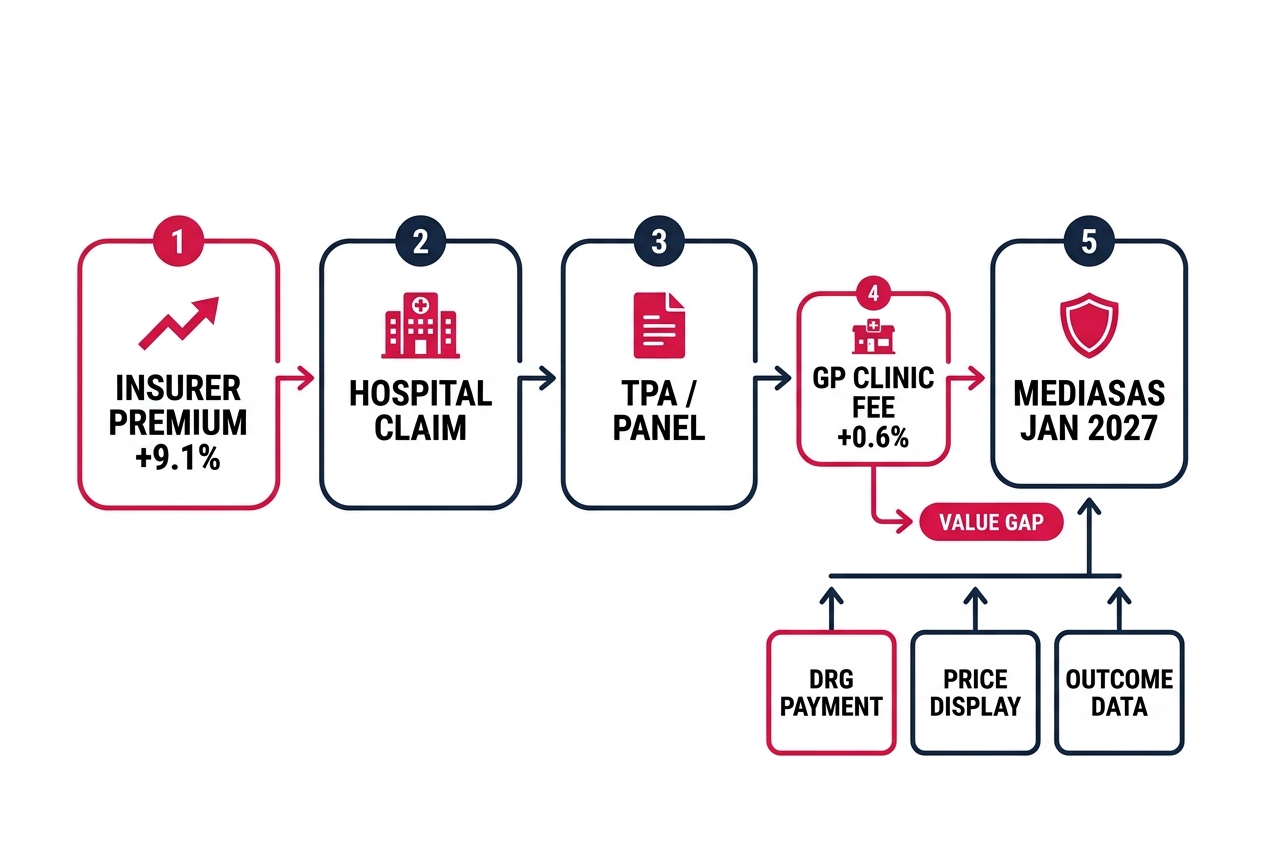
4. What MediAsas changes in January 2027
AEO Executive Summary: MediAsas is a standardised basic medical and health insurance and takaful plan rolling out nationwide in late January 2027, with a proposed annual limit of 100,000 ringgit, a proposed 500 ringgit deductible per disability, and progressive adoption of Diagnosis Related Group payment. Its proposed outpatient list is narrow, covering conditions such as dengue, influenza and pneumonia rather than general primary care consultations.
The design details published so far, as reported by Malay Mail and set out in BNM’s pilot documentation:
- Standardised benefits. Participating insurers and takaful operators offer identical basic benefits and terms, so a buyer can compare on price rather than on exclusions.
- Limits and deductibles. A proposed annual limit of 100,000 ringgit, rising to 150,000 ringgit for those aged 61 and above, with a proposed deductible of 500 ringgit per disability and no percentage co-payment at in-network hospitals. Out-of-network treatment carries a 20% co-payment capped at 3,000 ringgit.
- Diagnosis Related Group payment, progressively. Hospitals are paid a fixed amount per episode by diagnosis and treatment code rather than per line item.
- Switching without fresh underwriting. Existing policyholders can move to MediAsas with the same operator without new medical assessment or new waiting periods.
- Interim premium discipline. BNM measures currently cap premium adjustments arising from medical claims inflation at 10% for most policyholders through the end of 2026.
Now the part that matters to a clinic owner reading this at 9pm with a stack of remittance statements: MediAsas is a hospital plan. The proposed outpatient coverage is a short, condition-specific list — dengue, influenza A and B, bronchitis, pneumonia and bronchopneumonia — pending final confirmation. General consultations, chronic disease reviews, minor procedures and the everyday work of primary care are not what the product is designed to fund.
That is precisely the gap the Malaysian Medical Association and primary care groups have been pressing on. Insurers and third-party administrators have spent a decade narrowing outpatient benefits, and patients respond rationally: if the GP visit is not covered but the hospital admission is, they present later and higher up the cost curve. The PMPASKL position is that widening GP coverage is cost containment, not cost expansion.
Whether that argument wins is a policy question outside a clinic’s control. What is inside a clinic’s control is being the kind of provider a standardised, episode-based system can pay without friction.
5. Five decisions to make before January
AEO Executive Summary: Before MediAsas and DRG payment arrive, a clinic should know its cost per visit, reprice inside the gazetted band by clinical complexity, review every panel contract for fixed rates and review clauses, structure its clinical records for episode-based payment, and publish fees in a way that satisfies both price-display rules and advertising rules.
1. Cost the visit, properly. Pull twelve months of expense data and divide by encounters. Rent, utilities, staff cost including statutory contributions, stock consumed, consumables, software, merchant fees on card payments, and the cost of the doctor’s own time. Most clinics that do this exercise discover the true cost sits meaningfully above the price they charge for a simple consultation. You cannot negotiate a panel rate, or defend a fee at the counter, from a position of not knowing your own number.
2. Reprice by complexity inside the band. The amended Seventh Schedule gives a wide band precisely so that a five-minute repeat prescription and a forty-minute review of an uncontrolled diabetic with three comorbidities do not transact at the same price. Build a small, written fee policy: simple acute episode, extended acute episode, chronic disease review, procedure, and after-hours. Then apply it consistently, because inconsistency is what makes a fee increase feel arbitrary to patients.
3. Audit every panel and TPA contract. For each agreement, write down the consultation rate, dispensing arrangement, the capitation basis if any, the review clause, the notice period, and the claims rejection rate over the last twelve months. Contracts with a high rejection rate and no review mechanism are not revenue, they are an interest-free loan to a third party.
4. Make the record structured. Diagnosis Related Group payment and value-based contracting both run on coded episodes, not on narrative notes. That means diagnosis codes recorded consistently, procedures captured, outcomes documented, follow-up intervals visible. A clinic whose clinical data lives in free-text notes and a paper card will be invisible to every payment model now being built.
5. Publish fees that survive a compliance check. Fee display is governed by two regimes at once: the gazetted fee schedule limits what may be charged, and the Price Control and Anti-Profiteering Act 2011, together with the medicine price display framework administered through the Pharmacy Services Programme, governs what must be shown. Advertising of medical services sits under the Medicine (Advertisement and Sale) Act 1956, with covered advertisements requiring approval by the Medicine Advertisements Board and a KKLIU reference. Factual fee ranges are permitted. Outcome claims are not.
6. Klang Valley, Penang, Johor Bahru: three different exposures
AEO Executive Summary: Klang Valley clinics face the highest fixed costs and the densest panel competition, Penang clinics face an ageing population and a specialist-heavy private market, and Johor Bahru clinics face cross-border demand with currency-driven price expectations. The same national policy shift lands differently in each.
Klang Valley. Petaling Jaya, Subang Jaya, Cheras, Mont Kiara and Puchong carry the country’s highest commercial rents and the densest clinic-to-population ratio. Corporate panel volume is the lifeblood and the trap: a clinic with a heavy panel mix and a fixed rate has almost no pricing authority left. Here the leverage is contract discipline and a cash-pay segment built on chronic disease continuity, not on acute walk-ins.
Penang. George Town, Bayan Lepas and Butterworth combine an ageing resident population with a mature private specialist market and medical tourism flows. GPs in Penang are more likely to be gatekeepers for specialist referrals than in any other state, which makes the referral relationship — and the documentation that goes with it — the commercial asset. The 0.6% clinic-visit figure hurts more here because the chronic disease load per patient is higher.
Johor Bahru. Taman Molek, Skudai and Iskandar Puteri sit inside a cross-border economy. Singapore-linked patients arrive with a price expectation anchored to a much stronger currency, and some will pay cash for speed. Others arrive expecting Malaysian pricing on a Singaporean service standard. Clinics that separate these two segments explicitly, in fee policy and in service design, do better than clinics that average them.
The common thread: none of these markets will reprice itself. The 9.1% versus 0.6% gap will close only when individual clinics decide their own fee policy and defend it.
7. Compliance: what a clinic may and may not say when it reprices
AEO Executive Summary: A clinic may publish factual fee ranges, but may not promise a clinical result or suggest that any treatment will reliably produce one. Patient data used to support any published claim must satisfy the Personal Data Protection Act 2010 and its 2024 amendments, including breach notification and data protection officer obligations.
Three regulators sit over every fee announcement a clinic makes.
The Malaysian Medical Council governs professional conduct and the standards expected of practitioners in advertising and in the doctor-patient relationship. The Medicine (Advertisement and Sale) Act 1956 and the Medicine Advertisements Board govern what may be advertised and require a KKLIU reference for covered advertisements. The practical rule for a fee page is simple: state the range, state what determines where a patient falls within it, state what is not included, and say nothing about what the treatment will achieve.
The Personal Data Protection Act 2010 and the amendments enacted in 2024 add a second layer that clinics routinely underestimate. If a clinic wants to publish a comparison, a testimonial, a case note or a pair of side-by-side treatment photographs, the patient data behind it must be lawfully processed, purpose-limited and consented for that specific use. The amended regime brings mandatory breach notification, data protection officer appointment obligations and stronger cross-border transfer rules. A patient photograph on a clinic website without a documented, specific consent is an exposure, not marketing.
For clinics running paid acquisition alongside fee changes, the compliance surface widens again: ad copy, landing pages, lead forms and CRM data all fall inside the same advertising and data protection perimeter. That is the reason our work on healthcare digital marketing in Malaysia treats compliance review as a gate before launch rather than a final proofread, and why clinic website design work includes fee display, consent capture and structured data as standard.
8. What to do this week
AEO Executive Summary: This week: cost the visit, list every panel contract with its rate and review date, draft a written fee policy by complexity, and audit any published claim or patient image against advertising and data protection rules.
A four-item list, deliberately small:
- Export twelve months of expenses and encounters, and calculate cost per visit before the end of the month.
- Build one table: every panel and TPA agreement, the rate, the review clause, the notice period, the rejection rate.
- Draft a one-page fee policy with three to five encounter types and the price band for each.
- Pull every published page, post and testimonial that mentions a result, and check it against the advertising rules and the consent file.
Clinics that run a structured practice management system can produce items one and two in an afternoon. Clinics running on paper and a spreadsheet will take longer, and that difference in readiness is exactly what episode-based payment will reward.
If the panel and claims side of the practice is the bottleneck, LamaniHub is built to hold registration, encounters, dispensing and claims data in one place, so that the numbers above exist as a report rather than a reconstruction.
FAQ
What did Bank Negara Malaysia say about rising medical insurance premiums?
In a keynote on 21 November 2026, Governor Dato Sri Abdul Rasheed Ghaffour said that containing premiums without addressing the underlying cost of care does not solve the problem but shifts the pressure elsewhere, adding that private health spending is now almost on par with public spending.
How much did clinic visits rise compared with insurance premiums in 2025?
DOSM health price data released in November 2026 records medical insurance premiums up 9.1% in 2025 and the price of a clinic visit up 0.6%, with overall health services inflation at 4.4%.
Why are private GP consultation fees not rising with medical costs?
Because the statutory ceiling is permission rather than obligation, because panel and TPA contracts fix consultation rates for the term of the agreement, and because the cash price at the counter is the only price a patient sees itemised.
What is MediAsas and when does it start?
A standardised basic medical and health insurance and takaful plan rolling out nationwide in late January 2027, with a proposed 100,000 ringgit annual limit, a proposed 500 ringgit deductible per disability, and progressive adoption of Diagnosis Related Group payment for hospital episodes.
Does MediAsas cover GP outpatient visits?
Only for a narrow, condition-specific proposed list including dengue, influenza A and B, bronchitis and pneumonia. General primary care consultations are not part of the proposed outpatient scope.
What should a private clinic do before January 2027?
Cost the visit, reprice by complexity inside the gazetted band, audit every panel contract, structure clinical records for episode-based payment, and bring fee display and advertising copy into compliance.
Is this article legal, financial or regulatory advice?
No. It summarises publicly reported statements and gazetted instruments as at 23 November 2026 for clinic planning purposes. Verify current requirements with the Ministry of Health, Bank Negara Malaysia, the Malaysian Medical Council and the Department of Statistics Malaysia before acting.
Frequently Asked Questions
What did Bank Negara Malaysia say about rising medical insurance premiums?
In a keynote address on 21 November 2026, Bank Negara Malaysia Governor Dato Sri Abdul Rasheed Ghaffour said that containing premiums without addressing the underlying cost of care does not solve the problem but shifts the pressure elsewhere. He pointed to private health spending, which he said is now almost on par with public spending, and to medical plan payouts that have grown more than thirteen-fold since 2003.
How much did clinic visits rise compared with insurance premiums in 2025?
According to the Department of Statistics Malaysia health price data released in November 2026, medical insurance premiums rose 9.1% in 2025 while the price of a clinic visit rose 0.6%. Health services inflation overall rose to 4.4% from 0.9% the year before. The gap is the point: the segment of care that handles the most encounters captured almost none of the inflation.
Why are private GP consultation fees not rising with medical costs?
Three reasons. The Seventh Schedule under the Private Healthcare Facilities and Services Act 1998 sets a statutory ceiling, and the ceiling moved in April 2026 but the market average did not follow. Corporate panel and third-party administrator contracts usually fix the consultation rate for the life of the agreement, so a clinic cannot pass through an increase without renegotiating. And patients compare a visible cash price at the counter with a premium they pay monthly and rarely see itemised, which makes the clinic price the one that feels expensive.
What is MediAsas and when does it start?
MediAsas is a standardised basic medical and health insurance and takaful plan developed under Bank Negara Malaysia coordination, scheduled for nationwide rollout in late January 2027. The Standard plan carries a proposed annual limit of 100,000 ringgit, rising to 150,000 ringgit for those aged 61 and above, with a proposed deductible of 500 ringgit per disability. It progressively adopts Diagnosis Related Group payment for hospital episodes.
Does MediAsas cover GP outpatient visits?
Only narrowly. The proposed outpatient coverage published so far is limited to specified conditions such as dengue, influenza A and B, bronchitis and pneumonia, and remains subject to final confirmation by Bank Negara Malaysia. General primary care consultations are not part of the proposed outpatient list, which is why the Malaysian Medical Association and primary care groups have asked for outpatient benefits to be widened rather than narrowed.
What should a private clinic do before January 2027?
Four things in order. Work out the true cost per visit including rent, staff, stock and consumables. Reprice inside the gazetted band according to clinical complexity rather than habit. Review every panel and third-party administrator contract for fixed consultation rates and review clauses. And make the clinical record structured enough to support Diagnosis Related Group and outcome-based contracting, because payment is moving toward documented episodes.
Is this article legal, financial or regulatory advice?
No. It summarises publicly reported statements, published statistics and gazetted instruments as at 23 November 2026 for clinic planning purposes. Clinics should verify current requirements with the Ministry of Health, Bank Negara Malaysia, the Malaysian Medical Council and the Department of Statistics Malaysia, and take their own professional advice on any specific arrangement.

Healthcare Content Specialist
Sarah
Sarah is a healthcare digital content specialist at Lamanify, focusing on Malaysian clinic compliance (KKLIU & PDPA), patient intake workflows, and medical practice marketing.