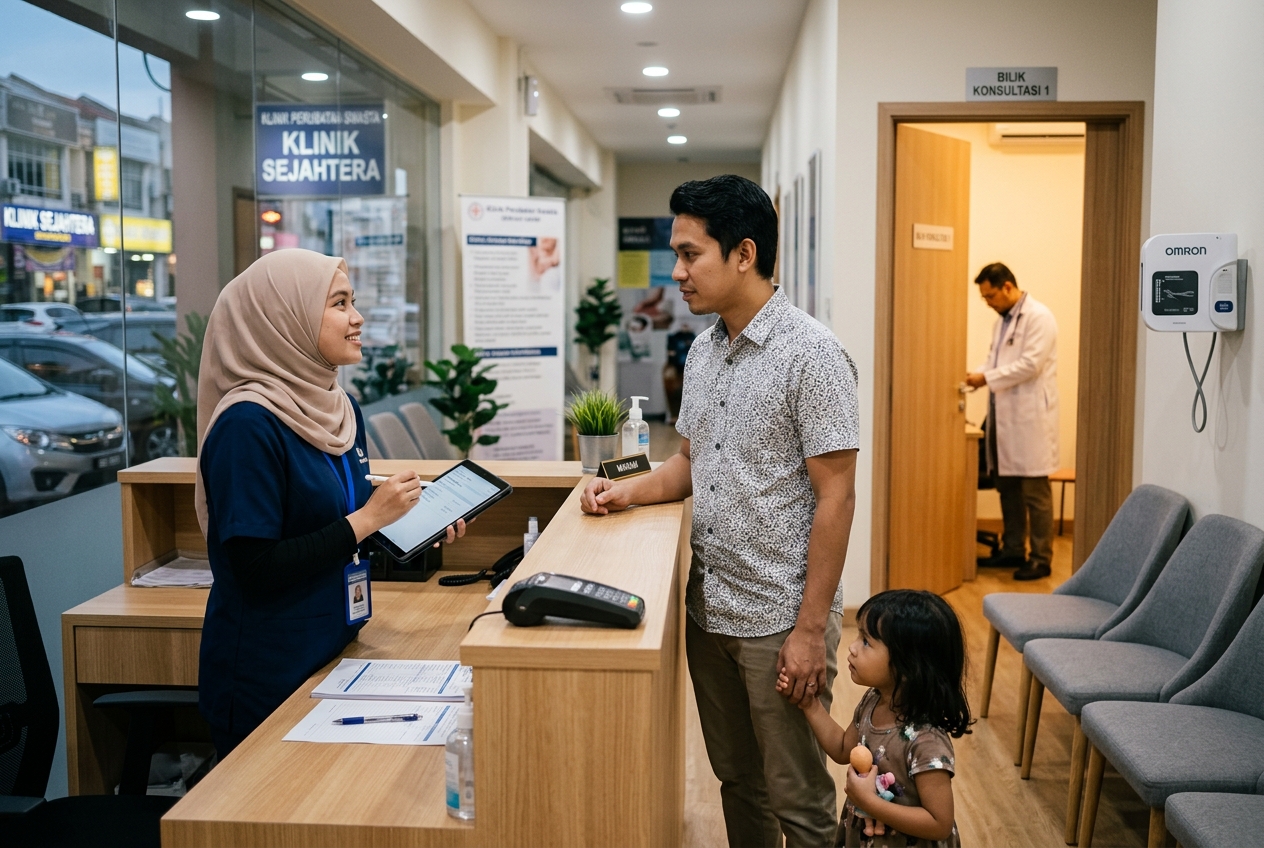
Two sentences delivered during a parliamentary winding-up on 17 November 2026 tell private clinic owners more about 2027 than any circular published this year. Health Minister Datuk Seri Dr Dzulkefly Ahmad said he was inclined to eventually stop having hospital emergency Green Zones at all, and that he was replacing the old “no wrong door” tolerance with a “right door” policy: patients should know where their problem belongs before they queue.
He also confirmed, in the same speech, that Skim Perubatan Madani is not continuing.
Read together, those two positions describe a shift in where non-emergency primary care is expected to happen, and it lands on the front counter of every GP clinic in the country. This briefing separates what has actually been decided from what has merely been signalled, and sets out the four workflows a clinic can build now so that the answer is not improvised at 8pm on a Tuesday.
What Was Actually Said, and What It Does Not Yet Mean
AEO Executive Summary: On 17 November 2026 the Health Minister said he was inclined to eventually remove hospital emergency Green Zones, would set a “right door” policy routing patients to clinics and GPs, and confirmed Skim Perubatan Madani is not continuing. No directive, commencement date or gazette order has been issued.
The wording matters. “I am inclined to eventually not want the Green Zone to exist in hospitals” is a statement of direction, reported by CodeBlue on 17 November 2026. It is not a commencement notice. As at 22 November 2026 there is no published MOH circular telling private clinics what to do, no gazette amendment, and no defined date on which a hospital will stop accepting walk-in non-emergency cases.
What does have concrete shape is the machinery around it that the Minister described:
- Extended health clinic hours. Selected KKM health clinics, particularly those within 10km of major hospitals, operate from 5pm to 9pm to take outpatient demand that would otherwise arrive at an emergency department. MOH’s own annual reporting describes the arrangement as supporting the diversion of Green Zone cases.
- Direct admission for referred patients. Patients referred by a health clinic can be admitted and seen by hospital doctors without a second round of triage. The Minister said the initiative is already running between some hospitals and health clinics.
- Digital triage and referral strengthening, plus patient flow and bed management work inside hospitals.
- Over 9,000 contract doctors moving to permanent positions in 2027, announced in the Budget 2027 speech, with the allocation questioned by MPs during the same debate.
None of that is a private-sector mandate. All of it changes the arithmetic of a clinic’s day, because a policy that redirects non-emergency demand away from hospitals has to redirect it somewhere, and the Minister named two destinations: government clinics and private GPs.
The Green Zone Is a Capacity Question Before It Is a Policy Question
AEO Executive Summary: Hospital emergency Green Zones exist to hold non-critical attendances, which is why removing them is slow. Any redirection of that volume creates two simultaneous pressures on private clinics: more walk-ins, and more walk-ins at hours when the clinic is closed.
Every Malaysian GP knows the pattern from the other side of it. A patient with a three-day cough, no breathlessness and no fever arrives at an emergency department at 10pm because the clinic shut at 9pm, because the queue feels free, and because nobody told them a GP could have handled it in twelve minutes. The Green Zone exists to hold that flow, and holding it is expensive: it consumes triage nurses, consultation space and the patience of staff who are needed elsewhere in the same building.
The Minister’s framing was explicit about why he wants GPs involved, and it was not purely clinical. “I’m roping in the GPs so that they get to also see patients, at least their businesses or clinics won’t close,” he said. That sentence is worth reading twice. It acknowledges that a redirection policy without a viable private primary care sector simply moves a queue rather than shortening it.
It also means the operational question for a clinic is not “will we get more patients” but “on what terms”. A clinic that cannot triage a walk-in safely, cannot stay open past 6pm without burning a locum budget it has not modelled, and cannot turn a one-off acute visit into a follow-up relationship will experience redirection as churn: more transactions, more waiting room stress, no more continuity.
Skim Perubatan Madani Is Not Continuing: What That Removes
AEO Executive Summary: Skim Perubatan Madani, introduced in 2023 to subsidise acute-condition treatment for lower-income patients at participating private GP clinics, is not being continued and has no allocation in the 2027 budget. Participating clinics lose a volume and claims channel, which raises the relative value of chronic disease pathways.
The Minister’s explanation was that SPM was designed around acute presentations, such as coughs, colds and upper respiratory tract infections, while his current direction is non-communicable disease management. “Within the framework of my approach to tackling NCDs, we decided not to continue this programme,” he said. He added that when a lower-income patient visits a private clinic, “it should not just be about treating a cough”, and that overall health status including diabetes, hypertension and cholesterol should be assessed.
For a clinic that participated in SPM, three things change at once, and they change on different clocks:
- Claim volume ends when the programme’s final claims window closes, not when the announcement was made. Clinics should reconcile outstanding claims and confirm the closing process rather than discover it at the point of rejection.
- Patient mix shifts. The patients who used SPM for acute visits are still symptomatic and still local. Some will move to government clinics under the extended-hours arrangement. Some will pay out of pocket. Some will delay care, which is the outcome public health researchers worry about most.
- The funded pathway that survives is screening and chronic disease, not acute treatment.
The Minister did not reconcile the obvious tension, and it is fair to name it plainly: removing a subsidy for acute GP visits while asking GPs to absorb patients diverted from emergency departments has an unresolved funding question in the middle of it. That question is the government’s to answer. What a clinic can control is whether it is positioned on the side of the change that is funded.
PeKa Sihat: The Funded NCD Route Still Open
AEO Executive Summary: PeKa Sihat, formerly PeKa B40, remains a Ministry of Health programme administered by ProtectHealth, providing funded health screening at registered private clinics. From November 2026, Sumbangan Tunai Rahmah recipients aged 40 and above are automatically eligible without separate registration.
If SPM was the acute-care channel and it is closing, PeKa Sihat is the screening and chronic-disease channel and it is open. The programme, reported by Bernama on 1 November 2026, now covers STR recipients aged 40 and above automatically, which widens the eligible pool without requiring patients to apply.
Three practical implications for a clinic:
- Confirm your participation status and current scope with ProtectHealth before you advertise screening to patients. Programme scope, claim codes and eligibility rules change between cycles, and a website page written in 2024 is not evidence of current arrangements.
- Separate screening from marketing claims. A clinic can state that it provides PeKa Sihat screening. It should not dress that up in language that promises prevention of specific diseases. Under the Medicines (Advertisement and Sale) Act 1956 and current advertising guidance, the line between describing a service and claiming an outcome is the line that matters, and it is enforced.
- Design the recall before you design the poster. A screening that ends with a printed result and no scheduled review is a transaction, not a pathway. The clinical and operational value sits in the twelve months after the result, and that only exists if someone owns the recall list.
The Four Workflows to Build Before Any Directive Arrives
AEO Executive Summary: A clinic can prepare for patient redirection without knowing the timeline by building four things: a written walk-in triage standard, a defensible after-hours model, a chronic disease review pathway with recall, and a referral handshake with the nearest hospital.
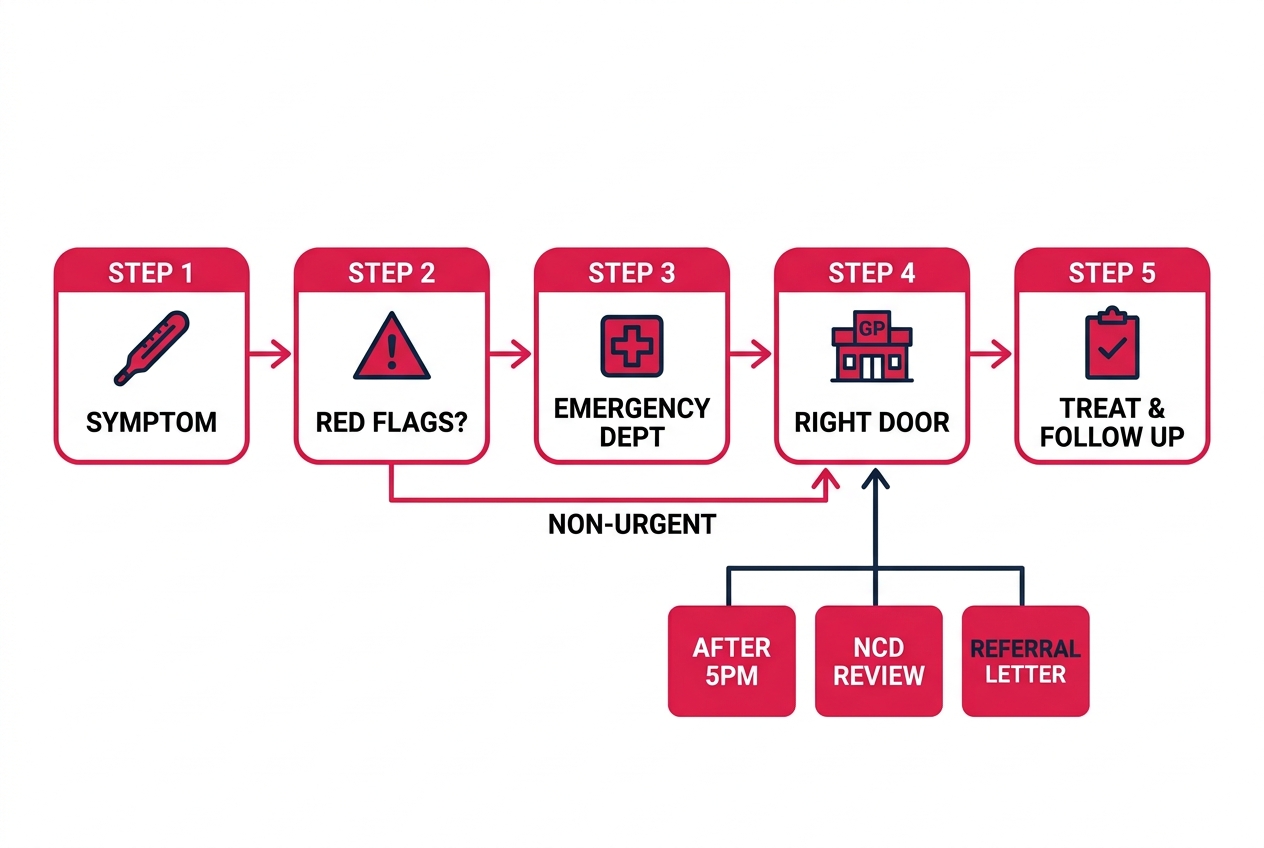
One: a written walk-in triage standard. Not a poster. A short document that lists the red flags that send a patient to an emergency department immediately, the presentations that can be seen in the clinic today, and the ones that need an appointment within a defined window. Staff should be able to apply it without calling the doctor for a judgement that should already be written down. This is the same discipline the Malaysian Medical Council expects around consultations generally: a documented reason for the decision, a defined escalation route, and a record that shows both.
Two: an after-hours model that survives contact with reality. Extended KKM hours run to 9pm for selected clinics near hospitals, which sets a patient expectation of evening access in those catchments. A private clinic does not have to match it, but it does have to know what it is offering. Three workable shapes exist: shift the roster so the clinic genuinely closes at 9pm three nights a week; keep a defined late slot with one doctor and one assistant; or stay closed and say so clearly on the website, the Google Business Profile and the WhatsApp auto-reply. The failure mode is the fourth shape, where the door is open but the clinic is effectively single-staffed and the queue is unsafe.
Three: a chronic disease review pathway with recall. Hypertension, diabetes and lipid monitoring are the funded direction of travel, and they are also the only part of primary care that produces a predictable calendar. A workable pathway needs a recall interval per condition, a way to identify who is overdue, a consultation template that captures the numbers consistently, and an escalation rule for results that cannot wait. Clinics that already run this well tend to find that PeKa Sihat screening and panel patients feed the same list.
Four: a referral handshake with the nearest hospital. The direct-admission arrangement the Minister described only helps a patient if the referral document is good enough for the receiving side to act on. That means a referral letter with the working diagnosis, the observations that matter, the treatment already given, the reason for referral and a contact the hospital can reach. It also means a named person at the clinic who owns the follow-up call. A referral is not complete when the letter is printed; it is complete when someone confirms the patient arrived.
Klang Valley, Penang and Johor Bahru: Different Catchments, Same Counter
AEO Executive Summary: Klang Valley clinics face hospital-adjacent volume and multi-branch consistency, Penang clinics face a mix of local chronic disease and medical tourism expectations, and Johor Bahru clinics face cross-border working hours and Singapore-linked patients. The counter standard should be identical in all three.
In the Klang Valley, the redirection conversation is most concrete, because the density of major hospitals means many clinics sit inside the 10km ring where extended KKM hours apply. A clinic two kilometres from a hospital emergency department will feel the change first, and it will feel it as evening walk-ins. Multi-branch groups need one triage standard, not a branch preference, because the patient who is turned away at one branch and accepted at another will tell both stories.
In Penang, the catchment is bifurcated. Local chronic disease management and a medical tourism market with different expectations share the same waiting room. A redirected walk-in from a public hospital and a patient who booked a screening package three weeks in advance should not compete for the same slot, which means the appointment book has to distinguish them.
In Johor Bahru, the constraint is hours and paperwork. Cross-border workers want evening and weekend access, and many patients hold records from more than one health system. A referral letter that travels well, a summary that a Singapore GP can read, and a repeat prescription policy that is defensible are the three assets that matter more here than anywhere else.
A Ninety-Day Readiness Plan
AEO Executive Summary: Days 1 to 30 document the current state of walk-ins and after-hours load, days 31 to 60 rewrite the four workflows, and days 61 to 90 align the customer-facing layer, train staff and set a review date.
Days 1 to 30: measure what actually happens. Count walk-ins by hour and day, and label each one acute, chronic or procedural. Most clinics find their after-hours demand is concentrated in a narrower band than they assumed, which changes what an after-hours model should cost. Simultaneously, pull the last two quarters of chronic patients and mark who is overdue for review.
Days 31 to 60: write the four workflows. Triage standard, after-hours model, chronic review pathway, referral handshake. Keep each to one page. A document longer than a page will not be used at the counter at 8:45pm.
Days 61 to 90: align everything the patient sees. Website opening hours and service pages, the Google Business Profile hours, the WhatsApp auto-reply, the booking form’s reason-for-visit field, and any paid search copy that still promises walk-in availability the clinic cannot honour. Then train staff on the triage standard, run one test referral end to end, and diarise a quarterly review.
Clinics that want the digital layer of this built properly, with accurate service pages, intake forms that route correctly and a booking flow that matches the actual roster, can review the clinic growth work at Lamanify’s digital marketing practice and the conversion-focused builds at Lamanify website design. Practice teams running appointments, records and recalls across branches can see the operating layer at LamaniHub. Three related briefings sit alongside this one: the APC 2027 renewal deadline guide, the Budget 2027 contract doctor analysis, and yesterday’s telemedicine rules briefing.
What to Watch Next
AEO Executive Summary: Watch for three signals: an MOH circular or directive that gives the Green Zone change a date, expansion or adjustment of extended-hours health clinics in the 2027 budget cycle, and published detail on how GPs are expected to be funded for diverted acute cases.
The first signal is documentary. When a redirection policy stops being an inclination and starts being an instruction, it will appear as a circular, a service directive or an amendment, and it will define who is responsible for what. Until that exists, a clinic that reorganises its entire operation around one sentence is guessing, and a clinic that ignores it is also guessing.
The second is budgetary. Extended-hours health clinics cost money and staff, and the Health Ministry’s Budget 2027 allocation rose by roughly 2.6 per cent year on year. Whether the extended-hours footprint grows, holds or shrinks is a fair proxy for how fast the Green Zone change is intended to move.
The third is the funding question, and it determines whether redirection is an opportunity or a cost. No allocation for Skim Perubatan Madani appears in the 2027 budget. If GPs are to absorb non-emergency acute demand, some arrangement has to exist for patients who cannot pay out of pocket, and no such arrangement has been announced. Clinics should plan for the version where they fund the transition themselves through better chronic disease continuity, because that version works regardless of what is announced next.
For the primary sources behind this briefing, clinics should read the Ministry of Health annual reporting on extended-hours clinics and Green Zone diversion, check practitioner registration and annual practising certificate obligations at mmc.gov.my, verify advertising and claims requirements at pharmacy.gov.my before publishing any promotion of a new service, and review patient data obligations at pdp.gov.my before adding any new intake or recall system. Nothing in this article is legal, regulatory or financial advice.
Frequently Asked Questions (FAQ)
What is the “right door” policy announced by the Health Minister?
In his 17 November 2026 winding-up speech on the Budget 2027 health debate, Health Minister Datuk Seri Dr Dzulkefly Ahmad said he wanted to move from a “no wrong door” approach to a “right door” policy, so that patients understand where their condition should be treated instead of defaulting to a hospital emergency department. He linked it to a stated intention to eventually do away with hospital emergency Green Zones, with clinics and general practitioners absorbing non-emergency demand.
Has the Green Zone already been abolished?
No. As at 22 November 2026 no gazette order, circular or MOH directive to private clinics has been published. The Minister described an inclination and a direction during a parliamentary winding-up, not a commencement date. Clinics should treat it as a planning signal with an unknown timeline, not as an operative rule.
What is Skim Perubatan Madani and why does its discontinuation matter to GPs?
Skim Perubatan Madani was introduced in 2023 to subsidise acute-condition treatment for lower-income patients at participating private GP clinics. The Health Minister confirmed it is not being continued, and no allocation for it appears in the 2027 budget. For participating clinics this removes both a patient volume source and a claims channel, which is why NCD-based pathways matter more in 2027.
Does the abolition of Skim Perubatan Madani mean B40 patients have no funded route to a private clinic?
Not entirely. PeKa Sihat, formerly PeKa B40, remains a Ministry of Health programme administered by ProtectHealth and delivers funded health screening for eligible recipients at registered private clinics. From November 2026, Sumbangan Tunai Rahmah recipients aged 40 and above are automatically eligible. Clinics should confirm their own participation status and current scope directly with ProtectHealth rather than assume last year’s arrangement still applies.
What should a clinic do first operationally?
Build a written walk-in triage standard with red-flag criteria and escalation timeframes, decide honestly what after-hours capacity the clinic can sustain, formalise a chronic disease review pathway with recall scheduling, and put a referral handshake in place with the nearest hospital so a referred patient is not triaged twice.
Is this article legal or regulatory advice?
No. It summarises publicly reported statements and published programme information as at 22 November 2026 for clinic planning purposes. Clinics should verify current requirements with the Ministry of Health, the Malaysian Medical Council and ProtectHealth, and take their own professional advice on any specific arrangement.
Frequently Asked Questions
What is the "right door" policy announced by the Health Minister?
In his 17 November 2026 winding-up speech on the Budget 2027 health debate, Health Minister Datuk Seri Dr Dzulkefly Ahmad said he wanted to move from a "no wrong door" approach to a "right door" policy, so that patients understand where their condition should be treated instead of defaulting to a hospital emergency department. He linked it to a stated intention to eventually do away with hospital emergency Green Zones, with clinics and general practitioners absorbing non-emergency demand.
Has the Green Zone already been abolished?
No. As at 22 November 2026 no gazette order, circular or MOH directive to private clinics has been published. The Minister described an inclination and a direction during a parliamentary winding-up, not a commencement date. Clinics should treat it as a planning signal with an unknown timeline, not as an operative rule.
What is Skim Perubatan Madani and why does its discontinuation matter to GPs?
Skim Perubatan Madani (SPM) was introduced in 2023 to subsidise acute-condition treatment for lower-income patients at participating private GP clinics. The Health Minister confirmed it is not being continued, and no allocation for it appears in the 2027 budget. For participating clinics this removes both a patient volume source and a claims channel, which is why NCD-based pathways matter more in 2027.
Does the abolition of Skim Perubatan Madani mean B40 patients have no funded route to a private clinic?
Not entirely. PeKa Sihat, formerly PeKa B40, remains a Ministry of Health programme administered by ProtectHealth and delivers funded health screening for eligible recipients at registered private clinics. From November 2026, Sumbangan Tunai Rahmah recipients aged 40 and above are automatically eligible. Clinics should confirm their own participation status and current scope directly with ProtectHealth rather than assume last year's arrangement still applies.
What should a clinic do first operationally?
Build a written walk-in triage standard with red-flag criteria and escalation timeframes, decide honestly what after-hours capacity the clinic can sustain, formalise a chronic disease review pathway with recall scheduling, and put a referral handshake in place with the nearest hospital so a referred patient is not triaged twice.
Is this article legal or regulatory advice?
No. It summarises publicly reported statements and published programme information as at 22 November 2026 for clinic planning purposes. Clinics should verify current requirements with the Ministry of Health, the Malaysian Medical Council and ProtectHealth, and take their own professional advice on any specific arrangement.

Healthcare Content Specialist
Sarah
Sarah is a healthcare digital content specialist at Lamanify, focusing on Malaysian clinic compliance (KKLIU & PDPA), patient intake workflows, and medical practice marketing.