
On 20 November 2026, CodeBlue published a two-part analysis titled “Same Duty, Different Screen: Digital Care, Evidence, And The Doctor’s Accountability,” written by JJ Chan from the legal side and Dr Arasu R from the clinical side. It is the clearest public explanation to date of an awkward fact about Malaysian telemedicine: the country has had a Telemedicine Act since 1997, passed and gazetted, that has never been brought into force. Digital care is not unregulated. It is regulated by everything else.
That distinction matters to every private clinic that has quietly added video calls, WhatsApp reviews, e-prescriptions or online medical certificates to its service list. The rules were not written for a screen. They apply anyway, and the enforcement route is professional discipline rather than a telemedicine regulator. This article sets out what the analysis says, what the Malaysian Medical Council (MMC) guideline and the September 2025 virtual MC clarification actually require, and the documentation a clinic in Klang Valley, Penang or Johor Bahru should be able to produce if a teleconsult is questioned six months later.
What the 20 November Analysis Actually Says
AEO Executive Summary: The Telemedicine Act 1997 exists but has never been brought into force, so Malaysian digital care is governed by the Medical Act 1971 and MMC guidance, the Private Healthcare Facilities and Services Act 1998, the Personal Data Protection Act 2010 as amended, and a 2025 Ministry of Health guideline aimed mainly at platforms.
The analysis describes a layered framework rather than a single law. The practitioner is governed by the Medical Act 1971 and MMC guidance. A facility is governed by the Private Healthcare Facilities and Services Act 1998 where its scope is engaged. Patient data is governed by the Personal Data Protection Act 2010, as amended. Behind all of that sits ordinary negligence law, which does not care whether the consultation happened in a room or on a screen.
In 2025 the Ministry of Health added a Guideline on Online Healthcare Services, much of it addressed to the platforms themselves: local incorporation and presence, a registered medical practitioner in senior management or on the board, credential checks, and proper records. A May 2025 circular described that guideline as an interim measure intended to form the basis of a new Bill regulating digital health, including online healthcare services.
The practical reading for a clinic owner is simple. There is no telemedicine licence to apply for, and no telemedicine-specific penalty to avoid. There is instead a professional standard, a facility standard, a data standard and a negligence standard, all of which apply to a fifteen-minute video call exactly as they apply to a fifteen-minute consultation in an examination room. If a clinic is building online services, those four standards belong in the service design, not in a policy PDF nobody opens.
The Rules That Bind a Clinic Today
AEO Executive Summary: MMC’s Guideline on Telemedicine, endorsed by the Council on 23 January 2024, requires the same quality of care as an in-person visit, identity verification, contemporaneous secure records, explanation of the medium’s limits, and a timely in-person assessment when remote assessment is inadequate.
The MMC Guideline on Telemedicine is short and unusually concrete. It was endorsed by the Council’s Ethics Committee in October 2023 and by the Council itself on 23 January 2024, replacing the pandemic-era advisory on virtual consultations. Its provisions read like a checklist a clinic can audit against:
- Technology changes nothing ethically or legally. The guideline states plainly that using technology does not alter the ethical, professional and legal requirements of care.
- The same quality and standard of care must be provided as in an in-person situation, with practitioners familiar with the practical limits of remote care.
- Identity and registration must be made known. The doctor discloses identity, place of practice and registration status, and the identities of the patient and every other participant are confirmed and documented at each consultation.
- Records must be contemporaneous and secure. Not written up the next morning from memory, and not stored on a personal phone gallery.
- Decisions must be explainable. The doctor must be able to justify any medical decision if the situation arises, which is a documentation obligation dressed as an ethical one.
- The medium must be judged honestly. If the technology or the format does not allow adequate assessment of the presenting problem, the doctor must arrange a timely in-person assessment.
- Limits and privacy must be explained to the patient, in terms the patient can act on.
- Caution applies to prescribing for patients the doctor has not personally examined.
- Some patients should be redirected. The guideline names those with cognitive disorders, those suspected to be under the influence of drugs or alcohol, and those with language barriers as patients who should be advised to attend a physical facility.
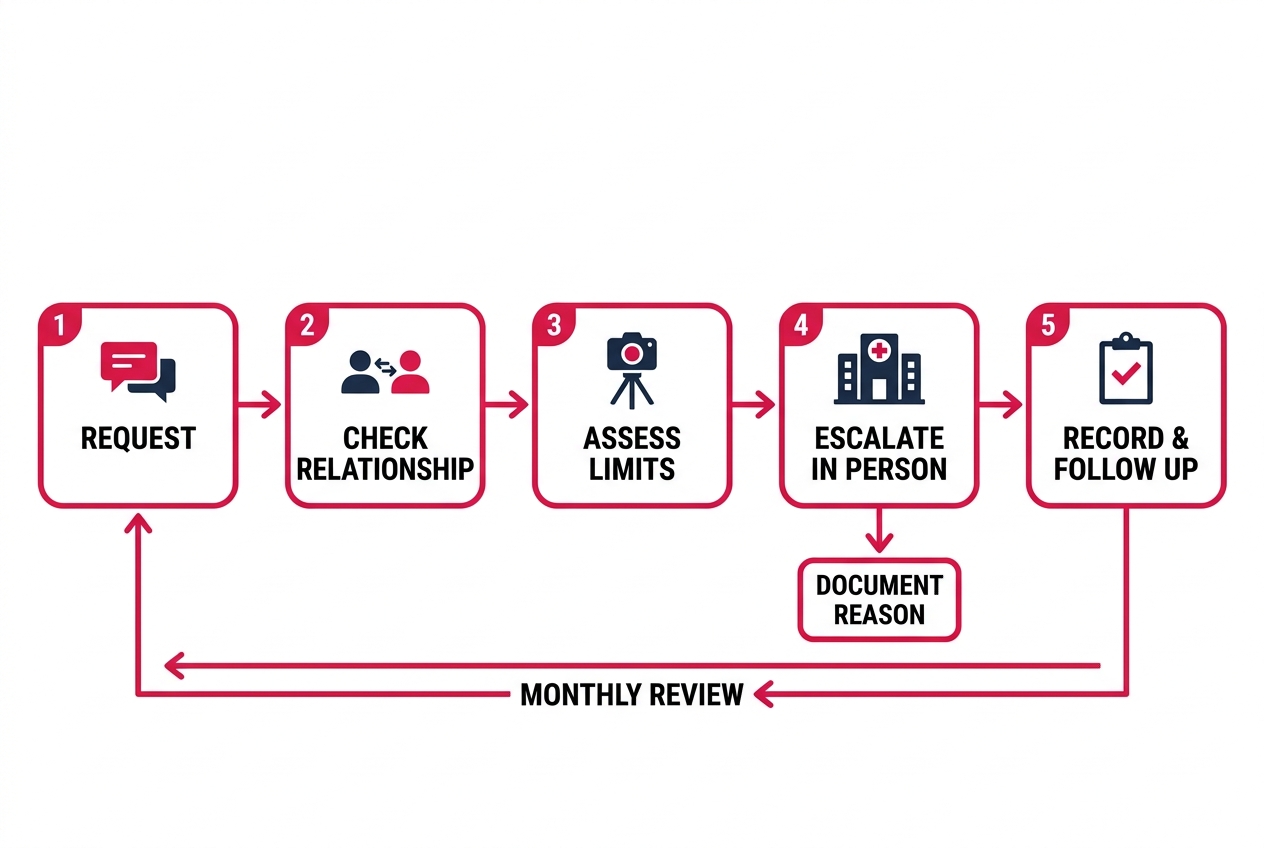
One further provision carries more operational weight than its quiet wording suggests. Virtual consultations should generally be used only where a doctor-patient relationship has already been established through a prior physical consultation, as part of follow-up care. MMC accepts that a virtual first consultation may be permissible, especially in primary care, but it is not the default, and where it happens the doctor must record the reason and be able to defend it.
Read together, those provisions describe a clinic that knows, before the call connects, whether this patient should be on a screen at all. That is a triage decision made at booking, not a judgment improvised at minute nine.
The Virtual MC Line Since 23 September 2025
AEO Executive Summary: An MMC Ethics Committee notification dated 23 September 2025 states that a medical sick certificate may not be issued solely following a virtual consultation. Clinics selling online MCs must therefore require an in-person assessment, or stop advertising the service.
This is the single most commercially sensitive rule in the set, because online medical certificates are a product that patients actively search for and that some clinics promote as a convenience feature. The MMC position, published by its Ethics Committee on 23 September 2025, is that a medical certificate cannot be issued solely on the basis of a teleconsultation.
The word “solely” is doing real work. It means a teleconsult can sit inside a sequence that includes an in-person assessment, but it cannot be the only basis for the certificate. A clinic whose booking flow reads “consult online, MC issued in 15 minutes” is advertising a service that current MMC guidance does not support, and the exposure falls on the doctor who signs the certificate, not on the platform or the marketing agency that wrote the copy.
Three practical consequences follow. First, the clinic website and WhatsApp auto-replies need to describe the MC process accurately, including the in-person step, before a patient pays. Second, front desk staff need a script for the patient who insists, because that conversation happens at the counter and at 11pm on WhatsApp. Third, the clinical record should show what the certificate was based on, which means an entry that names the in-person assessment and its date rather than a bare note that leave was granted.
There is a legitimate way to serve patients here. A clinic can offer a virtual review to decide whether an in-person assessment is needed, then see the patient and issue the certificate on the same day. That is slower than the advertised alternative, and it is the version that survives scrutiny.
The Standard of Care Does Not Drop Because the Camera Is On
AEO Executive Summary: Malaysian courts assess diagnosis and treatment against practice accepted as proper by a responsible body of peers that withstands logical scrutiny, and assess advice on treatment against a patient-centred standard covering material risks and reasonable alternatives. Neither test depends on where the doctor was sitting.
The analysis walks through the legal standard carefully, and clinic owners should understand the shape of it even without the case citations. Since the Federal Court’s 2017 decision in Zulhasnimar, diagnosis and treatment are judged against a practice accepted as proper by a responsible body of medical peers, provided that practice withstands logical scrutiny. Advice about proposed treatment is judged differently and more protectively: against what a reasonable patient would want to know, including material risks and reasonable alternatives, with materiality decided by the court rather than by the profession.
Neither test asks where the doctor was sitting. What changes with a screen is what reasonable care requires in the circumstances, including the possibility that reasonable care means declining to decide remotely and arranging to see the patient instead. A doctor who recognises the limit and escalates is practising safely. A doctor who pushes a remote consultation past what the medium can establish is not.
The second thing that changes is the evidence. A remote consultation leaves a digital trail: booking messages, identity checks, consent, platform chat, clinical notes, and any recording the clinic chooses to keep. If a complaint or claim follows, one question will decide much of the outcome: does that trail show the limits of the medium were recognised, explained to the patient, and managed?
That question is answerable only if someone wrote it down at the time. MMC requires the practitioner to be able to justify decisions; the record is how justification survives the gap between the consultation and the complaint, which is often measured in months.
What a Defensible Teleconsult Record Must Show
AEO Executive Summary: A defensible teleconsult record should show verified identities, everyone present, consent to remote care and its limitations, why the consultation was remote, what could and could not be assessed, the clinical reasoning, prescription rationale, escalation advice with a timeframe, and a named owner for follow-up.
Most clinic record systems were designed for a walk-in. They capture vitals, a complaint, a diagnosis and a prescription, because that is what an in-person visit produces. A teleconsult produces a different dataset and, if the template does not ask for it, the fields stay empty and the reasoning disappears.
A workable template captures the following, in roughly this order:
- Identity verification. Patient confirmed by at least two identifiers, and the doctor’s identity, place of practice and registration status made known at the start.
- Participants. Everyone present at either end, including a spouse, parent, interpreter or clinic assistant, recorded by role.
- Consent and limitations. Consent to remote consultation recorded, together with a note that the limits of remote assessment and the privacy limits of the chosen platform were explained.
- Reason for remote. Why this consultation is virtual rather than in person, especially where it is a first consultation or where the patient declined to attend.
- What could be assessed. Video quality, observations available, home readings, photographs received, and any wearable or device data.
- What could not be assessed. The examination that was not possible, named specifically. This single line is what distinguishes a careful record from an optimistic one.
- Clinical reasoning and plan. Impression, working diagnosis or problem list, and the plan, written as reasoning rather than as a conclusion.
- Prescription rationale. What was prescribed or continued, why it was appropriate without a hands-on examination, and what monitoring or review makes that safe.
- Escalation advice. What the patient should do, and how quickly, if symptoms change. “Come back if worse” is not escalation advice; a named threshold and a timeframe is.
- Follow-up ownership. Who reviews the patient, when, and through which channel, plus confirmation that records were shared or made accessible as required.
A clinic that captures those ten items has something more useful than a compliance artefact. It has a clinical document that supports continuity of care when the patient next walks in, and it has a defensible account of judgment if the case is ever reviewed by someone who was not there.
Three Workflows Worth Rewriting This Month
AEO Executive Summary: Clinics should rewrite three workflows: inbound messaging triage that decides virtual or in-person, repeat prescription rules with a defined prior-review window, and a medical certificate policy that reflects the September 2025 MMC position.
Inbound triage. Most remote care begins as a WhatsApp message, not a booking. The clinic needs a short triage script that ends in one of three outcomes: book a virtual slot, book an in-person slot, or escalate now. Staff need written criteria for each outcome, and the criteria should be conservative, because the cost of an unnecessary clinic visit is an inconvenience while the cost of a missed escalation is not recoverable.
Repeat prescriptions. The commercially attractive version of online care is the repeat script: a chronic patient pays a fee, answers five questions, and collects medicine. The defensible version has conditions. The patient should have been examined in person within a defined window, the medicine should be stable and low-risk to continue, the monitoring parameters should be current, and the record should show who reviewed them. A first-time prescription issued to a patient the clinic has never examined is the scenario MMC’s caution about prescribing is pointing at.
Medical certificates. The policy belongs on the website, in the booking flow and on the counter card, in language a patient understands: certificates require an in-person assessment, and a virtual consultation can be used to decide whether that assessment is needed. Staff should be able to explain it without improvising, and the clinic’s own marketing should stop implying otherwise, including in paid search copy written months ago.
Klang Valley, Penang and Johor Bahru: Different Pressures, Same File
AEO Executive Summary: Klang Valley clinics face multi-branch consistency and corporate panel expectations, Penang clinics face cross-border and medical tourism patients, and Johor Bahru clinics face Singapore-linked commuter demand. All three need one documentation standard applied everywhere.
In the Klang Valley, the pressure is volume and consistency. A group with three or four branches, each with its own locum roster, will drift: one branch documents the reason for a virtual consultation, another does not; one branch issues certificates after a video call, another insists on attendance. Corporate panel clients increasingly ask for service scope in writing, and a clinic that cannot state its teleconsult policy in one paragraph looks unreliable next to one that can.
In Penang, the pressure is cross-border. Medical tourism and long-stay expatriate patients generate follow-up requests from abroad, and MMC’s guideline is explicit that practitioners providing telemedicine to patients in Malaysia, wherever they sit, must meet Malaysian ethical, legal and statutory requirements, including appropriate indemnity cover. A clinic that routes consultations through an offshore platform should know who is registered where, who holds the record, and what happens to that record if the arrangement ends.
In Johor Bahru, the pressure is the causeway. Patients who work in Singapore want evening reviews, repeat prescriptions and referral letters that travel. The documentation burden is the same, but the continuity question is harder: a clinic that cannot produce a clean summary for a patient who will see a Singapore GP next week is creating a gap that the next clinician has to close blind.
The common answer is not a different policy per city. It is one documentation standard, one triage script, one certificate policy and one audit, applied at every branch and reviewed on a schedule.
A Thirty-Day Documentation Audit
AEO Executive Summary: A clinic can audit its teleconsult exposure in thirty days by sampling records, checking consent and identity fields, verifying escalation advice, reviewing prescription decisions, testing platform access controls, and confirming that marketing copy matches the actual service.
Week one is discovery. Pull every record from the last ninety days that involved a video call, a messaging-based review or a remote prescription. Count them. Most clinics discover the number is larger than they assumed, because staff do not always label these encounters as teleconsults.
Week two is sampling. Read twenty of those records against the ten-item template. Score each item present or absent. The pattern usually shows quickly: consent is captured, escalation advice is not; the reason for remote care is missing entirely; the “what could not be assessed” line does not exist because the template never asked.
Week three is policy. Rewrite the three workflows above, then check the customer-facing layer against them: website service pages, booking forms, WhatsApp saved replies, Google Business Profile answers, paid search copy and any printed counter material. Misalignment here is the most common finding, and it is the easiest to fix.
Week four is verification. Test the platform’s access controls, confirm what the vendor can see, review retention and export settings, and record who inside the clinic can pull a consultation record and how quickly. Then set a quarterly date to repeat the sample, because a standard that is audited once becomes a standard that is remembered once.
What Comes Next: Platform Duties and the Digital Health Bill
AEO Executive Summary: The Ministry of Health has described its 2025 online healthcare guideline as interim, with a new Bill on digital health planned. MMC’s telemedicine guideline is also scheduled for review two years after its January 2024 endorsement, so clinics should expect revision rather than stability.
Two clocks are running. The first is legislative: the Ministry has said the online healthcare guideline will feed a new Bill regulating digital health, including online healthcare services. When that Bill arrives, it will likely settle a question the current framework leaves open, namely what duties a platform itself owes a patient when it screens clinicians, structures the encounter and holds the records.
The second is professional: MMC’s telemedicine guideline is scheduled for review two years after endorsement, which places the review inside the current period. Clinics that built their policies around the 2024 text should expect the text to move, particularly around first-contact virtual care, platform arrangements and documentation expectations.
Neither clock requires a clinic to wait. The obligations that exist today are already specific enough to build against, and the clinics that will adapt cheapest are the ones whose records already show reasoning, consent and escalation. A new statute mostly changes the label on the file. It rarely forgives an empty one.
Clinics that want a stronger digital front door, with accurate service pages, compliant intake forms and a booking flow that routes patients correctly, can review the clinic growth work at Lamanify’s digital marketing practice and the conversion-focused site builds at Lamanify website design. Clinic operations teams running appointments, records and follow-up across branches can see the operating layer at LamaniHub. Two related briefings are worth reading alongside this one: our analysis of the PDPA amendment obligations for clinics and the clinic continuity playbook published yesterday.
For the underlying sources, clinics should read the MMC Guideline on Telemedicine directly, check practitioner registration and annual practising certificate status through mmc.gov.my, confirm advertising and claims requirements through pharmacy.gov.my before publishing any clinic promotion, and review data protection obligations through pdp.gov.my, including the Commissioner’s data breach notification guidance. Nothing in this article is legal advice; clinics with live disputes or platform contracts should take their own counsel.
Frequently Asked Questions (FAQ)
Is telemedicine legal in Malaysia?
Yes, but not through a dedicated statute. The Telemedicine Act 1997 was passed and gazetted yet has never been brought into force. Telemedicine is instead governed by the Medical Act 1971 and MMC guidance, the Private Healthcare Facilities and Services Act 1998 where a facility is involved, and the Personal Data Protection Act 2010 as amended.
Can a Malaysian clinic issue an MC after a virtual consultation only?
No. The MMC Ethics Committee notification dated 23 September 2025 states that a medical sick certificate may not be issued solely following a virtual consultation. A clinic that offers online MCs without an in-person assessment is acting outside current MMC guidance.
Does MMC allow a first consultation to be done virtually?
MMC guidance says virtual consultations should generally follow a doctor-patient relationship already established through a prior physical consultation, as part of follow-up care. A virtual first consultation is not prohibited and may be permissible, especially in primary care, but the doctor must document the reason and be able to justify it.
What must a clinic document for a teleconsultation?
At minimum: identity verification of doctor and patient, everyone present, consent to telemedicine and its limitations, the reason for a virtual rather than in-person review, what could and could not be assessed, available examination findings, the clinical impression and plan, prescription reasoning, escalation advice with a timeframe, and who owns follow-up.
Does a lower standard of care apply to online consultations?
No. MMC states that using technology does not alter the ethical, professional and legal requirements of care. Malaysian courts assess diagnosis and treatment against peer-accepted practice that withstands logical scrutiny, and assess advice on treatment against a patient-centred standard covering material risks and reasonable alternatives.
What data protection rules apply to clinic teleconsults?
Patient data shared over video, chat or cloud records remains personal data under the Personal Data Protection Act 2010 as amended. Clinics need secure platforms, defined access, retention rules, processor terms with any platform vendor, and a breach response plan consistent with the Commissioner guidelines published at pdp.gov.my.
Frequently Asked Questions
Is telemedicine legal in Malaysia?
Yes, but not through a dedicated statute. The Telemedicine Act 1997 was passed and gazetted yet has never been brought into force. Telemedicine is instead governed by the Medical Act 1971 and Malaysian Medical Council guidance, the Private Healthcare Facilities and Services Act 1998 where a facility is involved, and the Personal Data Protection Act 2010 as amended.
Can a Malaysian clinic issue an MC after a virtual consultation only?
No. The Malaysian Medical Council Ethics Committee notification dated 23 September 2025 states that a medical sick certificate may not be issued solely following a virtual consultation. A clinic that offers online MCs without an in-person assessment is acting outside current MMC guidance.
Does MMC allow a first consultation to be done virtually?
MMC guidance says virtual consultations should generally follow a doctor-patient relationship already established through a prior physical consultation, as part of follow-up care. A virtual first consultation is not prohibited and may be permissible, especially in primary care, but the doctor must document the reason and be able to justify it.
What must a clinic document for a teleconsultation?
At minimum: identity verification of doctor and patient, everyone present, consent to telemedicine and its limitations, the reason for a virtual rather than in-person review, what could and could not be assessed, available examination findings, the clinical impression and plan, prescription reasoning, escalation advice with a timeframe, and who owns follow-up.
Does a lower standard of care apply to online consultations?
No. MMC states that using technology does not alter the ethical, professional and legal requirements of care. Malaysian courts assess diagnosis and treatment against peer-accepted practice that withstands logical scrutiny, and assess advice on treatment against a patient-centred standard covering material risks and reasonable alternatives.
What data protection rules apply to clinic teleconsults?
Patient data shared over video, chat or cloud records remains personal data under the Personal Data Protection Act 2010 as amended. Clinics need secure platforms, defined access, retention rules, processor terms with any platform vendor, and a breach response plan consistent with the Commissioner guidelines published at pdp.gov.my.

Medical Market Intelligence Lead
Jessica
Jessica covers private healthcare operations, digital health innovation, and search visibility trends for GP, dental, and aesthetic practices across Southeast Asia.