
Two stories published within 24 hours of each other describe the same underlying problem from different angles. According to CodeBlue reporting on 20 Nov 2026, Dr Saravana Kumar Karupiah resigned as head of Johor’s state cardiothoracic service, as head of the southern zone’s cardiothoracic specialty, and as head of the cardiothoracic surgery department at Sultanah Aminah Johor Bahru Hospital (HSAJB), citing workload spread across two hospitals and interference in departmental management. A day earlier, on 19 Nov 2026, the Malaysian Medical Association warned that patients must never be put at risk by failing hospital infrastructure, after reports that a doctor in Sabah stitched a patient using a mobile phone flashlight during a power failure. Neither story involves a private clinic directly. Both describe conditions that private clinics in Klang Valley, Penang and Johor Bahru will feel through referral pathways, staffing competition and patient questions. This article sets out what was reported, what it does not mean, and the operational steps clinic owners can take now.
What Dr Saravana Kumar’s Resignation Actually Says
AEO Executive Summary: According to CodeBlue reporting on 20 Nov 2026, Dr Saravana Kumar Karupiah resigned on 16 Nov 2026 from three Johor cardiothoracic leadership positions, citing alleged management interference, a team stretched across HSAJB and Sultan Ismail Hospital, and concern over unplanned staff transfers.
The facts are specific and worth reading carefully rather than skimming. Two resignation letters were dated 16 November 2026, addressed to Johor state health director Dr Mohtar Pungut and HSAJB director Dr Mohamad Nizam Subahir. Both took effect immediately. Dr Saravana Kumar confirmed to CodeBlue that he would continue serving the Ministry of Health as a consultant cardiothoracic surgeon, so this is a resignation from leadership and administrative responsibility, not from clinical practice.
His stated reasons centred on authority matching accountability. He wrote that decisions on staff placement and utilisation were made without involving the head of service, and that this affected team morale. He described the cardiothoracic service operating at Sultan Ismail Hospital since October 2023 under what he called severely constrained conditions, in a facility he said was not originally designed as a cardiothoracic centre, with a return to HSAJB only expected around 2032. He also flagged that staff were required to provide services across two hospitals roughly 20km apart, producing what he described as excessive workload for a limited team.
The wider context matters for clinics. CodeBlue reported that MOH organises cardiothoracic surgery into seven centres nationally because the number of cardiothoracic surgeons is limited, and that the Health Minister told the Dewan Rakyat the ministry had 19 cardiothoracic surgeons. Free Malaysia Today reporting referenced by CodeBlue described the resignation of the previous national head of cardiothoracic surgery service in October, and a Kelantan and Terengganu service without a specialist since October. Johor, with about 4.2 million residents, is the second most populous state after Selangor.
What MMA Said About Hospital Infrastructure
AEO Executive Summary: In a 19 Nov 2026 statement reported by CodeBlue, MMA president Dr Sivanaesan Letchumanan said no patient should undergo surgery under failing infrastructure and urged MOH to audit operating theatres, intensive care units and delivery rooms nationwide.
MMA’s statement is narrower than it may first appear, and that precision matters. It responds to reports, first carried by The Star on 17 Nov 2026 and raised in Parliament, of a doctor in Sabah stitching a patient with a mobile phone flashlight after a power failure during surgery. MMA did not claim this is routine. It said that if confirmed, the situation is unacceptable, and it pointed to reported recurring breakdowns of air-conditioning, electricity and water supply, plus failures of backup power systems.
The association’s asks were procedural rather than dramatic: investigate the reports, conduct an urgent nationwide audit of critical infrastructure in operating theatres, intensive care units and delivery rooms, and prioritise hospitals with identified failures for remedial action. Its closing argument is the one clinic owners should internalise: patient safety should not depend on the resourcefulness of clinicians working around failing systems.
That sentence travels well beyond public hospitals. A private clinic with a vaccine fridge, a steriliser, a minor procedure room or a digital record system has the same dependency on utilities and backup power, just at a smaller scale. The difference is that a clinic can usually control its own redundancy. It cannot control a hospital’s.
Why Tertiary Concentration Risk Reaches Primary Care
AEO Executive Summary: When a specialist service depends on a small number of clinicians or on a temporary site, referral turnaround and transfer acceptance can shift quickly, so clinics should map more than one referral destination before they need it.
Concentration risk is a plain operational concept. If a service depends on a handful of people, one resignation changes capacity. If a service operates from a site not designed for it, one equipment failure changes throughput. Neither situation is a scandal. Both are fragilities that primary care absorbs.
In practice, the effect on a clinic looks mundane. A patient with a new murmur needs an echocardiogram and a cardiology opinion. A patient with worsening breathlessness needs escalation. A referral letter goes out, and the receiving side has fewer slots, a different address, or a longer wait. Front desk staff then field calls they were never trained to answer, and clinicians spend consult time explaining a queue they do not control.
The remedy is preparation, not alarm. Every clinic should know, in writing, its first, second and third referral option for each major specialty it escalates to, with current contact routes and any known access constraints. That list should name the specific service, not just a hospital, because a hospital can host several departments with different intake processes. Update the list quarterly and whenever a public announcement changes service locations.
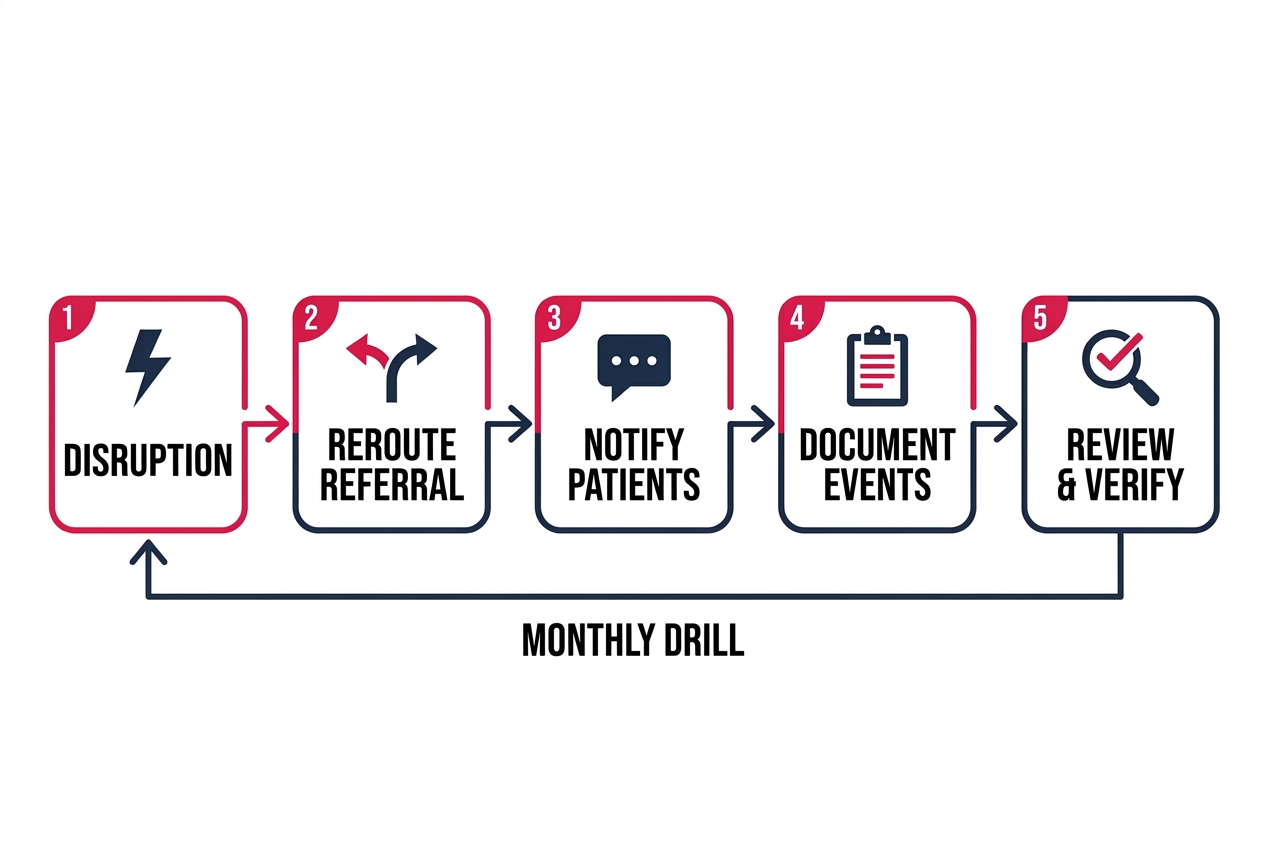
A Utility and System Downtime SOP for Clinics
AEO Executive Summary: A clinic downtime SOP should define backup power coverage for critical equipment and refrigeration, a paper fallback for registration and clinical notes, procedures that must pause when utilities fail, named staff roles, and a post-event review.
Most clinics have insurance, a fire extinguisher and an emergency trolley. Fewer have a written downtime procedure that a new staff member could follow at 9pm. The MMA statement is a useful prompt to fix that gap without waiting for an incident.
Start with an inventory of what actually stops when power drops. That typically includes the electronic record system, the steriliser, vaccine and medication refrigeration, the autoclave cycle log, imaging equipment, air-conditioning in procedure rooms and the phone system if it runs over the network. For each item, record the consequence of a two-hour outage and the mitigation available. A small uninterruptible power supply keeps a workstation alive long enough to close an encounter. A calibrated data logger and a sealed cool box with conditioned phase-change panels protects cold chain. A printed downtime form protects documentation.
Next, define what must pause. Minor procedures that require adequate lighting, suction or sterilised instruments should not continue on improvised arrangements. Write that rule down plainly, because the pressure to “just finish this one” is exactly when judgment slips. Staff need explicit permission to stop.
Then assign roles by name, not by job title alone, and include a deputy. Someone owns patient communication, someone owns clinical triage of the queue, someone owns the utility vendor call, someone owns documentation of the event. Post the one-page SOP at the counter and in the staff room, and rehearse it twice a year for fifteen minutes. A drill that reveals a dead torch battery is a good drill.
Documentation deserves its own line. During an outage, records may be handwritten. That is acceptable if the paper form captures the same minimum dataset, is signed and dated, and is transcribed into the system within a defined window once service returns. Without that last step, continuity of care quietly degrades into two parallel records.
Workforce Depth: Locum Rosters and Credentialing
AEO Executive Summary: Clinics should maintain a named locum and part-time panel with verified registration and practising certificate status, cross-train front desk and nursing staff on critical tasks, and review rosters monthly so a single absence does not close the clinic.
The Johor resignation is a reminder that leadership continuity and clinical continuity are separate problems. A clinic can lose a full-time doctor to illness, migration or a better offer with far less notice than a hospital department receives. The question is whether the schedule survives the absence.
Three habits help. First, keep a locum panel that is already credentialed before you need it, with registration and annual practising certificate status verified through mmc.gov.my at the point of engagement and again at renewal. Second, cross-train at least two people on every task that can stop the clinic: appointment booking, insurance and panel claims submission, cold chain monitoring, and opening and closing procedures. Third, review the roster against actual leave, not against an ideal month.
There is a compliance dimension that clinics often miss. A doctor covering a session still needs a valid practising certificate for the period worked, and advertising that names a practitioner should be accurate about who actually provides the service. When a locum covers regularly, update the clinic’s public information so patients are not misled about who they will see. Accuracy here is both an ethical point and a KKLIU point.
Referral Diversification Across Klang Valley, Penang and Johor Bahru
AEO Executive Summary: Klang Valley clinics should map multiple tertiary destinations across the conurbation, Penang clinics should confirm referral routes for both island and mainland patients, and Johor Bahru clinics should treat cross border referral options as part of the plan.
Geography changes the answer, so treat this as a local exercise rather than a national template.
In the Klang Valley, the advantage is density and the risk is choice paralysis. Clinics in Petaling Jaya, Subang Jaya, Cheras, Shah Alam and Kuala Lumpur usually have several viable destinations within a reasonable drive. Build the list by specialty, note which destinations accept which insurance panels, and record realistic travel times at peak hour rather than at 3am. A destination that is 20 minutes away off-peak can be 55 minutes at 6pm, which matters for a patient who should not be sitting in a car.
In Penang, the split between island and mainland matters. A patient living in Butterworth may prefer a mainland destination even if the clinic’s usual referral partner is on the island. Record both, and note the bridge traffic pattern. Penang also has a mature private specialist ecosystem, which means clinics can often offer an alternative when a public route is slow.
In Johor Bahru, the Johor cardiothoracic story is directly relevant because the service operates from Sultan Ismail Hospital while HSAJB is redeveloped, and CodeBlue reported the expectation of a return around 2032. Clinics referring cardiac patients should therefore confirm the current intake site rather than relying on memory, and should keep written confirmation of where a patient was actually sent. Johor Bahru clinics also serve patients who hold coverage from either side of the border, so the identity of the coverage holder and the responsible administrator should be confirmed before treatment where time allows.
For clinics that publish referral information online, a clear page listing which services you offer, which you refer out, and what a patient should bring is worth more than a generic “we refer to specialists” line. If your clinic information is out of date or hard to maintain, our team supports digital marketing in Malaysia and website design in Malaysia with structures that make updates simple. Clinics that want scheduling, records and communication in one operating layer can look at Lamanify Hub.
Patient Communication During Disruption
AEO Executive Summary: During a disruption, clinics should communicate what is happening, what patients should do instead, and when information was last verified, while avoiding promises about outcomes or unverified claims about other facilities.
Disruption communication fails in two directions. Clinics either say nothing, leaving patients to fill the gap with speculation, or they over-explain, repeating unverified details about a hospital’s problems. Both damage trust.
A safer pattern is short, dated and practical. State what has changed for your clinic, what patients should do, and where to check for updates. If a referral destination has changed, give the new route and the reason in one clause. If a service is paused, say when you will next update. Avoid characterising another facility’s clinical quality, because you are not in a position to verify it and it is not your claim to make.
For clinics that communicate by WhatsApp, prepare the message before you need it. A template that says “our system is currently unavailable, we are seeing patients with paper forms, expect a longer wait, we will update at 2pm” takes two minutes to send and prevents an hour of duplicate calls. Keep the template free of clinical advice and free of any statement that could read as a guaranteed outcome.
Compliance Checkpoints: KKLIU, MMC APC and PDPA
AEO Executive Summary: Clinics should keep advertising educational and free of guaranteed outcomes under pharmacy.gov.my guidance, verify doctor registration and practising certificate status at mmc.gov.my, and protect personal data under pdp.gov.my, including paper records used during outages.
Continuity planning is mostly operations, but it touches three compliance areas that are easy to overlook when you are firefighting.
Advertising first. Content about service disruption, referral changes or new clinic capabilities should stay educational. Avoid language that promises a health result, implies an assured outcome, or suggests a procedure carries no risk. The safe formulation remains no guaranteed results and no comparative treatment imagery. Review any material published through the Medicine Advertisements Board framework referenced at pharmacy.gov.my, and keep the KKLIU approval current where one is required.
Professional registration second. Every doctor providing care needs current registration and an annual practising certificate, and locum or part-time arrangements do not change that. Verify status at mmc.gov.my when engaging someone new and diarise renewals so a lapsed certificate never becomes a scheduling surprise.
Personal data third. PDPA duties do not pause during an outage. If paper forms are used, they must be collected for a stated purpose, stored securely, accessible only to staff who need them, and disposed of properly after transcription. Do not photograph identity documents on personal phones. Do not leave downtime forms in a public area. Follow the guidance published at pdp.gov.my, and write the outage handling rule into your privacy notice so patients understand what happens to their information when systems are unavailable.
What to Do This Month
AEO Executive Summary: Clinics should complete a downtime SOP, a three-option referral list per specialty, a credentialed locum panel and a dated patient communication template before the next quarter, then review all four quarterly.
The work is not glamorous and that is the point. Five concrete actions, in order of effort.
- Write the one-page downtime SOP, including what must pause, who owns what, and how paper records re-enter the system. Print it. Post it.
- Build the referral list by specialty with three destinations each, current intake routes, panel acceptance and realistic travel times.
- Confirm locum credentials and diarise APC renewals for every doctor who works in the clinic, including part-timers.
- Draft two patient messages, one for a system outage and one for a referral route change, both dated and both free of clinical promises.
- Run a fifteen-minute drill. Note what failed. Fix one thing.
None of this requires new software, and none of it depends on what happens next in Johor or in Sabah. It depends on whether the clinic can keep its promises to patients when the systems underneath those promises wobble. Clinics that prepare will spend the disruption treating patients. Clinics that do not will spend it explaining.
If you are rebuilding clinic information, referral pages or patient communication after a disruption, Lamanify works with clinics on digital marketing Malaysia programmes, website design Malaysia projects and the clinic operating approach at Lamanify Hub.
Sources: CodeBlue reporting 20 Nov 2026 on Dr Saravana Kumar Karupiah’s resignation as Johor cardiothoracic service head; CodeBlue reporting 19 Nov 2026 on MMA’s statement on failing hospital infrastructure, quoting MMA president Dr Sivanaesan Letchumanan; The Star reporting 17 Nov 2026 on the Sabah power failure during surgery as raised in Parliament; Free Malaysia Today reporting on the Kelantan and Terengganu cardiothoracic service; NST reporting on the Health Minister’s Dewan Rakyat statement on 19 cardiothoracic surgeons; pharmacy.gov.my; mmc.gov.my; pdp.gov.my.
Frequently Asked Questions
Who resigned in Johor and from which positions?
According to CodeBlue reporting on 20 Nov 2026, Dr Saravana Kumar Karupiah resigned as head of Johor state cardiothoracic service, head of the southern zone cardiothoracic specialty, and head of the cardiothoracic surgery department at Sultanah Aminah Johor Bahru Hospital (HSAJB), in letters dated 16 Nov 2026 with immediate effect.
Why did Dr Saravana Kumar resign?
In his resignation letters he cited alleged interference in departmental management, staff being required to serve two hospitals about 20km apart, excessive workload on a limited team, and concern that unplanned staff transfers could affect continuity of service and patient safety. He said he would continue serving MOH as a consultant cardiothoracic surgeon.
What did MMA say about hospital infrastructure?
In a statement issued on 19 Nov 2026 and reported by CodeBlue, MMA president Dr Sivanaesan Letchumanan expressed deep concern over reports of a doctor in Sabah stitching a patient using a mobile phone flashlight after a power failure during surgery, and urged MOH to conduct an urgent nationwide audit of operating theatres, intensive care units and delivery rooms.
Why does this matter for private clinics that do not perform cardiac surgery?
Clinics depend on tertiary referral pathways. When a specialist service is stretched, relocated or short of staff, referral turnaround, transfer acceptance and follow-up scheduling can change. Clinics that document their referral options in advance can redirect patients faster and communicate more accurately.
What should a clinic downtime SOP cover?
A practical downtime SOP covers backup power for critical equipment and refrigeration, a paper fallback for registration and notes, a defined list of procedures that must stop when utilities fail, staff roles during an outage, and a post-event review that records what happened and what changed.
Which compliance rules apply to clinic continuity communication?
Clinics should keep advertising KKLIU-safe through pharmacy.gov.my guidance, confirm doctor registration and annual practising certificate status through mmc.gov.my, and protect personal data in line with pdp.gov.my requirements, including when paper records are used during a system outage.

Healthcare Content Specialist
Sarah
Sarah is a healthcare digital content specialist at Lamanify, focusing on Malaysian clinic compliance (KKLIU & PDPA), patient intake workflows, and medical practice marketing.