
The Malaysian Medical Council’s renewal window for the 2027 Annual Practising Certificate closes on 30 November 2026. For private clinics across the Klang Valley, Penang, and Johor Bahru, that leaves roughly three weeks to confirm every practitioner on the roster has a complete application, a valid indemnity certificate, and the continuing professional development evidence the regulator expects to see.
This is not a back-office formality. A lapsed APC is the point at which a clinic’s operating licence, its rota, its prescribing chain, and its public claims all become exposed at the same time. The 2026 cycle already demonstrated how quickly that cascades: a processing backlog at the regulator became a national story about doctors practising on expired certificates, and the Ministry of Health had to publish a position on enforcement.
Here is the operational brief for clinic directors and practice managers who have not yet closed the file.
What the 30 November 2026 deadline actually covers
Quick answer: The 2027 APC renewal window closes on 30 November 2026. Practitioners who miss it face a late fee, and any clinical work performed before the certificate is issued sits outside the protection of a valid APC.
The Malaysian Medical Council’s APC page sets out the renewal requirements under Regulation 28 of the Medical Regulations 2017. Two supporting documents are mandatory with the application: a professional indemnity cover certificate, and evidence of CPD points for the relevant cycle. The Council’s October 2026 notice on 2027 renewals restates the 30 November cut-off and confirms that a late fee applies to applications received afterwards.
Three points are easy to miss:
- The deadline is not the issuance date. A complete application submitted before 30 November is not the same as an APC in hand. Clinics should track both the submission date and the issue date, because the second is what a CKAPS inspection will ask for.
- The late fee is not a grace period. Paying it does not retroactively authorise practice in the gap.
- Renewal is individual, not facility-level. Each practitioner holds their own certificate. A clinic with twelve doctors has twelve separate files to close.
Why the 2026 backlog matters for 2027 planning
Quick answer: In early 2026, a large APC processing backlog led the Malaysian Medical Council to forgo disciplinary action against doctors who applied completely by 31 December 2025, and CKAPS said it would not enforce against facilities in that situation. That forbearance was tied to a specific set of conditions.
The sequence is worth restating because it shaped how many practices now plan. In January 2026, CodeBlue reported that the Ministry of Health’s medical practice division would not take action under Section 31(1)(c) of the Private Healthcare Facilities and Services Act 1998 against private facilities engaging doctors still waiting for their 2026 certificate. The condition was narrow: the application and payment had to have been made on or before 31 December 2025 and the file still had to be in process in the MeRITS system.
The Council’s position at the time was similarly conditional. It said it would refrain from disciplinary action where a complete application had been submitted by the deadline and requirements were met, and that for those complete applications the effective date of the certificate would run from 1 January 2026 or the start of indemnity coverage, rather than the date of issue.
Two operational lessons follow, and both apply directly to the 2027 cycle:
- The forbearance was about processing delay, not about late applicants. A doctor who had not applied by the cut-off was not covered by it.
- The regulator has not published an equivalent blanket arrangement for 2027. As of 9 November 2026 there is no announced 2027 forbearance, so a clinic that plans on the assumption of one is planning on an assumption that does not currently exist.
The three-part test under Regulation 28
Quick answer: A 2027 application is complete when it carries current registration, at least 20 CPD points from the active cycle, and a valid professional indemnity certificate. Missing any one of the three renders the file incomplete.
Regulation 28 of the Medical Regulations 2017 sets the documentary standard. In practice, clinic administrators should verify the following per practitioner.
Part one: registration status
Confirm the practitioner’s registration is current and that the name on the application matches the registration record exactly. Discrepancies in name formatting, identity card details, or qualification entries are a common cause of a file being returned rather than processed, which is functionally the same as a late application once the calendar runs out.
Part two: CPD points
The Council’s CPD Guidelines require a minimum of 20 points collected within the applicable cycle. The cycle runs 1 July to 30 June, which means the points that support a 2027 renewal are those accrued across the year ending 30 June 2026.
This is the single most common failure point in a December scramble. Points earned in July or August 2026 do not repair a shortfall in the cycle that has already closed. If a practitioner is short, the honest options are to discuss the position with the Council and document the plan, not to backfill entries.
Part three: professional indemnity
The indemnity certificate must be valid and must cover the period the application relates to. Three practical checks:
- Continuity of cover. Look for a gap between the expiry of the previous policy and the inception of the new one. A two-week gap in the middle of the year is still a gap.
- Scope of cover. A policy written for a different scope of practice, such as a GP policy covering a doctor who now performs aesthetic procedures, is a compliance problem even if the certificate is current.
- Locums and part-timers. Every doctor who sees a patient needs their own cover in place, including sessional locums brought in to cover leave.
The CPD rule is about to change shape
Quick answer: The Malaysian Medical Council approved a new MMC-CPD Grading System at its 465th meeting on 21 April 2026, effective 1 July 2026. The Council has described 1 July 2026 as the initial collection date for the APC 2028 cycle.
This is the part most clinics have not yet internalised. The grading framework changes how CPD activity is categorised and weighted, and the new collection period began on 1 July 2026 — months before many practices updated their internal CPD tracking.
The implication for a clinic is straightforward but easy to defer: the way you logged points for the 2027 renewal is not necessarily the way the 2028 renewal will be assessed. Practice managers should confirm now that their doctors understand the new categories, that the activities being booked in the second half of 2026 map onto them, and that someone is checking the running total monthly rather than annually.
A simple monthly CPD review at the practice meeting, five minutes per doctor against the myCPD record, is cheaper than an emergency programme in June.
What Act 586 means for the facility, not just the doctor
Quick answer: Section 31(1)(c) of Act 586 obliges a licensed private healthcare facility to ensure the people it employs or engages are registered under the law regulating them. A doctor practising without a valid APC puts the facility’s own compliance position at risk.
The doctor carries the personal regulatory exposure. The clinic carries a separate exposure under the facility licensing framework administered by CKAPS, the Private Medical Practice Control Section within the Ministry of Health’s medical practice division.
That distinction is why a “we’ll sort it out in January” approach is a governance failure rather than an administrative one. The facility’s obligation is to ensure registration, not to hope for it. In practical terms this means a clinic should be able to produce, on request, a current APC for every practitioner on its roster, with the indemnity certificate attached.
For multi-branch groups in the Klang Valley, Penang, and Johor Bahru, the risk compounds: a single practitioner covering three branches generates three sets of exposure, and the credential file has to follow the doctor, not the building.
The non-doctor credentials that expire on the same calendar
Quick answer: Pharmacists renew an Annual Retention Certificate that requires a minimum of 30 CPD points across two years, and poison licences are renewed annually through MyPharma-C 2.0. Clinics that treat credentialing as a doctors-only exercise leave these gaps open.
Three adjacent deadlines belong in the same tracker.
Pharmacy Board Malaysia. The Board’s CPD framework sets a minimum of 30 CPD points collected within two years for the Annual Retention Certificate application and renewal. For a clinic with an in-house dispensary, the pharmacist’s retention status is as operationally critical as any doctor’s APC.
Poison licence renewal. Licences under the Poisons Act 1952 are renewed annually, and the renewal window closes at the end of December. A dispensary operating on an expired licence is a dispensing compliance problem regardless of how well the clinical roster is managed.
Allied health access to myCPD. A Ministry of Health notice dated 3 September 2026 states that allied health professionals who are not regulated under Act 774 and who serve outside the Ministry will no longer have access to the myCPD system from 1 November 2026. Clinics employing dietitians, physiotherapists, or other allied health staff in that category need an alternative CPD record-keeping arrangement, starting now rather than at the next audit.
Where PDPA enters the credential file
Quick answer: Practitioner credential records contain personal data. Under the Personal Data Protection (Amendment) Act 2024, controllers must notify the Commissioner of a qualifying breach within 72 hours, and organisations processing substantial personal data must appoint a Data Protection Officer.
Credential files are ordinary personal data: names, identity numbers, registration numbers, employment history, sometimes copies of identity documents. Once a clinic digitises them — which is the correct operational choice — they sit inside the Personal Data Protection Act 2010 framework as amended.
Two obligations now carry real weight:
- Breach notification. Since 1 June 2025, a data controller that has reason to believe a personal data breach has occurred must notify the Personal Data Protection Commissioner as soon as practicable and within 72 hours where the threshold is met. A shared drive of scanned APC certificates and identity cards is exactly the kind of store that turns a credential audit into a breach notification.
- Data Protection Officer. The Commissioner’s guidance makes DPO appointment mandatory from 1 June 2025 for controllers processing substantial personal data. A clinic group with thousands of patient and staff records falls inside that description.
The practical fix is unglamorous: restrict the credential folder to named administrators, remove identity document copies once verification is complete, keep the verification note rather than the document, and record who accessed the file and when.
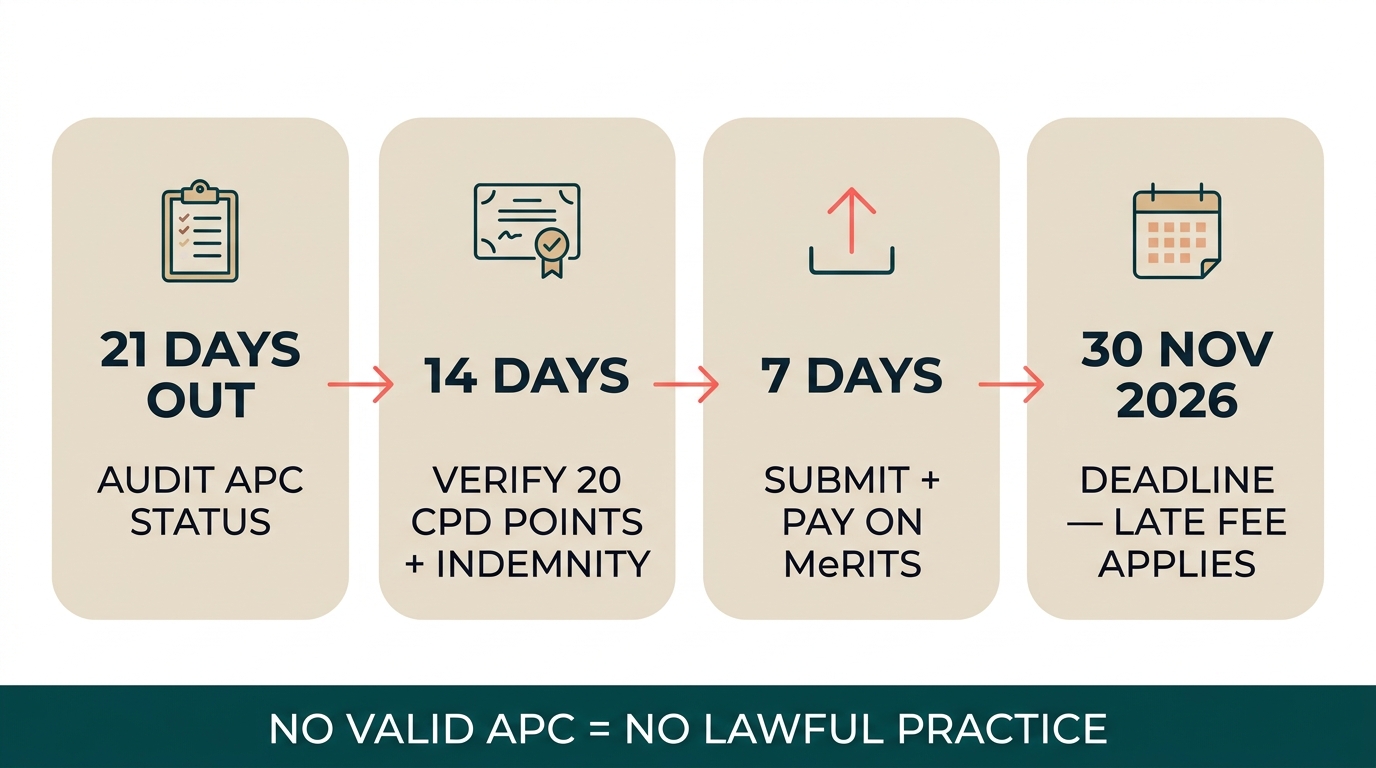
The 21-day clinic sprint
Quick answer: The remaining window supports a five-stage sequence: audit the roster, verify CPD and indemnity per doctor, submit and pay, then confirm issuance, with a contingency rota prepared before it is needed.
| Stage | Owner | By | Output |
|---|---|---|---|
| Roster audit | Practice manager | 12 Nov 2026 | Every practitioner listed with submission status |
| CPD verification | Each practitioner, checked by admin | 17 Nov 2026 | Running point total per doctor against the closed cycle |
| Indemnity check | Admin and broker | 19 Nov 2026 | Certificate on file, no continuity gap |
| Submission and payment | Practitioner | 24 Nov 2026 | MeRITS acknowledgement filed centrally |
| Issuance follow-up | Practice manager | 30 Nov 2026 | Certificate number recorded per doctor |
| Contingency rota | Clinical lead | 27 Nov 2026 | Named cover if any file is unresolved |
Two elements of that plan do most of the work. First, the audit is centralised: the practice manager holds the status of every file, not each doctor separately. Second, the contingency rota is prepared before it is needed, because the alternative — discovering on 1 December that two doctors cannot lawfully see patients — is a scheduling problem with a compliance consequence.
What this means for clinic marketing
Quick answer: Public claims about practitioner credentials must be accurate at the moment they are published. A clinic that advertises “MMC-registered doctors” while a roster member’s APC is in renewal limbo is making a claim it cannot support.
This is where credentialing and marketing intersect, and where the Medicine Advertisements Board framework and the Malaysian Medical Council’s ethical guidance both apply. A few operating rules keep clinics on the right side of it.
- Do not advertise credentials you cannot evidence on the day of publication. “All our doctors are MMC-registered” is a factual claim, not a slogan. It has to be true for every doctor named on the page.
- Do not use superlatives about your practitioner panel. Claims such as “the most experienced panel in Kuala Lumpur” are precisely the kind of self-laudatory statement the Council’s code cautions against.
- Keep practitioner bios current. A profile page naming a doctor who has left the practice, or whose registration has lapsed, is both a marketing inaccuracy and a compliance finding.
- Separate education from promotion. Explaining what an APC is, as this article does, is educational. Advertising a “renewal service” with a success claim is an advertisement, and it needs the appropriate treatment.
Clinics running paid search and social campaigns across the Klang Valley, Penang, and Johor Bahru should add a credential check to the campaign approval step. It takes ten minutes and prevents a live ad from contradicting the clinic’s own compliance file. Our digital marketing for Malaysian healthcare practices and clinic website design teams build that check into the publishing workflow, and LamaniHub keeps practitioner records, rosters, and consent documentation in one operating system rather than in three spreadsheets and a shared drive.
City-level notes for multi-branch operators
Klang Valley. The densest concentration of sessional and locum arrangements in the country sits here, which means the highest proportion of doctors whose APC is administered by someone other than the clinic. Confirm the locum’s certificate directly rather than accepting an agency assurance.
Penang. Practices serving a mix of local and medical-tourism patients should check that indemnity cover matches the scope actually performed, particularly where aesthetic or day-care procedures have been added to a general practice policy.
Johor Bahru. Cross-border patient flow means records frequently contain both Malaysian and Singaporean identifiers. That widens the personal data footprint and makes the PDPA handling rules above more rather than less relevant.
The bottom line
The 2027 APC deadline is a fixed date with a known consequence, and the work required to meet it is not complicated — it is simply distributed across too many people to be left unmanaged. A clinic that centralises the file, verifies CPD against the correct cycle, checks indemnity for continuity and scope, and prepares a contingency rota will close the year without drama.
A clinic that waits will spend December discovering which of its doctors cannot lawfully see patients, and January explaining why.
This article is an operational briefing for clinic administrators and does not constitute legal advice. Practitioners should confirm their individual position directly with the Malaysian Medical Council.
Frequently asked questions
When exactly does the 2027 APC window close?
30 November 2026. Applications received after that date attract a late fee, and practice before the certificate is issued is not covered by a valid APC.
Which CPD cycle counts for the 2027 renewal?
The cycle running 1 July to 30 June. For a 2027 renewal, the relevant points are those collected in the year ending 30 June 2026, with a minimum of 20 points required under Regulation 28 of the Medical Regulations 2017.
Can a clinic be penalised for a doctor’s lapsed APC?
Yes, in principle. Section 31(1)(c) of the Private Healthcare Facilities and Services Act 1998 requires a licensed facility to ensure the practitioners it employs or engages are registered under the relevant law. CKAPS administers that obligation.
Did the 2026 forbearance carry forward to 2027?
No announcement to that effect exists as of 9 November 2026. The 2026 arrangement was conditional on a complete application and payment by 31 December 2025 with the file still in process, and it addressed processing delay rather than late submission.
What should a clinic do if a doctor is short of CPD points?
Contact the Malaysian Medical Council directly, document the position and any agreed plan in writing, and treat the practitioner’s roster status as unresolved until the Council confirms otherwise. Do not backfill CPD entries.
Frequently Asked Questions
When is the deadline to renew the 2027 Annual Practising Certificate (APC) in Malaysia?
The Malaysian Medical Council's renewal window for the 2027 APC closes on 30 November 2026. Applications submitted after that date attract a late fee, and a practitioner cannot lawfully practise until the certificate is issued.
How many CPD points do doctors need for APC renewal in Malaysia?
Regulation 28 of the Medical Regulations 2017 requires applicants to submit evidence of at least 20 continuing professional development (CPD) points collected within the current CPD cycle, which runs from 1 July to 30 June, alongside a valid professional indemnity certificate.
Does a private clinic need to check doctors' APCs under Act 586?
Yes. Section 31(1)(c) of the Private Healthcare Facilities and Services Act 1998 requires a licensed facility to ensure that the practitioners it employs or engages are registered under the law regulating them, which includes holding a valid APC.
Is there a grace period for late APC renewal in 2027?
The Malaysian Medical Council has not published an equivalent blanket forbearance for the 2027 cycle. The 2026 arrangement was explicitly tied to complete applications and payment made by 31 December 2025 and still being processed in MeRITS, so it cannot be assumed to carry forward.
What happens to a clinic's operations if a doctor's APC lapses?
The practitioner cannot lawfully practise, which means consultations, procedures, and prescriptions issued in that window become exposed. Clinics should plan rota cover in advance, because locum arrangements also depend on a valid APC and indemnity cover for the replacement doctor.

Medical Market Intelligence Lead
Jessica
Jessica covers private healthcare operations, digital health innovation, and search visibility trends for GP, dental, and aesthetic practices across Southeast Asia.