
On 2 November 2026, answering a question in the Dewan Rakyat, Health Minister Datuk Seri Dr Dzulkefly Ahmad put a set of numbers on the record that describe the enforcement environment every Malaysian clinic now trades inside.
The Pharmacy Enforcement Division had run 12 raids targeting the illegal sale of retatrutide, a GLP-1 related weight-loss drug that is not registered with the Drug Control Authority, and seized 697 units with an estimated value of 341,000 ringgit between 2025 and September 2026. Seven further operations against Ozempic and semaglutide products produced 62 units worth 64,170 ringgit. The same parliamentary answer repeated a figure that has been building quietly since 2023: 42,639 unapproved medical advertisements removed from e-commerce platforms, and enforcement action against a further 13,070 on social media, between January 2023 and December 2025.
Three weeks later, on 23 November 2026, the other half of that enforcement picture surfaced in a magistrate’s court in Ipoh: a man was fined 10,000 ringgit for possessing an unregistered slimming product. It was his fourth conviction for the same category of offence.
Read together, those two stories describe a shift that matters more to a neighbourhood clinic than to a hospital group. The product registration rules and the advertising approval rules are converging on the same surface — the clinic’s online storefront — and enforcement is now reaching individuals, not only companies.
What the Minister actually told Parliament
Quick answer: Between 2025 and September 2026, the Health Ministry ran 12 raids on unregistered retatrutide and seized 697 units worth 341,000 ringgit, while removing 42,639 unapproved medical advertisements from e-commerce platforms between 2023 and 2025.
The question came from Datuk Seri Dr Zaliha Mustafa, who asked whether arrests had followed the illegal online sale of regulated GLP-1 products, particularly after promotion by social media influencers.
| Enforcement metric | Figure | Period |
|---|---|---|
| Raids on illegal retatrutide sale | 12 | 2025 – September 2026 |
| Retatrutide units seized | 697 | 2025 – September 2026 |
| Estimated value of retatrutide seized | 341,000 ringgit | 2025 – September 2026 |
| Operations against Ozempic and semaglutide | 7 | Same period |
| Units and value seized in those operations | 62 units / 64,170 ringgit | Same period |
| Unapproved medical advertisements removed from e-commerce | 42,639 | January 2023 – December 2025 |
| Enforcement actions on social media advertisements | 13,070 | January 2023 – December 2025 |
| Special drug approval applications approved | 240 (2.56 million ringgit) | January – September 2026 |
Two details in the Minister’s answer deserve more attention than the headline seizure value. First, the prohibition on retatrutide is not limited to selling it. The Ministry has said the drug cannot be imported, marketed or supplied in Malaysia while it remains unregistered. Second, the Ministry said it would keep stepping up monitoring of e-commerce and online platforms. That is a statement about where the next round of enforcement is aimed.
The 10,000 ringgit possession case that clinics should read twice
Quick answer: Possessing an unregistered medicine is an offence in its own right. A man was fined 10,000 ringgit in Ipoh after pleading guilty to possession of an unregistered slimming product, and he had three previous convictions for similar offences.
The facts, as reported by The Star on 23 November 2026, are short. The individual pleaded guilty at the Ipoh Magistrate’s Court on 10 November, following prosecution by the Perak State Health Department’s Pharmacy Enforcement Branch. The charge was brought under Regulation 30(1) of the Control of Drugs and Cosmetics Regulations 1984, for an offence under Regulation 7(1)(a): possession of an unregistered product.
The penalties are not trivial, and they escalate:
- First offence: a fine of up to 25,000 ringgit, imprisonment of up to three years, or both.
- Subsequent offence: a fine of up to 50,000 ringgit, imprisonment of up to five years, or both.
The Perak Health Department also confirmed that no retatrutide product had been registered with the Drug Control Authority, and that the substance remains an investigational medicine in Phase 3 trials without marketing approval from any regulator worldwide.
For a clinic, the uncomfortable part is the word “possession”. Stock in a back room, a sample left by a sales representative, a box a patient asked the clinic to hold, a product bought at a discount for a “trial” — each of those is possession of a product that either is registered or is not. The regulations do not create a general exemption for stock held on a patient’s behalf. The status that matters is the registration status, and it is checkable before the box is opened.
Four registers, four different numbers
Quick answer: There is no single “approved by the Ministry” status. Medicines, cosmetics, medical devices, and poisons each sit on a different register, with a different number and a different law.
This is the source of most of the confusion we see in clinic marketing files. A supplier says the product is “KKM registered” and sends a certificate. The certificate is for the company. The product may still be unregistered, and the advertisement promoting it is a separate approval altogether.
| What you sell | Where the status lives | What the customer-facing number looks like | Governing instrument |
|---|---|---|---|
| Medicine (prescription or over-the-counter) | NPRA product register, on behalf of the Drug Control Authority | MAL registration number on the pack; KKLIU number on any advertisement | Sale of Drugs Act 1952; Control of Drugs and Cosmetics Regulations 1984; Medicines (Advertisement and Sale) Act 1956 |
| Cosmetic | NPRA notification | Notification number, not a MAL number | Control of Drugs and Cosmetics Regulations 1984 |
| Medical device | Medical Device Authority register | Registration number, plus “Registered under Act 737” in the advertisement | Medical Device Act 2012 (Act 737) |
| Poison or controlled medicine | Poisons Act licensing and prescription records | Premises licence and prescription requirement, not a marketing number | Poisons Act 1952 |
| Traditional or complementary product | NPRA registration where the product is caught | MAL number where registered | Control of Drugs and Cosmetics Regulations 1984 |
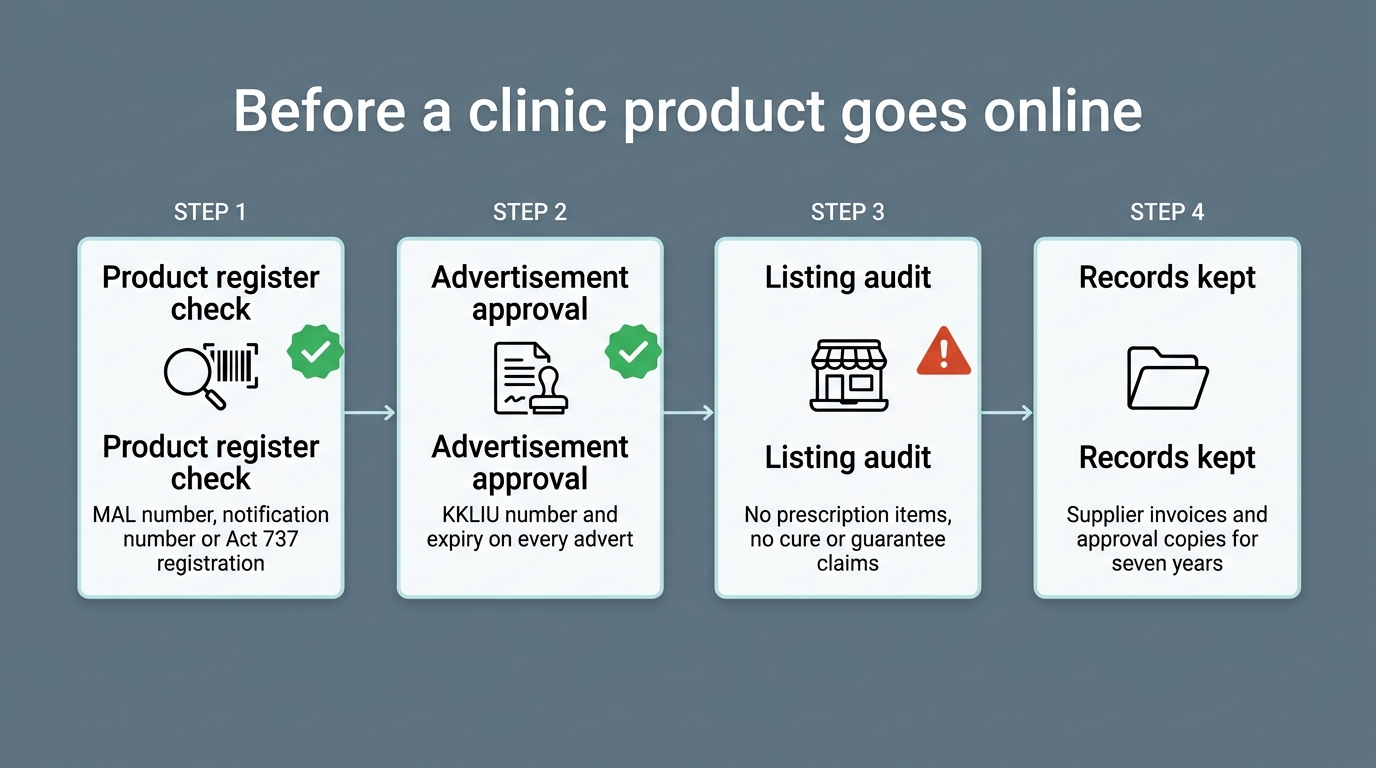
The practical discipline is simple to state and tedious to run: reconcile every product on the shelf and every product on the website against the register that governs it, and record the date you checked. The National Pharmaceutical Regulatory Agency publishes a public product search for medicines and cosmetics, the Medical Device Authority publishes its device register, and the Pharmacy Services Programme publishes the list of advertisements approved by the Medicine Advertisements Board.
Why an online listing is an advertisement
Quick answer: Malaysian law defines an advertisement widely enough to cover a shop listing, a video, a label and a social post. Approval attaches to the advertisement, and the approval number and its expiry date have to be shown clearly.
The Medicines (Advertisement and Sale) Act 1956 defines an advertisement to include a notice, a label, a wrapper and an announcement by any means, and the Ministry counts internet media within that definition. A marketplace listing with a product title, a photograph and a claim is not a shop sign. It is an advertisement for a medicine.
Three consequences follow, and they are the ones clinics most often miss:
- Registration and advertising are separate approvals. A registered medicine still needs an approved advertisement. A supplier’s product registration certificate says nothing about the copy your clinic wrote.
- The number has to be visible. An approved advertisement carries a KKLIU number and an expiry date, and the Ministry’s guidance is that the number must be displayed clearly on the advertisement. Burying it in an image footer or a terms page is not display.
- An expired approval is not an approval. KKLIU numbers encode a year, and approvals run to an expiry date. A listing that stayed live while the approval lapsed is an unapproved advertisement with a paper trail attached to it.
The corollary for clinic managers: the approved-advertisement list is public. Before a product goes live, check that the exact advertisement you intend to run matches an entry on that list, for that product, for that period.
The seven checks before a product goes live
Quick answer: Audit the listing against the regulator’s record, not against what the supplier told your purchasing officer.
- Product identity. The brand name, variant and pack size on the listing must match the registered product exactly. Parallel imports and repackaged units frequently do not.
- Registration evidence. Save a dated screenshot or printout of the register entry, not just the supplier’s letter. The register is the source; the letter is a claim about the source.
- Supplier legitimacy. Importers and distributors of medical devices require an establishment licence and good distribution practice. A clinic buying from an unlicensed distributor inherits the product risk even when its own paperwork looks complete.
- Advertisement approval. Confirm the KKLIU number exists on the Medicine Advertisements Board list, that it covers this product, and that it has not expired.
- Claim discipline. Language must stay inside the approved indication. Comparative superiority, outcome promises and implied treatment of named conditions take an advertisement outside its approval regardless of how the product is registered.
- Prescription-only separation. Prescription medicines may not be advertised to the general public. A public listing, a price, a bundle or a “message us to order” prompt on a prescription item is the pattern enforcement teams are trained to look for.
- Records. Keep supplier invoices, batch and expiry details, registration printouts, approval copies and the date each check was performed. Retain them for as long as the product is sold and for the period your clinical record policy requires, which for most Malaysian practices is at least seven years.
What the platforms are now doing
Quick answer: Marketplace operators have become the first layer of enforcement, using regulator lists and keyword filters, so a listing can be removed before a human being reads it.
During 2026 the Medical Device Authority began working directly with marketplace and short-video platforms on device listings, following raids on companies placing unregistered devices on the market. The mechanics described in the trade press are consistent across platforms: the regulator supplies its registration list and a list of terms that should not appear in listings, the platform filters and demerits sellers, and repeat breaches move from listing removal to account-level action.
That changes the economics of a compliance failure. A takedown is fast, an appeal is slow, and a demerit follows the seller account rather than the individual listing. For a clinic that has spent two years building a storefront, a keyword-triggered suspension is a revenue event, not a warning letter.
It also changes what “clean” means. A compliant listing is not one where the claims are defensible in a conversation with a regulator six months later. It is one where the title, the thumbnail and the first line of description contain nothing that a filter has been told to catch.
What this looks like across Klang Valley, Penang and Johor Bahru
Quick answer: The rules are national, but the enforcement exposure and the commercial pressure differ by market.
Klang Valley. The highest density of GP, aesthetic and specialist practice in the country, the largest volume of marketplace listings, and the shortest delivery times. A clinic in Petaling Jaya or Subang Jaya selling supplements or devices online is competing on the same shelf as national retailers, which pushes copy toward stronger claims. That is precisely the copy that gets filtered. The Selangor and Kuala Lumpur pharmacy enforcement branches are also the most active in the country, as the Damansara Utama and Shah Alam cases in 2026 showed.
Penang. A market where medical tourism, wholesale distribution and clinic retail overlap. Island practices frequently source products through Penang-based trading companies that also supply Singapore and Indonesia, and a product line that is lawful in one of those markets is not automatically registered here. Clinics should ask a Penang supplier for the Malaysian register entry, not the regional catalogue.
Johor Bahru. Cross-border demand from Singapore residents means clinics in JB are often asked to stock products a patient already uses across the causeway. Singapore’s Health Sciences Authority registration does not travel. A product registered in Singapore still needs its Malaysian registration, and the advertisement still needs its own approval, even when the audience is a single patient who asked on WhatsApp.
The PDPA layer that sits underneath all of this
Quick answer: An online order for a health product is personal data, sometimes sensitive personal data, and the amended Personal Data Protection Act now carries breach notification duties and materially higher penalties.
The PDPA amendments that came fully into force in 2025 raised the maximum penalty for a breach of the security principle to 1 million ringgit, three years’ imprisonment, or both, and introduced mandatory notification of personal data breaches to the Commissioner. For a clinic, the practical exposures are mundane:
- Order forms that collect a delivery address alongside a product that reveals a health condition.
- WhatsApp order threads kept on a staff member’s personal phone, outside any retention or access policy.
- Screenshots of order lists shared with a supplier for restocking.
- Marketing lists built from purchasers and then used for unrelated campaigns without fresh consent.
None of these requires a hacker to become a reportable incident. A misplaced phone or a shared spreadsheet is enough.
A 30-day remediation plan
Quick answer: Four weeks, four passes: inventory, register reconciliation, advertisement audit, then systems and staff briefing.
| Week | Work | Output |
|---|---|---|
| Week 1 | Inventory every product sold online and in clinic, including samples and consignment stock | A single product list with supplier, registration claim and quantity on hand |
| Week 2 | Reconcile each product against NPRA, MDA or Poisons records; quarantine anything unverified | A register with numbers, check dates and a quarantine shelf |
| Week 3 | Audit every live listing, page, video and broadcast against the approved-advertisement list; fix or unpublish | A screenshot log showing each advertisement’s KKLIU number and expiry |
| Week 4 | Move records into one system, set expiry reminders, brief reception and clinic assistants on what they may say online | Named owner, calendar reminders, and a short written script for staff |
The clinics that finish this in November will spend December trading. The clinics that start in January will spend the first quarter explaining a takedown.
What good looks like
A defensible online product line is not a legal department. It is a short set of habits: check the register before you buy, check the approval before you publish, keep the screenshot, and let the clinic’s systems do the remembering.
That last part is where most practices still fail. Registration numbers, approval expiries and supplier licences get recorded in three different places by three different people, and the person who knew where the file was leaves. A clinic operating system that holds product records next to inventory and supplier details turns a quarterly panic into a standing report.
For clinics reviewing the public-facing side of this, our guide to healthcare digital marketing in Malaysia covers how claims architecture is built to survive a staffing change, and the clinic website design work we do treats product pages as regulated advertising from the first wireframe. LamaniHub holds product, supplier and inventory records alongside the clinical and billing record, so the listing and the evidence behind it live in the same system.
Two earlier briefings in this series are worth reading alongside this one: the KKLIU social media enforcement guide covers the advertising rules in detail, and the GLP-1 compliance playbook covers the clinical and approval pathway for weight-management services. The medicine price display mandate explains the pricing rules that apply when a product is sold rather than prescribed.
The bottom line
In November 2026 the Health Ministry told Parliament, in one answer, both halves of its enforcement posture: 697 units of an unregistered drug seized at a value of 341,000 ringgit, and 42,639 unapproved advertisements pulled from e-commerce platforms. Ten days later a man in Ipoh was fined 10,000 ringgit simply for possessing an unregistered slimming product, for the fourth time.
The pattern is not a crackdown on rogue operators at the edge of the market. It is the normalisation of product and advertising compliance as a routine inspection surface, one that reaches clinics through the same storefronts they use to grow.
A clinic does not need to stop selling online. It needs to be able to show, on a Tuesday morning, that every product it lists is registered, every advertisement it runs is approved, and every record that proves both exists in a system it controls.
This article is an operational briefing for clinic administrators and does not constitute legal or regulatory advice. Practitioners and facilities should confirm the registration and advertising status of specific products directly with the National Pharmaceutical Regulatory Agency, the Medical Device Authority or the Pharmacy Enforcement Division.
Sources
- The Star (Nation), 2 November 2026 — Health Ministry seizes 341,000 ringgit worth of weight-loss drug retatrutide, Parliament told: thestar.com.my
- The Star (Nation), 23 November 2026 — Man fined 10,000 ringgit for possession of unregistered slimming product: thestar.com.my
- Pharmacy Services Programme, Ministry of Health Malaysia — Medicines (Advertisement and Sale) Act 1956 and Regulations, Medicine Advertisements Board, and approved advertisement search: pharmacy.gov.my
- Pharmacy Services Programme — Buying medicines online: guidance and enforcement: pharmacy.moh.gov.my
- National Pharmaceutical Regulatory Agency — public product search: npra.gov.my
- Medical Device Authority — registration and advertising requirements under Act 737: mda.gov.my
- Malaysian Medical Council — advertising and professional conduct guidance: mmc.gov.my
- Personal Data Protection Department — Act 709, as amended, and breach notification guidance: pdp.gov.my
Frequently asked questions
Can a Malaysian clinic sell medicines on Shopee, Lazada or TikTok Shop?
Only registered products, and only with advertisements that have been approved. A registered medicine still needs an approved advertisement showing its KKLIU number, and prescription medicines may not be advertised to the general public at all. Selling through a marketplace does not change any of those requirements.
Is a KKLIU number required on every online listing?
Yes, where the listing advertises a medicine. The Ministry’s guidance is that the approval number and its validity must be displayed clearly on the advertisement, and the approved-advertisement list is public, so a number that cannot be matched to an entry raises a question rather than answering one.
Does product registration cover the advertisement as well?
No. Registration and advertising are separate approvals with separate numbers. A supplier’s product registration certificate proves the product may be sold; it says nothing about whether the words and images in your listing are approved.
Is possessing unregistered stock an offence, or only selling it?
Possession is an offence under Regulation 7(1)(a) of the Control of Drugs and Cosmetics Regulations 1984, charged together with Regulation 30(1). A first offence carries a fine of up to 25,000 ringgit, imprisonment of up to three years, or both, with higher penalties for subsequent offences.
Do medical devices sold online need separate registration?
Yes. Under the Medical Device Act 2012, an unregistered device may not be placed on the Malaysian market, and public advertising of a registered device requires approval and must display the registration number and the words “Registered under Act 737”. Importers and distributors also require an establishment licence.
What records should a clinic keep for products it sells online?
Supplier invoices, batch and expiry details, dated printouts of the registration entry, copies of advertisement approvals with their expiry dates, and a log of who checked what and when. Retain them for as long as the product is sold and for the period your clinical record policy requires, commonly at least seven years.
Frequently Asked Questions
Can a Malaysian clinic sell medicines on Shopee, Lazada or TikTok Shop?
Only registered products, and only with advertisements that have been approved. A registered medicine still needs an approved advertisement showing its KKLIU number, and prescription medicines may not be advertised to the general public at all. Selling through a marketplace does not change any of those requirements.
Is a KKLIU number required on every online listing?
Yes, where the listing advertises a medicine. The Ministry's guidance is that the approval number and its validity must be displayed clearly on the advertisement, and the approved-advertisement list is public, so a number that cannot be matched to an entry raises a question rather than answering one.
Does product registration cover the advertisement as well?
No. Registration and advertising are separate approvals with separate numbers. A supplier's product registration certificate proves the product may be sold; it says nothing about whether the words and images in your listing are approved.
Is possessing unregistered stock an offence, or only selling it?
Possession is an offence under Regulation 7(1)(a) of the Control of Drugs and Cosmetics Regulations 1984, charged together with Regulation 30(1). A first offence carries a fine of up to 25,000 ringgit, imprisonment of up to three years, or both, with higher penalties for subsequent offences.
Do medical devices sold online need separate registration?
Yes. Under the Medical Device Act 2012, an unregistered device may not be placed on the Malaysian market, and public advertising of a registered device requires approval and must display the registration number and the words "Registered under Act 737". Importers and distributors also require an establishment licence.
What records should a clinic keep for products it sells online?
Supplier invoices, batch and expiry details, dated printouts of the registration entry, copies of advertisement approvals with their expiry dates, and a log of who checked what and when. Retain them for as long as the product is sold and for the period your clinical record policy requires, commonly at least seven years.

Healthcare Growth & Regulatory Analyst
Amin
Amin analyses healthcare marketing regulations, medical clinic technology, and patient acquisition systems across Malaysia.