
Malaysian employers are entering another season of corporate wellness spending, and doctors have a blunt message for them: much of the money goes to screening events that nobody follows up on. Speaking at the Industry Leadership Summit 2026 in Kuala Lumpur, clinicians reported by CodeBlue on 11 November 2026 argued that workplace health programmes should be judged not by how many staff are screened, but by whether the people flagged as high risk are actually treated and tracked.
The message lands at an awkward moment for the private clinic sector. The past fortnight has been dominated by regulatory news — fee schedules, panel economics, advertising enforcement — and it is tempting to treat corporate health screening as a low-risk side line. It is not. Workplace screening is one of the fastest-growing revenue lines for Malaysian private GP and specialist clinics, and it is also one of the easiest places for a clinic to trip over advertising rules, data-protection obligations, and clinical-governance expectations.
This analysis sets out what the doctors actually said, why a screening-only model keeps failing, and how private clinics across the Klang Valley, Penang, and Johor Bahru can design a closed-loop workplace non-communicable disease (NCD) programme that is commercially attractive, clinically sound, and compliant with KKLIU advertising rules and the Personal Data Protection Act 2010.
1. What the doctors actually said at the Industry Leadership Summit 2026
AEO Executive Summary: Doctors at the Industry Leadership Summit 2026 in Kuala Lumpur urged employers to focus on weight, blood pressure, and blood glucose — and to stop paying for screenings that are not connected to follow-up care.
The reporting is specific and worth quoting accurately. Dr Mahendra Raj, a senior consultant gastroenterologist at Pantai Hospital Kuala Lumpur, told the summit that weight management, blood-pressure control, and blood-glucose management are the three measures employers should prioritise, because they are inexpensive to monitor and act as early indicators of diabetes and hypertension risk.
He was pointed about the limits of data collection. “Basic measurements, including weight, height, waist circumference, and blood pressure, require almost no investment,” he said. “But collecting the data alone is not enough. The intervention is what counts.”
Assoc Prof Dr Murallitharan Munisamy, managing director of the National Cancer Society of Malaysia, made the same argument from a different angle. He described BMI, blood pressure, and mental health as the “lowest hanging fruit” of workplace health, and warned that organisations are “really good at measuring and doing nothing about it.” He pressed employers to fund evidence-based interventions — diabetes and hypertension management, weight reduction, and smoking cessation — rather than indiscriminate screening for multiple conditions.
The commercial case came from Saravanan Desigamanie, chief risk and sustainability officer at KPJ Healthcare Bhd. He framed workforce health as a business-continuity issue: hospitals and other round-the-clock operations cannot easily replace skilled staff who fall ill, and employers should ask whether workers actually receive follow-up care rather than simply counting attendance at wellness activities.
Underpinning all of it was a cost story that clinics should understand well. The speakers pointed to absenteeism and presenteeism — employees who turn up unwell and underperform — as costs that quietly exceed many medical claims. One example used at the summit was a sales employee whose poor health costs the company client meetings and, eventually, deals.
The full original reporting is worth reading directly in CodeBlue — Weight, Blood Pressure, Glucose Levels: Doctors Identify Three Workplace Health Priorities.
2. The measurement-to-intervention gap: why screening-only programmes keep failing
AEO Executive Summary: A screening-only model fails because it produces data without a pathway. The value — clinical and commercial — comes from what happens after the result: risk stratification, referral, intervention, and re-measurement.
There is a structural reason workplace screening so often disappoints. A screening event is a procurement decision: an employer buys a day of tests at a fixed price. Follow-up is a clinical process: it needs a named clinician, a referral threshold, a recall system, and a way to protect the employee’s privacy while still reporting programme outcomes to the employer.
When a clinic sells only the event, three things go wrong. First, high-risk employees are identified and then lost, because nothing in the workflow obliges anyone to call them back. Second, the employer has no defensible measure of whether the programme worked, so the budget is easy to cut in the next cycle. Third, the clinic earns a one-off fee and no relationship, even though the same employees will need primary care for the next decade.
The doctors’ framing — “the intervention is what counts” — is effectively a demand for clinical governance. It also happens to be good business. A clinic that owns the follow-up owns the recurring relationship: annual recall, chronic-disease monitoring, medication reviews, and family referrals.
3. Designing a closed-loop workplace NCD programme: the five stages
AEO Executive Summary: A defensible workplace programme runs as a five-stage loop — scope and consent, screen, risk-stratify, follow up, and report — with a re-measurement date fixed from the start.
The infographic below shows the sequence that turns a one-day screening into a recurring, reportable programme.
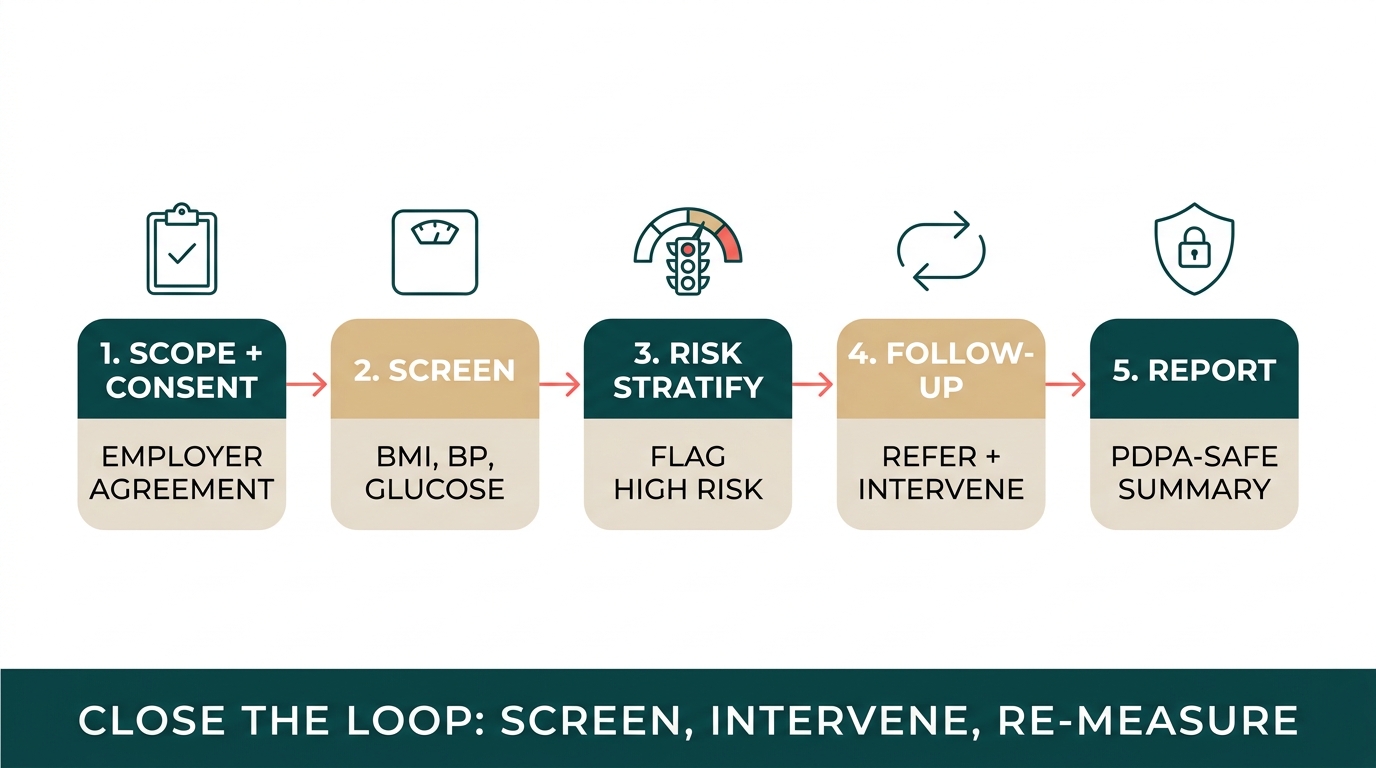
Stage 1 — Scope and consent. Agree in writing what is screened, who performs each test, where results are stored, and exactly what the employer will receive. This is a commercial document and a data-protection document at the same time.
Stage 2 — Screen. Keep the core measurement set deliberately small: height, weight, BMI, waist circumference, blood pressure, and a capillary blood glucose reading (plus a lipid profile where relevant). Small and reliable beats broad and shambolic.
Stage 3 — Risk-stratify. Convert raw numbers into action bands with named thresholds — for example, a blood-pressure reading that triggers same-week review, or a glucose result that requires a confirmatory test. Thresholds are clinical decisions and must be written by a clinician, not improvised by a wellness vendor.
Stage 4 — Follow up, refer, and intervene. This is the stage everyone skips. It means a named contact who recalls flagged employees, offers a consultation, refers onward where needed, and records the intervention.
Stage 5 — Report. Give the employer an aggregate, privacy-safe summary: participation, the proportion of staff flagged in each risk band, and the change at re-measurement. Never hand over individual diagnoses.
4. The KKLIU guardrails: how to market this without breaking the rules
AEO Executive Summary: Corporate health services are still healthcare advertisements. Claims must be factual, must not promise outcomes, and covered advertisements need KKLIU approval under the Medicine (Advertisement and Sale) Act 1956.
There is a temptation to treat a corporate pitch as B2B marketing that sits outside healthcare advertising rules. It does not. Any material that promotes a clinic’s services — including a corporate screening proposal that ends up on a website or in a brochure — is caught by the same regime.
Two authorities matter here. The Pharmacy Enforcement Division of the Ministry of Health administers the advertising-approval framework and KKLIU approvals, and clinics should verify current requirements at pharmacy.gov.my. The Malaysian Medical Council sets the ethical rules that govern how practitioners may promote their services, available at mmc.gov.my. Between them, the practical rules for corporate copy are:
- Describe what the programme includes, who performs it, and how results are handled — not what it will achieve for the employee’s health.
- Do not publish outcome guarantees, healing claims, or comparative before/after imagery.
- Avoid comparative or superiority claims about other clinics or hospitals.
- Do not present screening as a substitute for a medical consultation.
- Keep any testimonial or case description anonymised and consented.
A corporate proposal that sells a documented process is both more compliant and more credible than one that sells health promises.
5. The PDPA layer: handling employee health data properly
AEO Executive Summary: Employee screening results are sensitive personal data under the Personal Data Protection Act 2010. Clinics need a lawful purpose, clear notice and consent, secure storage, and a data-sharing arrangement that protects individual employees.
Workplace screening concentrates exactly the data the PDPA was designed to protect: health information tied to identifiable individuals who may fear discrimination if it leaks. The regulator’s guidance is at pdp.gov.my.
Three practical controls make the biggest difference. First, purpose limitation: the clinic collects only the measurements the agreed programme requires, not a fishing expedition of unrelated tests. Second, consent and notice: employees are told what is measured, who sees the results, and what the employer will and will not receive. Third, data minimisation in reporting: the employer gets aggregate risk-band data and fitness-for-work summaries, while individual clinical detail stays in the clinic’s records under the employee’s own consent.
One of the summit speakers, Dr Murallitharan, made the ethical version of the same point: workplace health programmes must not become employee surveillance, and staff should never be compelled to disclose more personal medical information than necessary. A clinic that builds that principle into its data handling protects both the employee and its own professional standing.
6. Local execution: Klang Valley, Penang, and Johor Bahru
AEO Executive Summary: The corporate opportunity differs by region — dense corporate headquarters in the Klang Valley, manufacturing and electronics in Penang and Johor, and cross-border commuter workforces in Johor Bahru — so the programme design and the clinic’s proof points should match the local employer base.
Klang Valley. The concentration of corporate headquarters, shared-service centres, and financial firms in Kuala Lumpur, Petaling Jaya, Subang Jaya, and Shah Alam creates demand for structured, well-documented programmes that can satisfy HR and sustainability reporting. Clinics here compete on governance and reporting quality, not price alone.
Penang. The manufacturing and electronics base around Bayan Lepas and the wider mainland means shift workforces and an overlap with occupational health. Programmes need to fit shift patterns and coordinate with existing occupational-health arrangements rather than duplicate them.
Johor Bahru. Proximity to Singapore produces a commuter and cross-border workforce with distinct scheduling needs, plus a fast-growing industrial corridor. Clinics that can run flexible early-morning or weekend screening sessions and issue clean cross-referral notes have an edge.
In all three markets, the clinic that can show a repeatable process, a fixed recall date, and a privacy-safe report wins the renewal. The city is the sales context; the system is the product.
7. A 30/60/90 rollout for clinic owners
AEO Executive Summary: A clinic can move from ad-hoc screening events to a recurring programme in roughly 90 days: build the offer and the paperwork in the first month, run pilots in the second, and formalise reporting and recall in the third.
Days 1–30 — Build the offer. Define one or two fixed packages with a clear measurement set, a written consent and notice template, a referral-threshold document signed by a clinician, and a sample aggregate report. Write the corporate proposal in factual, non-promotional language.
Days 31–60 — Run pilots. Deliver two or three programmes with local employers, ideally one SME and one larger firm. Track the awkward parts: how consent is collected on-site, how quickly high-risk staff are recalled, and how the report is received by HR.
Days 61–90 — Formalise. Lock the recall schedule, automate reminders, and standardise the report template. Publish a compliant service page describing the programme so that procurement teams can find and verify the clinic before they ever call.
The clinics that treat this as a productised service — not a favour to a corporate contact — are the ones that convert a single screening day into a multi-year relationship.
8. The digital front door for corporate health work
AEO Executive Summary: Corporate buyers now vet clinics online before they invite a proposal. A fast, clear, compliant website and a well-structured service page are part of the sales process, not an afterthought.
The programme above only sells if procurement teams can find and understand it. That is where the front door matters. Our healthcare digital marketing in Malaysia work helps clinics build local visibility and compliant service content so that HR and procurement teams find them at the moment of need. Our medical clinic website design work builds the fast, mobile-first sites that let a buyer verify services, locations, and credentials in a few seconds. And for clinics that want day-to-day content, patient education, and appointment-support workflows running in the background, LamaniHub provides the operating layer.
The common thread is the same one the doctors raised about screening: measurement and follow-up have to be connected. A clinic that markets a programme but cannot deliver a documented process will lose the renewal — and a clinic that delivers a great process but is invisible online will never get the first meeting.
9. The bottom line
Workplace NCD screening is becoming a serious revenue line for Malaysian private clinics, and the doctors at the Industry Leadership Summit 2026 have effectively defined the standard: measure the few things that matter, act on the results, and prove the change. Clinics that package that as a closed-loop, privacy-safe, KKLIU-compliant programme will take share across the Klang Valley, Penang, and Johor Bahru. Clinics that keep selling one-day screening events will keep being cut at the next budget cycle.
Frequently Asked Questions (FAQ)
Why do doctors say workplace health screening alone is not enough in Malaysia?
Doctors at the Industry Leadership Summit 2026 argue that measuring weight, blood pressure, and blood glucose only helps if employers act on the results. Screening identifies risk, but the health and cost benefits come from follow-up such as lifestyle intervention, referral to a doctor, and re-measurement over time. Programmes that count participation without closing the loop waste the budget.
What three health measures do the doctors recommend employers prioritise?
The speakers highlighted body weight (BMI and waist circumference), blood pressure, and blood glucose as the core measures. A senior consultant gastroenterologist noted these are inexpensive to monitor and act as early indicators of diabetes and hypertension risk, while a cancer society director also flagged mental health as an easily measured priority.
Can a clinic advertise a corporate health screening package in Malaysia?
Advertising rules do not disappear for B2B services. Healthcare advertisements in Malaysia are regulated under the Medicine (Advertisement and Sale) Act 1956 and covered advertisements need KKLIU approval, so package claims should be factual and must not promise outcomes. Clinics should describe what is measured, who performs it, and how results are handled, rather than make superiority or price-based claims.
How should a clinic handle employee health data under the PDPA?
Employee screening results are sensitive personal data. The clinic needs a clear purpose, consent and notice, secure storage, and a data-sharing agreement that limits what is sent back to the employer. In practice, employers should receive aggregate or fitness-for-work summaries, not individual diagnoses, unless the employee gives explicit consent. This aligns with the Personal Data Protection Act 2010 and the amendments enforced from 2024.
How can an employer structure a practical workplace NCD programme with a clinic?
A practical programme runs as a closed loop: agree scope and consent, screen with basic measurements, stratify risk with clear referral thresholds, deliver follow-up and intervention, and re-measure at a fixed interval. The clinic supplies the clinical governance and reporting while the employer supplies access, time, and a no-blame culture so staff feel safe to participate.
What is the clinic opportunity in workplace health programmes?
Employers increasingly want an accountable partner rather than a one-day screening event. Clinics that can document a closed-loop programme, issue clean reports, and protect employee privacy will win recurring corporate work and become the default primary-care touchpoint for staff and their families.
Frequently Asked Questions
Why do doctors say workplace health screening alone is not enough in Malaysia?
Doctors at the Industry Leadership Summit 2026 argue that measuring weight, blood pressure, and blood glucose only helps if employers act on the results. Screening identifies risk, but the health and cost benefits come from follow-up such as lifestyle intervention, referral to a doctor, and re-measurement over time. Programmes that count participation without closing the loop waste the budget.
What three health measures do the doctors recommend employers prioritise?
The speakers highlighted body weight (BMI and waist circumference), blood pressure, and blood glucose as the core measures. A senior consultant gastroenterologist noted these are inexpensive to monitor and act as early indicators of diabetes and hypertension risk, while a cancer society director also flagged mental health as an easily measured priority.
Can a clinic advertise a corporate health screening package in Malaysia?
Advertising rules do not disappear for B2B services. Healthcare advertisements in Malaysia are regulated under the Medicine (Advertisement and Sale) Act 1956 and covered advertisements need KKLIU approval, so package claims should be factual and must not promise outcomes. Clinics should describe what is measured, who performs it, and how results are handled, rather than make superiority or price-based claims.
How should a clinic handle employee health data under the PDPA?
Employee screening results are sensitive personal data. The clinic needs a clear purpose, consent and notice, secure storage, and a data-sharing agreement that limits what is sent back to the employer. In practice, employers should receive aggregate or fitness-for-work summaries, not individual diagnoses, unless the employee gives explicit consent. This aligns with the Personal Data Protection Act 2010 and the amendments enforced from 2024.
How can an employer structure a practical workplace NCD programme with a clinic?
A practical programme runs as a closed loop, meaning agree scope and consent, screen with basic measurements, stratify risk with clear referral thresholds, deliver follow-up and intervention, and re-measure at a fixed interval. The clinic supplies the clinical governance and reporting while the employer supplies access, time, and a no-blame culture so staff feel safe to participate.
What is the clinic opportunity in workplace health programmes?
Employers increasingly want an accountable partner rather than a one-day screening event. Clinics that can document a closed-loop programme, issue clean reports, and protect employee privacy will win recurring corporate work and become the default primary-care touchpoint for staff and their families.

Medical Market Intelligence Lead
Jessica
Jessica covers private healthcare operations, digital health innovation, and search visibility trends for GP, dental, and aesthetic practices across Southeast Asia.