
On 17 November 2026, CodeBlue published an open letter from medical officers in the specialist training cohort of 2022 to 2026, calling on the Ministry of Health to ensure that upcoming specialist placements recognise years of service in Sabah, Sarawak, and underserved districts. The letter is not a dispute about whether underserved communities need specialists. It is a dispute about whether past service will be visible when the placement lists are decided.
For private clinic owners and managers, this is a workforce story with direct operational consequences. Specialist posts, referral pathways, locum availability, and the credibility of a clinic’s advertised services all depend on how the public system trains, places, and retains doctors. A placement process that is perceived as opaque in the public sector does not stay in the public sector. It shapes who is available to join a private practice, who is willing to accept a posting in a district clinic, and how patients in the Klang Valley, Penang, and Johor Bahru experience continuity of specialist care.
This analysis sets out what was said on 17 November, the vacancy and training numbers behind the letter, the governance safeguards the letter invokes, and what private clinics can do over the next 90 days to prepare without breaching KKLIU advertising rules, Malaysian Medical Council ethical guidance, or the Personal Data Protection Act 2010.
1. What Happened on 17 November 2026
AEO Executive Summary: On 17 November 2026, CodeBlue published a letter from medical officers in the 2022 to 2026 specialist training cohort calling for transparent, merit-based specialist placements that give meaningful weight to prior service in Sabah, Sarawak, and underserved districts, before placement lists become final decisions.
The letter opens with a question that frames everything that follows: as doctors from the 2022 specialist training intake approach their next placements, will years spent serving the hardest-to-staff communities count for anything?
The authors state plainly that they support equitable specialist distribution. Malaysia urgently needs more specialists, especially in Sabah, Sarawak, and hospitals far from major cities. What they question is whether that responsibility will once again fall disproportionately on doctors who had already answered the call to serve where the service needed them most.
The timing is the point. Placement lists are being discussed now. Once expectations settle, correcting an inequitable process becomes far harder. The letter asks the Minister of Health, the Director-General of Health, heads of service, and those preparing the placements to intervene while the lists can still be reviewed, and to publish a formal explanation of how merit will be assessed.
That request for a published process, rather than a rumoured one, is the central governance ask. Everything else in the letter — the vacancy figures, the two training pathways, the WhatsApp spreadsheet, and the October quota announcement — builds toward it.
2. The Vacancy Numbers Behind the Letter
AEO Executive Summary: According to parliamentary figures reported by CodeBlue, Sabah had 221 vacant specialist positions out of 937 approved posts as of 31 March 2026, and Sarawak had 177 vacancies out of 863, while the Health Minister disclosed in October that 382 of 1,055 medical officers offered permanent posts in these states did not report for duty.
Two sets of numbers give the letter its urgency, and both should be read with their sources attached.
First, the vacancy picture. As of 31 March 2026, Sabah had 221 vacant specialist positions out of 937 approved posts, and Sarawak had 177 vacancies out of 863, according to parliamentary figures reported by CodeBlue. The authors do not present these figures as a complaint. They present them as the reason placement fairness matters: the posts exist, the need is documented, and the question is who will fill them and on what terms.
Second, the uptake picture. In October, the Health Minister disclosed that 382 of 1,055 medical officers offered permanent posts in these states this year did not report for duty. For clinic operators, this is the number that connects the public debate to private practice. Posts that are offered and not taken up do not disappear. They become longer waiting lists, thinner on-call rosters, and heavier referral queues for private clinics that receive the overflow.
Neither figure, on its own, answers the fairness question. Vacancies show where need is greatest. Non-reporting shows that an offer alone does not secure a doctor. The letter argues that a placement system which ignores prior service risks reproducing both problems: the same doctors are sent again to the hardest posts, while others who have never served there secure preferred urban postings.
3. Two Pathways, Unequal Journeys
AEO Executive Summary: On 30 August 2022, the Ministry of Health announced 1,347 offers for specialist training in the 2022 and 2023 academic session, of which 216 contract officers entered under the Program Latihan Kepakaran with Biasiswa KKM, while many permanent officers had first served for years in Sabah, Sarawak, or underserved district hospitals before obtaining a training place.
The letter distinguishes two journeys into specialist training, and insists the distinction be handled fairly rather than treated as a contest between permanent and contract doctors.
On 30 August 2022, the Ministry of Health announced 1,347 offers for specialist training in the 2022 and 2023 academic session, covering medical, dental, and parallel-pathway programmes. Of these, 216 contract officers received offers under the newly introduced Program Latihan Kepakaran dengan Biasiswa KKM. That reform, advanced during the tenure of former Health Minister Khairy Jamaluddin, opened a sponsored route to specialisation for contract doctors, which the letter acknowledges as a significant change.
The other journey, the letter explains, often began with a posting. Many permanent officers accepted postings to Sabah, Sarawak, or underserved district hospitals in pursuit of secure appointments, then served there for years before obtaining a place in a Master’s training programme. They crossed seas, lived away from family, and worked where colleagues were scarce. When the Covid-19 pandemic struck, some were mobilised into Covid-19 centres in smaller district hospitals and other facilities, facing the crisis with limited manpower and support.
The contract pathway, during 2021 and 2022, allowed certain medical officers to remain in the same hospital and department, sometimes in tertiary hospitals in the Klang Valley or other Peninsular cities, in some cases at their preferred institutions since housemanship. The letter is careful here: that continuity was permitted by the system, it does not diminish the work of those doctors, and it does not describe every contract officer, many of whom endured profound insecurity and hardship.
The ask is therefore individual rather than tribal. Assess each officer on where they served, for how long, and at what personal and professional cost. A bare list of preferred hospitals, the authors argue, cannot capture that history.
4. A WhatsApp Message Is Not a Merit Assessment
AEO Executive Summary: The letter states that in at least some specialties, trainees were asked through WhatsApp messages and a shared online spreadsheet editable by participants to enter preferred placements, with no field for years of previous service in underserved districts, and asks who will verify the information, apply the criteria, and resolve competing requests.
The most concrete concern in the letter is procedural. In at least some specialties, trainees were asked, through WhatsApp messages and a shared online spreadsheets editable by participants, simply to enter their preferred placement. There was, the letter states, no field for years of previous service in Sabah, Sarawak, or underserved districts, and no opportunity at that stage to document other merit-based considerations.
Three problems follow from that design, and each maps to a governance principle that private clinics will recognise from their own operations.
The first is visibility. Doctors who previously served where the service needed them are left wondering whether their histories are visible at all in a preference-only field. The second is verification. When a shared sheet is editable by all participants, an auditable record matters, because the integrity of the input cannot be assumed. The third is accountability. The letter asks a direct set of questions: if a preference list is only an early planning tool and not the final decision mechanism, why have affected trainees not been clearly informed, who will verify the information, who will apply the criteria, and who will resolve competing requests?
The letter offers a comparison the Ministry can answer. In 2025, the Ministry of Health separate ePlacement system for permanent medical officers collected career information for weighted placement decisions. The cohorts are different, the authors note, but doctors completing specialist training deserve an equally rigorous assessment and not uncertainty about whether any such assessment exists.
The safeguard the letter invokes is already on the books. The Ministry of Health own Surat Pekeliling Ketua Setiausaha Bilangan 1 Tahun 2023 requires merit-based placement and transfer decisions through designated committees. Its criteria refer to service needs, experience, and length of service, and it prohibits using outside influence to pressure decision-makers. The authors state they are not alleging wrongdoing by any named officer or head of service. Their argument is narrower and harder to dismiss: a process that relies visibly on preferences alone, without explaining what happens next, invites distrust, precisely because the safeguards exist to prevent informal networks from deciding outcomes.
For clinic operators, the lesson generalises. Any roster, panel, or referral arrangement that runs on an editable shared sheet with no verification step will eventually produce a dispute about fairness. The fix is not technology for its own sake. It is a named verifier, published criteria, and a review route, recorded before the list becomes a decision.
5. The Principle the Government Already Supports
AEO Executive Summary: On 8 October 2026, Health Minister Dzulkefly Ahmad announced a proposal for a 30 per cent specialist-training quota for medical officers serving in Sabah and Sarawak, together with additional merit for those who had served there when applying for training and study leave, which the letter welcomes and asks to see reflected in placement decisions.
The letter welcomes a principle the government has already endorsed, and asks why it should stop at the training gate.
On 8 October 2026, Health Minister Dzulkefly Ahmad announced a proposal for a 30 per cent specialist-training quota for medical officers serving in Sabah and Sarawak, together with additional merit for those who had served there when applying for training and study leave. The letter states that it welcomes that recognition.
The question that follows is the logical hinge of the whole argument. Why should prior service count when applying to become a specialist, only to risk becoming invisible when that doctor is finally ready to serve as one?
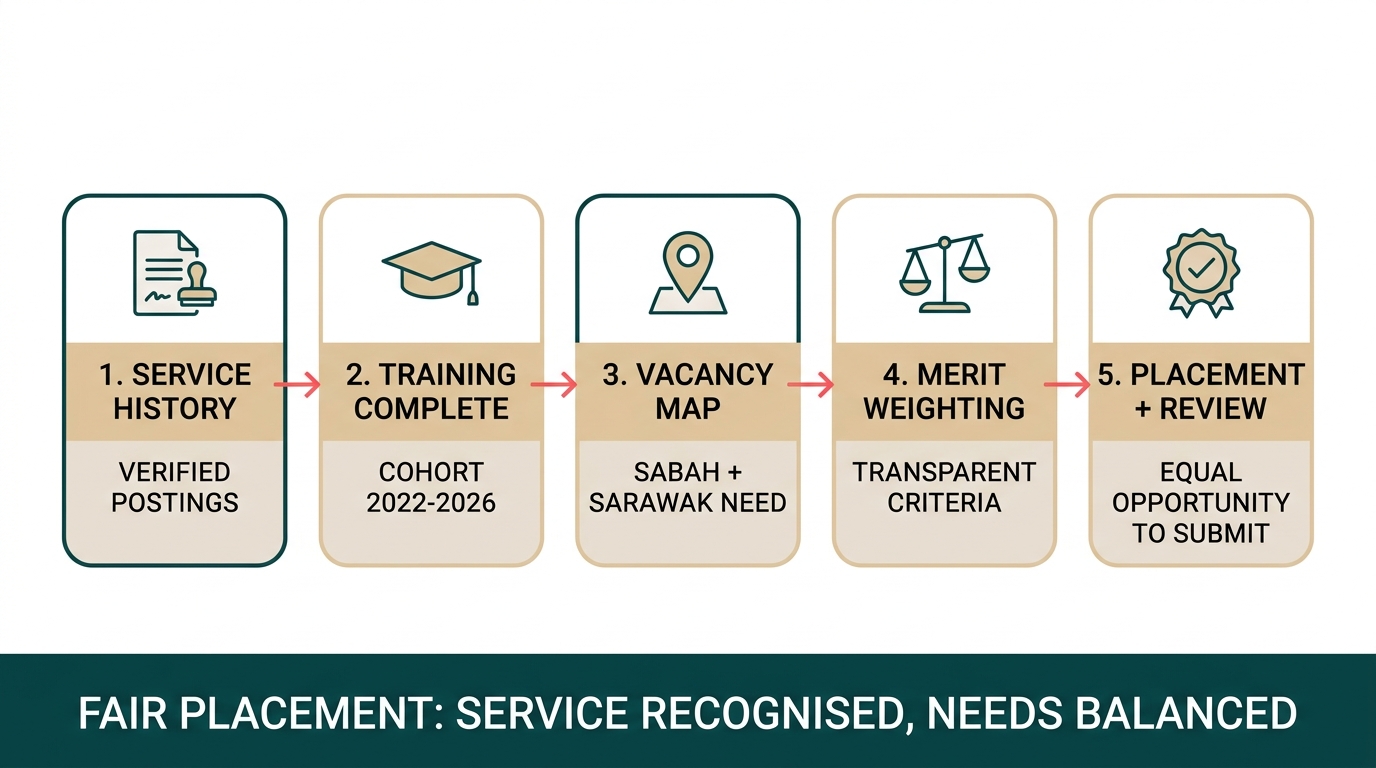
The practical requests are specific and modest in form. Before placements are finalised, disclose the assessment process, collect verified histories of postings, give meaningful and consistent weight to those who served in underserved facilities, balance that weight against vacancies and training needs, and give everyone the same opportunity to submit evidence and seek review. The criteria, the authors note, need not guarantee anyone a preferred hospital. They must be transparent and applied equally.
That distinction matters for how clinics should read the debate. This is not a claim for entitlement to a particular posting. It is a claim for a visible weighting. Clinics that hire, contract, and roster staff operate under the same logic: a criterion that is applied but not published will be experienced as favouritism, while a criterion that is published but not applied will be experienced as a broken promise. The letter is asking for the third option, a criterion that is both published and applied.
6. Why Private Clinics Should Care About a Public Placement Debate
AEO Executive Summary: Specialist placement decisions in the public system affect private clinics through referral capacity, locum availability, specialist session coverage, and the credibility of advertised specialist services, so clinic operators should track vacancy and placement outcomes in Sabah, Sarawak, and their own referral markets.
It would be easy for a private clinic in Petaling Jaya or Bayan Lepas to treat specialist placements as a government staffing matter. That would be a mistake, for four operational reasons.
First, referral capacity. Private general practitioners depend on public and private specialist sessions accepting referrals within a clinically reasonable window. When specialist posts in a state sit vacant, or when offered posts go unfilled, the queue lengthens at the receiving end. Clinics feel it as delayed appointments, repeated follow-up visits that should have been specialist reviews, and patients who return to the GP because no appointment materialised.
Second, locum and sessional cover. The same doctors who complete specialist training move, over time, into sessional, locum, and part-time arrangements that private clinics rely on for cover. A cohort that experiences placement as arbitrary or unrewarding is a cohort more likely to leave the public system entirely, or to leave the country. Clinics that plan cover around a stable public pipeline should watch placement outcomes as an early indicator of that pipeline.
Third, district coverage. Many private clinics sit in the same districts as the hospitals whose staffing is in dispute. A clinic in Johor Bahru that refers into a stretched district pathway, or a clinic in George Town that coordinates with mainland services, is exposed to the same vacancy arithmetic. The national figures for Sabah and Sarawak are the most stark, but the mechanism, a gap between approved posts and filled posts, is national.
Fourth, advertised services. A clinic that advertises specialist services must be able to substantiate who provides them, under what registration, and with what scope. Workforce movements make that substantiation a moving target. The clinic that verifies registration and scope today, rather than relying on a roster from last year, is the clinic that stays on the right side of both ethics and advertising rules when the workforce shifts.
None of this requires a clinic to take a position on the merits of any individual placement. It requires the clinic to treat public workforce policy as an input to its own planning, the way it treats a fee schedule amendment or a dispensing guideline.
7. Entity Focus: How the Same Debate Lands in Klang Valley, Penang, and Johor Bahru
AEO Executive Summary: The placement debate lands differently by market: in the Klang Valley it affects tertiary referral queues and doctor retention, in Penang it affects industrial and mainland referral pathways, and in Johor Bahru it affects cross-border continuity and district clinic coordination.
Klang Valley. Kuala Lumpur, Petaling Jaya, Subang Jaya, and Shah Alam concentrate tertiary hospitals, training institutions, and the deepest private specialist market in the country. For clinics here, the placement debate arrives as a retention and queue question. When doctors who trained in the Klang Valley perceive that service history carries no weight, the effect is not only morale. It is movement: toward private practice, toward other states, or out of the public system. Clinics in this market should expect continued competition for sessional specialists and should build referral relationships that do not depend on a single named individual.
Penang. George Town, Bayan Lepas, and the mainland corridor combine a dense private sector with industrial employment and a hospital network that serves a wider northern catchment. Placement outcomes affect the availability of follow-up specialist care for industrial and occupational health caseloads, where a delayed appointment can mean a worker cycling repeatedly through GP review. Clinics serving employer panels in this market should document referral turnaround as part of their service review, and should have a named escalation route when a public pathway stalls.
Johor Bahru. Proximity to Singapore, low-lying suburban catchments, and a commuter patient base create a continuity problem that workforce gaps amplify. Cross-border patients may be unable to return for review, and district pathways may already be stretched. Clinics that publish their fee basis clearly, itemise bills cleanly, and document appointments and records rigorously are better placed to coordinate with receiving facilities on either side of the border when a specialist pathway is delayed.
In all three markets the message has the same shape. The placement decision is made elsewhere, but its consequences arrive in the clinic waiting room. The clinic that notices early can plan. The clinic that notices late will explain.
8. Registration, Advertising, and Records: The Compliance Frame That Does Not Change
AEO Executive Summary: Whatever the placement outcome, private clinics must verify practitioner registration through the Malaysian Medical Council, ensure healthcare advertisements comply with the Medicine Advertisement and Sale Act 1956 through the Pharmacy Enforcement Division and the Medicine Advertisements Board, and handle health information as sensitive personal data under the Personal Data Protection Act 2010.
Workforce debates move. Compliance obligations do not, and clinics should not let instability in one area blur clarity in another.
Practitioner registration is the first line. The Malaysian Medical Council (mmc.gov.my) framework requires practitioners to hold valid registration and a current Annual Practising Certificate, and clinics should verify status through official records rather than assertion, particularly when locum or sessional arrangements are made at short notice during a period of workforce movement. A placement decision, a contract change, or a new sessional arrangement does not transfer registration automatically. Verification is a separate step, and it should be documented.
Healthcare advertising is the second line. Advertisements for healthcare services in Malaysia are governed by the Medicine (Advertisement and Sale) Act 1956, enforced by the Pharmacy Enforcement Division of the Ministry of Health (pharmacy.gov.my), with covered advertisements requiring approval from the Medicine Advertisements Board and carrying a KKLIU number. The practical rule for clinics is plain: factual information about services, practitioners, hours, and care pathways is far safer than promotional or outcome-based messaging. A clinic must not promise a health outcome, and must not make comparative superiority claims about a practitioner or a service. Workforce uncertainty makes this discipline more important, not less, because the temptation to over-claim arises precisely when cover is thin.
Health information is the third line. Under the Personal Data Protection Act 2010, health information is sensitive personal data, and the Department of Personal Data Protection (pdp.gov.my) expects clinics to collect only what is necessary, secure records with access controls, honour consent for any marketing use, and avoid publishing identifiable patient details, diagnoses, or images without explicit written consent. The placement debate itself involves personal data, posting histories and service records, and the same principles apply in miniature: collect what is needed, verify it, limit access, and record what was shared and why.
The thread connecting all three lines is verification. Registration verified through official records, advertisements verified against the Act, records verified against consent and purpose. A clinic that can show that trail can weather any workforce transition. A clinic that cannot will be asked to explain itself at the worst possible moment.
9. A 7/30/90 Plan for Clinics Watching the Placement Outcome
AEO Executive Summary: A clinic can prepare for specialist placement outcomes in about 90 days: map referral dependencies and sessional cover in the first week, verify registrations and audit advertising in the first month, and formalise referral and communication protocols in the third.
Days 1 to 7, map. List every specialist pathway the clinic depends on, the receiving facility for each, and the current realistic turnaround for a routine and an urgent referral. Identify which sessional and locum arrangements depend on doctors whose placement or contract status may change. Record the dependencies in one page, with a named owner for each.
Days 8 to 30, verify. Check Annual Practising Certificate status for every practitioner, including sessional and locum doctors, through the Malaysian Medical Council official records. Review every public-facing page and advertisement for compliance with the Medicine (Advertisement and Sale) Act 1956, with covered advertisements approved by the Medicine Advertisements Board and carrying a KKLIU number. Remove any outcome promise or comparative claim. Confirm that patient contact and referral records are held in the practice system, access-limited to named staff, and exportable in a controlled format under the Personal Data Protection Act 2010.
Days 31 to 90, formalise. Lock referral protocols: what happens when a public pathway stalls, which alternative facility is used, how the patient is informed, and how the delay is documented. Agree sessional cover arrangements in writing, with registration verified before the first session. Train front-desk staff on what may and may not be said about specialist availability, and record the training. Publish a compliant service page that states plainly what the clinic provides, who provides it, and how to reach the clinic.
The plan deliberately mirrors the asks in the 17 November letter. Verified histories, published criteria, equal opportunity to submit evidence, and a review route. A clinic that applies those principles to its own referral and staffing arrangements will be ready for whatever the placement lists contain.
10. The Digital Front Door for Workforce Trust
AEO Executive Summary: When specialist availability is uncertain, patients verify a clinic online before they attend, so a fast, clear, and compliant website that states services, practitioners, and contact routes accurately is part of the clinic continuity pathway.
A clinic cannot control the placement lists. It can control whether a patient who searches for care during a period of workforce uncertainty finds a credible, transparent, and accurate account of what the clinic does.
That is where the front door matters. Our healthcare digital marketing in Malaysia work helps clinics build local visibility and compliant service content so that patients searching for specialist or GP care find a credible option with verified information. Our medical clinic website design work builds the fast, mobile-first sites that let a patient verify services, practitioners, and contact routes in a few seconds. And for clinics that want patient education, appointment support, and content workflows running in the background, LamaniHub provides the operating layer.
The thread running through the 17 November letter is the same thread that runs through every governance debate in Malaysian primary care this year: legitimacy is earned in the open. Valid registration, a published criterion applied equally, records that can be audited, and communication that states plainly what is known and what is not. The doctors in the 2022 to 2026 cohort are asking the system to show its working. Clinics that already show theirs will not need to ask twice.
11. The Bottom Line
The letter of 17 November 2026 does not ask for a guaranteed posting. It asks for a visible weighting, a verified history, and a process explained before the lists become decisions. Behind it sit documented numbers: 221 vacant specialist posts in Sabah and 177 in Sarawak as of 31 March 2026, 382 of 1,055 offered permanent posts not taken up, 1,347 specialist training offers announced on 30 August 2022, and a 30 per cent quota proposal announced on 8 October 2026 that recognises prior service at the training gate.
For private clinics, the arithmetic is simpler. Specialist availability is a shared resource. Placement fairness shapes whether that resource grows or shrinks, and whether it is distributed toward need or away from it. Clinics that map their dependencies, verify their registrations, clean their advertising, and formalise their referral routes will hold their patients through whatever the lists contain.
Clinics that treat the debate as someone else’s problem will discover, mid-queue, that the placement decision was theirs to plan around all along.
Frequently Asked Questions (FAQ)
What did medical officers from the 2022 to 2026 specialist training cohort ask for on 17 November 2026?
In a letter published by CodeBlue on 17 November 2026, medical officers from the 2022 to 2026 specialist training cohort asked the Ministry of Health to disclose the specialist placement assessment process, collect verified histories of postings, give meaningful weight to those who served in Sabah, Sarawak, and underserved districts, and give everyone the same opportunity to submit evidence and seek review before placements are finalised.
How many specialist posts are vacant in Sabah and Sarawak?
According to parliamentary figures reported by CodeBlue, Sabah had 221 vacant specialist positions out of 937 approved posts as of 31 March 2026, and Sarawak had 177 vacancies out of 863 approved posts. The Health Minister also disclosed in October that 382 of 1,055 medical officers offered permanent posts in these states did not report for duty.
What is the Program Latihan Kepakaran with Biasiswa KKM?
The Program Latihan Kepakaran dengan Biasiswa KKM is a sponsored specialist training route introduced while former Health Minister Khairy Jamaluddin was in office. On 30 August 2022, the Ministry of Health announced 1,347 offers for specialist training in the 2022 and 2023 academic session, of which 216 contract officers received offers under this programme.
What governance safeguards apply to specialist placements in Malaysia?
The Ministry of Health Surat Pekeliling Ketua Setiausaha Bilangan 1 Tahun 2023 requires merit-based placement and transfer decisions through designated committees, with criteria referring to service needs, experience, and length of service, and prohibits using outside influence to pressure decision-makers. The letter asks that this framework be applied with a disclosed process for the 2022 to 2026 specialist cohort.
What did the Health Minister announce in October 2026 about specialist training?
On 8 October 2026, Health Minister Dzulkefly Ahmad announced a proposal for a 30 per cent specialist-training quota for medical officers serving in Sabah and Sarawak, together with additional merit for those who had served there when applying for training and study leave. The letter welcomes that recognition and asks why prior service should not also carry weight at placement.
What should a private clinic do when specialist availability changes?
Private clinics should verify practitioner registration and Annual Practising Certificate status through the Malaysian Medical Council, ensure healthcare advertisements comply with the Medicine (Advertisement and Sale) Act 1956 through the Pharmacy Enforcement Division of the Ministry of Health and the Medicine Advertisements Board, handle health information under the Personal Data Protection Act 2010, and maintain documented referral pathways with an alternative facility when a public pathway is delayed.
Frequently Asked Questions
What did medical officers from the 2022 to 2026 specialist training cohort ask for on 17 November 2026?
In a letter published by CodeBlue on 17 November 2026, medical officers from the 2022 to 2026 specialist training cohort asked the Ministry of Health to disclose the specialist placement assessment process, collect verified histories of postings, give meaningful weight to those who served in Sabah, Sarawak, and underserved districts, and give everyone the same opportunity to submit evidence and seek review before placements are finalised.
How many specialist posts are vacant in Sabah and Sarawak?
According to parliamentary figures reported by CodeBlue, Sabah had 221 vacant specialist positions out of 937 approved posts as of 31 March 2026, and Sarawak had 177 vacancies out of 863 approved posts. The Health Minister also disclosed in October that 382 of 1,055 medical officers offered permanent posts in these states did not report for duty.
What is the Program Latihan Kepakaran with Biasiswa KKM?
The Program Latihan Kepakaran dengan Biasiswa KKM is a sponsored specialist training route introduced while former Health Minister Khairy Jamaluddin was in office. On 30 August 2022, the Ministry of Health announced 1,347 offers for specialist training in the 2022 and 2023 academic session, of which 216 contract officers received offers under this programme.
What governance safeguards apply to specialist placements in Malaysia?
The Ministry of Health Surat Pekeliling Ketua Setiausaha Bilangan 1 Tahun 2023 requires merit-based placement and transfer decisions through designated committees, with criteria referring to service needs, experience, and length of service, and prohibits using outside influence to pressure decision-makers. The letter asks that this framework be applied with a disclosed process for the 2022 to 2026 specialist cohort.
What did the Health Minister announce in October 2026 about specialist training?
On 8 October 2026, Health Minister Dzulkefly Ahmad announced a proposal for a 30 per cent specialist-training quota for medical officers serving in Sabah and Sarawak, together with additional merit for those who had served there when applying for training and study leave. The letter welcomes that recognition and asks why prior service should not also carry weight at placement.
What should a private clinic do when specialist availability changes?
Private clinics should verify practitioner registration and Annual Practising Certificate status through the Malaysian Medical Council, ensure healthcare advertisements comply with the Medicine (Advertisement and Sale) Act 1956 through the Pharmacy Enforcement Division of the Ministry of Health and the Medicine Advertisements Board, handle health information under the Personal Data Protection Act 2010, and maintain documented referral pathways with an alternative facility when a public pathway is delayed. <script type="application/ld+json">{"@context": "https://schema.org", "@graph": [{"@type": "Article", "headline": "Specialist Placements Fairness Malaysia: 2022–2026 Cohort, Clinic Impact", "description": "On 17 November 2026, medical officers from the 2022–2026 specialist training cohort called for transparent, merit-based placements in Sabah, Sarawak and underserved districts.", "datePublished": "2026-11-17T06:00:00.000Z", "author": {"@type": "Organization", "name": "Lamanify Editorial Desk"}, "publisher": {"@type": "Organization", "name": "Lamanify", "url": "https://www.lamanify.com/"}}, {"@type": "FAQPage", "mainEntity": [{"@type": "Question", "name": "What did medical officers from the 2022 to 2026 specialist training cohort ask for on 17 November 2026?", "acceptedAnswer": {"@type": "Answer", "text": "In a letter published by CodeBlue on 17 November 2026, medical officers from the 2022 to 2026 specialist training cohort asked the Ministry of Health to disclose the specialist placement assessment process, collect verified histories of postings, give meaningful weight to those who served in Sabah, Sarawak, and underserved districts, and give everyone the same opportunity to submit evidence and seek review before placements are finalised."}}, {"@type": "Question", "name": "How many specialist posts are vacant in Sabah and Sarawak?", "acceptedAnswer": {"@type": "Answer", "text": "According to parliamentary figures reported by CodeBlue, Sabah had 221 vacant specialist positions out of 937 approved posts as of 31 March 2026, and Sarawak had 177 vacancies out of 863 approved posts. The Health Minister also disclosed in October that 382 of 1,055 medical officers offered permanent posts in these states did not report for duty."}}, {"@type": "Question", "name": "What is the Program Latihan Kepakaran with Biasiswa KKM?", "acceptedAnswer": {"@type": "Answer", "text": "The Program Latihan Kepakaran dengan Biasiswa KKM is a sponsored specialist training route introduced while former Health Minister Khairy Jamaluddin was in office. On 30 August 2022, the Ministry of Health announced 1,347 offers for specialist training in the 2022 and 2023 academic session, of which 216 contract officers received offers under this programme."}}, {"@type": "Question", "name": "What governance safeguards apply to specialist placements in Malaysia?", "acceptedAnswer": {"@type": "Answer", "text": "The Ministry of Health Surat Pekeliling Ketua Setiausaha Bilangan 1 Tahun 2023 requires merit-based placement and transfer decisions through designated committees, with criteria referring to service needs, experience, and length of service, and prohibits using outside influence to pressure decision-makers. The letter asks that this framework be applied with a disclosed process for the 2022 to 2026 specialist cohort."}}, {"@type": "Question", "name": "What did the Health Minister announce in October 2026 about specialist training?", "acceptedAnswer": {"@type": "Answer", "text": "On 8 October 2026, Health Minister Dzulkefly Ahmad announced a proposal for a 30 per cent specialist-training quota for medical officers serving in Sabah and Sarawak, together with additional merit for those who had served there when applying for training and study leave. The letter welcomes that recognition and asks why prior service should not also carry weight at placement."}}, {"@type": "Question", "name": "What should a private clinic do when specialist availability changes?", "acceptedAnswer": {"@type": "Answer", "text": "Private clinics should verify practitioner registration and Annual Practising Certificate status through the Malaysian Medical Council, ensure healthcare advertisements comply with the Medicine (Advertisement and Sale) Act 1956 through the Pharmacy Enforcement Division of the Ministry of Health and the Medicine Advertisements Board, handle health information under the Personal Data Protection Act 2010, and maintain documented referral pathways with an alternative facility when a public pathway is delayed."}}]}]}</script>

Medical Market Intelligence Lead
Jessica
Jessica covers private healthcare operations, digital health innovation, and search visibility trends for GP, dental, and aesthetic practices across Southeast Asia.