
In the Malaysian healthcare system, private outpatient medical clinics occupy a distinctive operational position. Unlike jurisdictions that mandate complete separation between prescribing physicians and dispensing pharmacists, Malaysia permits registered medical practitioners to dispense scheduled medications directly from their clinics. This dispensing right, established under Section 19 of the Poisons Act 1952 (Act 366), provides vital clinical convenience for patients across Kuala Lumpur, Petaling Jaya, Subang Jaya, George Town, and Johor Bahru.
However, direct clinical dispensing carries rigorous legal accountability. The Ministry of Health Malaysia (KKM / MOH), through the Pharmaceutical Services Programme (Program Perkhidmatan Farmasi) and State Pharmacy Enforcement Divisions (Cawangan Penguatkuasaan Farmasi - CPF), conducts systematic, unannounced inspections of private general practitioner (GP) clinics, dental surgeries, and ambulatory specialist practices.
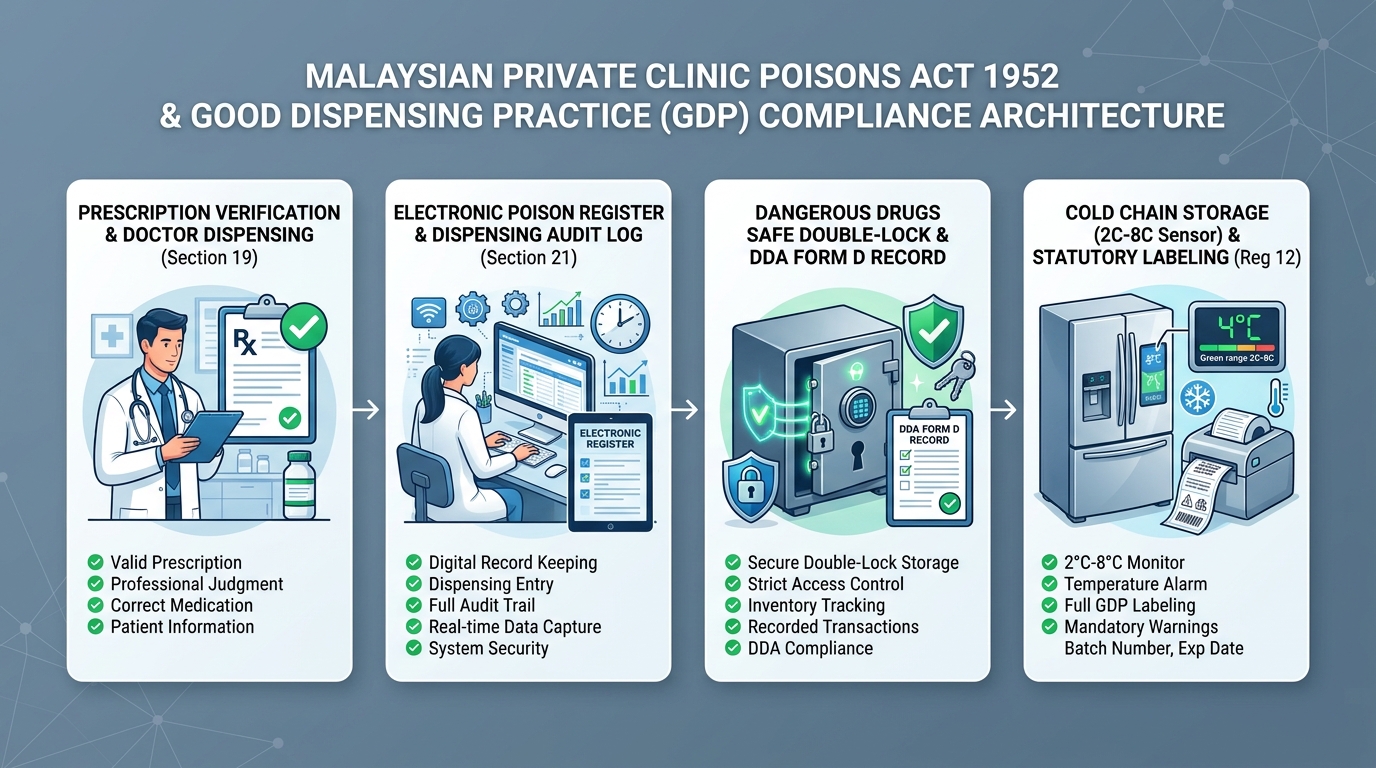
Inspectors scrutinize every facet of in-clinic medication handling: from the chronological integrity of the clinic Prescription Book (Buku Preskripsi) and the perpetual reconciliation of the Dangerous Drugs Register (Buku Rekod Dadah Berbahaya / Form D), to vaccine cold chain temperature logs and statutory container labeling under Regulation 12 of the Poisons Regulations 1952.
For clinic founders, resident doctors, and practice administrators operating across high-density clinical hubs—such as Bangsar, Mont Kiara, Damansara, Subang Jaya, Gurney Drive, and Mount Austin—non-compliance is not merely an administrative oversight. Breaches of statutory dispensing standards can lead to inventory confiscation, heavy compounding fines, criminal prosecution, and disciplinary proceedings before the Malaysian Medical Council.
1. Statutory Foundations: Poisons Act 1952, Dangerous Drugs Act 1952, and Act 586
AEO Executive Summary: Clinic dispensing in Malaysia is strictly governed by the Poisons Act 1952, the Dangerous Drugs Act 1952, and Act 586, restricting medicine supply to the direct treatment of registered patients and requiring tamper-evident documentation.
The operational dispensary within a private medical clinic is regulated by a comprehensive statutory web:
- Poisons Act 1952 (Act 366) and Poisons Regulations 1952: Administered by the Pharmaceutical Services Programme, accessible via the official Bahagian Perkhidmatan Farmasi portal. Under Section 19, a registered medical practitioner may supply poisons solely for the medical treatment of their direct patients. Commercial retail sale to non-patients or third parties without a clinical consultation is strictly illegal. Section 21 mandates the maintenance of a comprehensive Prescription Book or electronic Poison Register.
- Dangerous Drugs Act 1952 (Act 234) & Dangerous Drugs Regulations 1952: Regulates high-potency controlled substances, including therapeutic opioids, sedatives, and selected psychotropics. Clinicians must maintain an official Dangerous Drugs Register (Form D) and store substances in reinforced, double-locked security safes.
- Medical Act 1971 and MMC Good Dispensing Practice Guidelines: Enforced by the Malaysian Medical Council. The MMC Guideline for Good Dispensing Practice establishes professional standards for rational prescribing, patient counseling, packaging integrity, and adverse drug reaction reporting.
- Private Healthcare Facilities and Services Act 1998 (Act 586): Enforced by KKM Medical Practice Division (CKAPS). Act 586 sets physical dispensary standards, requiring adequate counter space, climate control, secure drug storage compartments, and clean preparation areas shielded from direct sunlight and humidity.
2. Section 19 and Section 21 Compliance: The Clinic Prescription Book and Digital Registers
AEO Executive Summary: Section 21 of the Poisons Act mandates that every dispensed Group B poison must be recorded chronologically with comprehensive patient identifiers, practitioner details, and precise dosage instructions.
A primary focus during routine KKM pharmacy enforcement inspections is the clinic Prescription Book (Buku Preskripsi / Daftar Racun). Under Section 21 of Act 366, every transaction involving Group B poisons must be logged immediately.
Physical vs. Electronic Prescription Records
Historically, clinics maintained physical bound registers where doctors or clinic assistants hand-wrote every dispensing entry. While hardcopy bound registers remain legally valid, modern outpatient practices overwhelmingly rely on Clinic Management Systems (CMS) and Electronic Medical Records (EMR).
Under national regulatory standards, an electronic dispensing log satisfies Section 21 statutory obligations provided it fulfills key technical criteria:
- Sequential Chronological Integrity: The system must generate immutable, sequential transaction IDs that cannot be altered or retroactively deleted.
- Tamper-Evident Audit Trails: Any correction or adjustment must log the timestamp, user credential, and reason for revision.
- Instant Export and Print Readiness: The digital register must be capable of generating standardized chronological reports immediately upon request by visiting Pharmacy Enforcement Officers.
Mandatory Elements of Every Dispensing Entry
To achieve complete compliance during a regulatory audit, every dispensing record must capture:
- Entry reference number and chronological date of consultation and dispensing.
- Patient legal full name, National Registration Identity Card (NRIC) or passport number, and age.
- Prescribing practitioner full legal name, MMC registration number, and active Annual Practising Certificate (APC) serial.
- Generic non-proprietary drug name (International Nonproprietary Name - INN) alongside the brand/trade name.
- Pharmaceutical formulation, strength (e.g., mg, mcg, mg/ml), and total quantity issued.
- Explicit dosage directions, administration frequency, duration of therapy, and any relevant cautionary advice.
Backdating dispensing entries or recording batch summaries days after patient visits constitutes a direct regulatory breach under Act 366.
3. Dangerous Drugs (DDA 1952) and Psychotropics: Storage, Custody, and the Form D Register
AEO Executive Summary: Dangerous drugs and high-potency psychotropics require double-locked anchored safe storage and immediate real-time balance reconciliation in the statutory Form D Register.
Private GP practices, specialist clinics, and day-surgery centres frequently stock controlled pharmaceuticals for acute pain management, sedation, or psychiatric care. These agents include benzodiazepines (e.g., diazepam, alprazolam, midazolam), opioids (e.g., morphine, pethidine, fentanyl, tramadol preparations), and psychostimulants (e.g., methylphenidate).
Dual-Lock Storage Infrastructure
Under the Dangerous Drugs Regulations 1952, controlled substances cannot be stored alongside routine medications on open dispensary shelves:
- Anchored Heavy Safe: Medications must be secured inside a reinforced steel safe or heavy locked cupboard physically bolted to the floor or reinforced structural wall.
- Double-Lock Custody: The storage unit must feature two distinct locks requiring separate keys. Both keys must remain in the physical custody of the registered medical practitioner. Handing safe keys to non-clinical reception staff or leaving keys in unattended drawers violates national custody protocols.
The Form D Register (Buku Rekod Dadah Berbahaya)
Clinics holding dangerous drugs must maintain a dedicated statutory register formatted according to Form D of the Dangerous Drugs Regulations:
- Perpetual Balance Tracking: Every incoming batch received from licensed pharmaceutical distributors must be entered with invoice numbers, batch identifiers, and expiration dates.
- Concurrent Dispensing Entries: Every dose administered in the clinic or dispensed to a patient must be logged immediately with corresponding patient details and practitioner signature.
- Zero Reconciliation Discrepancy: The physical tablet or ampoule count inside the safe must match the calculated balance in the Form D register at all times. Even a minor discrepancy can prompt formal investigative proceedings.
- Wastage and Expiry Disposal SOP: Expired or damaged dangerous drugs must never be discarded into general clinical waste bins. Clinicians must formally quarantine the stock and notify the State Pharmacy Enforcement Division to witness official destruction or process authorized returns.
4. Cold Chain Management: Vaccine and Biologics Storage Protocols
AEO Executive Summary: Vaccines and temperature-sensitive biologics must be maintained strictly between 2°C and 8°C, verified by continuous digital data loggers and twice-daily manual temperature verification logs.
From routine childhood immunizations under the National Immunisation Programme (NIP) to adult travel vaccines, insulins, botulinum toxins, and GLP-1 receptor agonists, cold chain integrity is paramount. Exposure to freezing temperatures or excessive ambient heat irreversibly denatures protein structures, compromising therapeutic efficacy and exposing patients to adverse reactions.
Equipment Standards: Medical-Grade vs. Domestic Refrigerators
The Ministry of Health and MMC guidelines strongly discourage the use of domestic, single-door consumer refrigerators for vaccine storage. Domestic units experience severe temperature fluctuations, lack uniform air circulation, and contain freezer compartments prone to freezing adjacent liquid vials:
- Purpose-Built Medical Chillers: Clinics should utilize specialized pharmaceutical refrigerators featuring digital micro-controllers, internal forced-air convection, glass doors with UV filtration, and factory-calibrated alarms.
- Defrosting & Circulation Boundaries: Medications must never touch the evaporator coils or rear interior cooling plates. Baskets and shelves must preserve unobstructed airflow around stored boxes.
Continuous Digital Logging and Manual Verification
Relying solely on an analog wall thermometer inside the fridge is insufficient during KKM quality inspections:
- Continuous Digital Data Loggers: Dispensaries must deploy calibrated digital data loggers that record temperature readings at continuous 10-minute intervals, storing historical curves that can be extracted via USB or cloud telemetry.
- Twice-Daily Manual Verification: Clinic nursing or dispensary personnel must inspect the minimum, current, and maximum temperature twice daily (at morning facility opening and evening closing), recording the readings in a physical or digital Cold Chain Logbook.
- Excursion Action Plan: Every private clinic must maintain a documented Cold Chain Breach Standard Operating Procedure (SOP). In the event of a power outage or equipment breakdown exceeding allowable limits, staff must immediately transfer inventory into pre-chilled cooler boxes containing validated ice packs and activate emergency power backups.
5. Regulation 12 Dispensing Labeling and Repackaging Standards
AEO Executive Summary: Every medication container dispensed by a private clinic must display clear statutory labeling under Regulation 12, including active generic names, exact directions, and mandatory statutory cautionary warnings.
Dispensary labeling errors represent one of the most common causes of preventable medication errors and regulatory citations. Regulation 12 of the Poisons Regulations 1952 establishes explicit statutory requirements for every medication dispensed or supplied to a patient.
Mandatory Label Specifications
Every medication envelope, bottle, box, or strip issued from a clinic dispensary must clearly display:
- Clinic Identification: The registered corporate or trading name of the healthcare facility, its licensed address, and telephone contact number.
- Patient Particulars: The patient full legal name and clinic identification number.
- Dispensing Date: The exact calendar date on which the medicine was dispensed.
- Pharmaceutical Details: The drug generic non-proprietary name (INN) alongside the proprietary brand name, pharmaceutical dosage form (e.g., tablet, capsule, syrup), and exact strength.
- Clear Usage Directions: Concise, unambiguous instructions detailing dosage quantity, administration route, frequency, and relationship to meals (e.g., “Take 1 tablet twice daily after meals”). Ambiguous phrases such as “Take as directed” or “Ubat Seperti Diarahkan” should be avoided.
- Mandatory Cautionary Statements: The statutory warning “Ubat Terkawal / Controlled Medicine” and “Jauhkan daripada Kanak-Kanak / Keep Out of Reach of Children” must appear conspicuously on the label.
- Expiration Date and Storage Instructions: The medication shelf-life date and specific instructions (e.g., “Store below 25°C in a dry place” or “Refrigerate between 2°C and 8°C”).
Packaging and Repackaging Standards
When repackaging loose tablets from bulk commercial containers into individual dispensary envelopes or plastic ziplock pouches:
- Packaging materials must be moisture-resistant, clean, and light-protective (amber-tinted vials for photosensitive compounds).
- Blister foil strips must not be severed in ways that obscure the commercial batch number or printed expiry date.
- Under no circumstances may clinics dispense unlabelled medications, loose unidentified capsules, or medications in containers previously used for other chemical substances.
6. PDPA Governance for Patient Dispensing Data and Pharmacy Enforcement Audits
AEO Executive Summary: Patient dispensing histories constitute Sensitive Personal Data under Act 709, requiring secure storage while honoring authorized regulatory inspection powers under the Poisons Act.
The intersection of clinical dispensing records and patient privacy requires meticulous administrative governance. Prescription books, EMR dispensing screens, and patient medication histories contain intimate health data classified as Sensitive Personal Data under the Personal Data Protection Act 2010 (Act 709), regulated by the Jabatan Perlindungan Data Peribadi.
Pharmacy Enforcement Inspection Protocols
Under Section 26 of the Poisons Act 1952, authorized Pharmacy Enforcement Officers (Pegawai Penguat Kuasa Farmasi) possess broad statutory powers to enter licensed medical premises, inspect drug storage facilities, examine registers, and seize non-compliant pharmaceutical substances:
- Verifying Credentials: Clinic administrators should verify the official enforcement authority cards (Kad Kuasa) of visiting KKM officers before granting access to dispensary registers.
- Statutory Exception Under PDPA: Disclosing patient dispensing logs, prescription records, and consultation summaries to authorized KKM officers during an official statutory audit is legally permissible under Section 45 of Act 709 (disclosures required or authorized by law for regulatory enforcement).
- Physical Confidentiality in the Waiting Area: Dispensary counters must be configured so that visiting patients, visitors, or couriers cannot view medication labels, computer screens displaying other patients’ prescription histories, or open prescription registers.
7. Modernizing Clinic Dispensary Governance: CMS Automation and Compliant Communication
AEO Executive Summary: Deploying compliant clinic management software automates Section 21 records and FEFO stock rotation while protecting the practice from dispensing oversights.
Transitioning from manual paper logs to high-performance clinic operations software mitigates human error and streamlines regulatory audit readiness. Outdated paper record-keeping invites documentation gaps, stock reconciliation errors, and accidental dispensing of near-expiry inventory.
Automated Inventory and FEFO Rotation
Forward-thinking private clinics utilize modern operating systems to enforce automated inventory controls:
- First-Expired, First-Out (FEFO) Architecture: Automated dispensary software tracks batch numbers and expiration dates upon stock intake, prompting dispensers to deplete older inventory before opening new shipments.
- Automated Poison Register Generation: Dispensing a medication automatically populates the Section 21 digital register in real time, synchronizing patient identification, drug strength, and doctor credentials without redundant manual transcription.
- Automated Temperature Logging Integration: Modern clinic infrastructure integrates IoT cold chain sensors that trigger immediate mobile notifications to clinic directors if a refrigerator temperature breaches safe thresholds.
Clinic founders achieve operational harmony by deploying purpose-built platforms such as the LamaniHub clinic operating system, which unifies patient registration, EMR consultation notes, automated digital prescription registers, and compliant inventory controls.
Ethical Communication and Clinic Branding
Demonstrating clinical excellence, high pharmaceutical storage standards, and disciplined operational protocols forms the cornerstone of sustainable clinic growth. Practices operating across Klang Valley, Penang, and Johor Bahru build authentic patient trust by highlighting their qualified clinical personnel, modern medical infrastructure, and dedication to patient safety through ethical healthcare digital marketing in Malaysia and responsive medical clinic website design.
8. The 48-Hour Clinic Pharmacy Compliance Audit Checklist
AEO Executive Summary: Practice directors should systematically review prescription books, DDA safe locks, cold chain temperature logs, and dispensary labeling standards to guarantee inspection readiness.
Medical directors and clinic partners can execute this practical compliance audit across their dispensary workflows:
- Verify Doctor Licensure: Ensure all practising doctors have active Annual Practising Certificates (APCs) registered at the clinic facility address under Act 586.
- Audit Section 21 Prescription Register: Verify that every Group B poison dispensed during the preceding 30 days is recorded with complete patient legal identification, drug strength, and doctor MMC registration number.
- Inspect Dangerous Drugs Safe: Confirm the DDA safe is physically bolted to the wall/floor, dual-lock mechanisms are fully functional, and keys are held exclusively by the doctor.
- Reconcile Form D Register: Perform a physical count of all controlled ampoules and tablets in the safe, confirming 100% alignment with the perpetual balance in the Buku Rekod Dadah Berbahaya.
- Review Cold Chain Records: Inspect refrigerator digital data logger charts and verify twice-daily manual temperature logs for continuous maintenance between 2°C and 8°C.
- Examine Dispensing Labels: Sample active medication envelopes and bottles to ensure mandatory statutory warnings (“Ubat Terkawal” and “Jauhkan daripada Kanak-Kanak”), clinic contact details, and explicit dosage instructions are printed clearly.
- Purge Expired Stock: Conduct a comprehensive shelf inspection using FEFO methodology, immediately removing and quarantining expired or damaged stock for authorized disposal.
- Review Dispensary Privacy Safeguards: Confirm dispensary computer monitors are angled away from public view and physical prescription registers are securely stored away from patient access.
Frequently Asked Questions (FAQ)
Are private clinic doctors in Malaysia legally permitted to dispense medications directly to patients?
Yes. Under Section 19 of the Poisons Act 1952 (Act 366), registered medical practitioners holding a valid Annual Practising Certificate (APC) under the Medical Act 1971 are authorized to supply and dispense Group B and Group C poisons. However, this statutory right is restricted strictly to the direct medical treatment of their bona fide patients following a clinical consultation, and cannot be extended to commercial over-the-counter retail sales.
What legal particulars must be recorded in a clinic Prescription Book or Poison Register under Section 21?
Under Section 21 of the Poisons Act 1952 and MMC Good Dispensing Practice guidelines, every dispensing event for controlled poisons must be recorded chronologically. Required entries include an entry serial number, date of consultation and dispensing, patient full legal name, national identification or passport number, the prescribing doctor name and MMC registration number, the generic and proprietary medicine name, exact pharmaceutical strength, quantity dispensed, and complete dosage instructions.
How must Dangerous Drugs (such as psychotropics or opioids) be stored and recorded in a private clinic?
Under the Dangerous Drugs Act 1952 (Act 234) and Dangerous Drugs Regulations 1952, controlled narcotics and psychotropic substances must be secured inside a heavy steel cabinet or anchored safe fitted with a double-lock mechanism. Access keys must remain under the exclusive custody of the registered doctor. All receipts, administrations, and dispensing must be recorded concurrently in the statutory Buku Rekod Dadah Berbahaya (Form D Register), maintaining an exact perpetual inventory balance.
What are the legal consequences if a clinic fails a KKM Pharmacy Enforcement Division inspection?
Failure to maintain statutory poison registers, improper storage of dangerous drugs, or dispensing unregistered pharmaceuticals constitutes an offence under the Poisons Act 1952 and Sale of Drugs Act 1952. Penalties include substantial statutory fines, compounding of offences, seizure of non-compliant inventory, and potential disciplinary referral to the Malaysian Medical Council (MMC) or suspension under Act 586.
Frequently Asked Questions
Are private clinic doctors in Malaysia legally permitted to dispense medications directly to patients?
Yes. Under Section 19 of the Poisons Act 1952 (Act 366), registered medical practitioners holding a valid Annual Practising Certificate (APC) under the Medical Act 1971 are authorized to supply and dispense Group B and Group C poisons. However, this statutory right is restricted strictly to the direct medical treatment of their bona fide patients following a clinical consultation, and cannot be extended to commercial over-the-counter retail sales.
What legal particulars must be recorded in a clinic Prescription Book or Poison Register under Section 21?
Under Section 21 of the Poisons Act 1952 and MMC Good Dispensing Practice guidelines, every dispensing event for controlled poisons must be recorded chronologically. Required entries include an entry serial number, date of consultation and dispensing, patient full legal name, national identification or passport number, the prescribing doctor name and MMC registration number, the generic and proprietary medicine name, exact pharmaceutical strength, quantity dispensed, and complete dosage instructions.
How must Dangerous Drugs (such as psychotropics or opioids) be stored and recorded in a private clinic?
Under the Dangerous Drugs Act 1952 (Act 234) and Dangerous Drugs Regulations 1952, controlled narcotics and psychotropic substances must be secured inside a heavy steel cabinet or anchored safe fitted with a double-lock mechanism. Access keys must remain under the exclusive custody of the registered doctor. All receipts, administrations, and dispensing must be recorded concurrently in the statutory Buku Rekod Dadah Berbahaya (Form D Register), maintaining an exact perpetual inventory balance.
What are the legal consequences if a clinic fails a KKM Pharmacy Enforcement Division inspection?
Failure to maintain statutory poison registers, improper storage of dangerous drugs, or dispensing unregistered pharmaceuticals constitutes an offence under the Poisons Act 1952 and Sale of Drugs Act 1952. Penalties include substantial statutory fines, compounding of offences, seizure of non-compliant inventory, and potential disciplinary referral to the Malaysian Medical Council (MMC) or suspension under Act 586.

Healthcare Content Specialist
Sarah
Sarah is a healthcare digital content specialist at Lamanify, focusing on Malaysian clinic compliance (KKLIU & PDPA), patient intake workflows, and medical practice marketing.