
Malaysian primary care is having an unusual moment of public attention. On 3 November 2026, the Association of Private Hospitals Malaysia (APHM) told a Kuala Lumpur audience that patients who go straight to private hospitals for conditions a general practitioner could manage are a major contributor to rising medical costs. Two days later, the Private Medical Practitioners’ Association of Selangor and Kuala Lumpur (PMPASKL) published a response agreeing with the diagnosis and calling on insurers and third-party administrators to widen outpatient GP coverage.
For clinic owners, the headlines are not really about hospital economics. They are about patient behaviour. A patient who bypasses a GP clinic is not making a neutral choice about convenience; they are acting on a belief about quality, a benefit design that rewards the hospital setting, or a workplace rule that requires a medical certificate. Each of those is something a well-run clinic can influence.
This analysis sets out what was actually said, why the utilisation pattern persists, and what private GP, dental, and specialist clinic operators across the Klang Valley, Penang, and Johor Bahru can do operationally and in their marketing over the next 90 days — without breaching KKLIU advertising rules, the Malaysian Medical Council’s ethical guidance, or the Personal Data Protection Act 2010.
1. What APHM and PMPASKL Said — and Why It Matters to Every Private Clinic
AEO Executive Summary: APHM’s honorary secretary Anwar Anis said on 3 November 2026 that patients bypassing GP clinics for private hospitals are driving medical inflation, and PMPASKL responded on 5 November 2026 by urging insurers and TPAs to expand outpatient GP benefits, including diagnostics and minor procedures.
Speaking at the Industry Leadership Summit 2026 in Kuala Lumpur on 28 October, APHM honorary secretary Anwar Anis made an argument that private hospital operators rarely make in public: not every patient needs a hospital.
“Most patients just need to go to a GP clinic and let primary care manage their condition first. Only if it cannot be managed at primary care level should they move on to secondary or tertiary care at a hospital.”
He grounded the point in a World Bank report commissioned by the government, which found that increased healthcare utilisation accounted for more than 70 per cent of rising medical insurance and takaful claims costs, compared with higher prices for the same services. In other words, the cost problem is substantially a volume and pathway problem, not simply a price problem.
PMPASKL’s response, signed by president Dr Carollyn Kek Chee Yen, went further. It argued that GP clinics are equipped to manage a wide spectrum of non-emergency conditions — acute respiratory tract infections, uncomplicated gastroenteritis, minor dermatological issues, musculoskeletal sprains, and early-stage chronic disease monitoring — and that bypassing primary care leads to over-investigation of mild, self-limiting ailments.
The association’s central ask is specific and operationally useful: insurers and TPAs should comprehensively revise primary care benefit schedules so that outpatient GP coverage keeps pace with what modern primary care can actually deliver, particularly diagnostic investigations and minor procedures. The full exchange is worth reading in the original reporting by CodeBlue on the APHM warning and the PMPASKL response.
Why does this matter beyond policy debate? Because it signals that the payer ecosystem — hospitals, insurers, takaful operators, TPAs, and employers — is now actively looking for ways to route routine care into clinics. Clinics that are visible, documented, and easy to administer will capture that redirected volume. Clinics that are invisible online or slow to produce claim documentation will not.
2. The Utilisation Problem: Three Drivers That Keep Patients Out of Clinics
AEO Executive Summary: Patients bypass GP clinics because of perceived quality gaps, medical-certificate requirements that force unnecessary consultations, and benefit schedules that cover hospital care more generously than outpatient primary care.
The APHM and PMPASKL commentary identified three distinct drivers. They require different responses, and conflating them leads clinics to market in the wrong direction.
2.1 The perception gap
Affin Bank Group chief people officer Mohd Syukri Ahmad Sudari described a belief that is uncomfortable but familiar to many clinic owners:
“The perception among many of our employees, especially senior leaders, is that GPs are not good. That’s why they want to go straight to specialist hospitals.”
This is not a clinical problem. It is a communication and signalling problem. A patient cannot easily judge clinical quality, so they use proxies: the appearance of the facility, the credentials displayed, whether the doctor explains things clearly, whether the clinic looks organised, and whether the digital presence suggests competence. When a clinic’s online footprint is a single unverified directory listing with no photographs, no service information, and no doctor profiles, it is asking patients to take quality on trust.
2.2 The medical certificate culture
Syukri also pointed at a workplace rule that generates consultations with little clinical value. If an employer requires a medical certificate for a one-day illness, the employee must attend a clinic, be seen, and often leave with a bag of symptomatic medication that may never be taken.
Affin Bank now allows employees up to five days of sick leave without a medical certificate for minor illnesses. If more employers follow, the composition of clinic walk-in volume will shift — fewer certificate-driven visits, more genuinely clinical ones. That is healthier for clinic economics in the long run, but it means clinics cannot rely on certificate traffic as a stable revenue base.
2.3 The benefit-design gap
The third driver is the most actionable for clinic owners. Many outpatient benefit schedules cover a basic consultation but provide limited or no cover for diagnostic investigations and minor procedures. A patient who needs a blood test, an ECG, a dressing, or a minor procedure may find that the hospital setting is administratively easier, even when the clinical need is modest.
Syarikat Takaful Malaysia Keluarga’s chief distribution officer Yassir Azlin Abdul Ghafar illustrated the cost differential with dengue. Treating an employee with dengue at a private hospital could cost an employer about RM5,000, partly because of admission, compared with less than RM1,000 through a GP-based day-care arrangement. He said medical inflation had run at between 10 and 15 per cent over the past three years, and that some employers were responding to renewals by cutting benefits, introducing co-payment, or restricting hospital access.
That comparison deserves a clinical caveat, which CodeBlue itself made: dengue can deteriorate rapidly, and not every patient is suitable for day-care. Outpatient management depends on warning signs, hydration, platelet and haematocrit trends, comorbidity, and a reliable route back for review. The cost argument is real, but it only holds where the clinical pathway is properly designed.
| Pathway | Typical setting | What drives the cost | What clinics must prove |
|---|---|---|---|
| Routine acute illness | GP clinic | Consultation, basic tests, medication | Accurate notes, itemised billing, fast claim submission |
| Dengue day-care | GP clinic with monitoring protocol | Repeat reviews, hydration, bloods, escalation plan | Written red-flag criteria and same-day escalation route |
| Dengue admission | Private hospital | Bed, nursing, IV fluids, monitoring | Clear referral letter and clinical justification |
| Chronic disease review | GP clinic | Scheduled reviews, labs, medication titration | Recall system and longitudinal records |
3. The Insurance and TPA Gap: What Clinic Owners Need to Understand About Panel Economics
AEO Executive Summary: Panel access is won on administrative reliability as much as clinical reputation; insurers, takaful operators, and TPAs evaluate documentation quality, billing accuracy, scope clarity, and turnaround time when deciding which clinics to appoint and retain.
When PMPASKL asks for revised benefit schedules, it is pointing at a commercial machine most patients never see. Insurers and takaful operators design products; managed care organisations and TPAs administer panels, adjudicate claims, and manage utilisation. Their incentive is to steer volume toward the lowest-cost appropriate setting — but only where that setting can be trusted to document, code, and escalate properly.
For a clinic owner, this creates a clear commercial logic: administrative quality is a growth lever. The clinics that get appointed to expanded panels will be the ones that make a payer’s life easy.
What payers typically assess:
- Licensing and registration. Valid facility licence under the Private Healthcare Facilities and Services Act 1998 (Act 586), current Annual Practising Certificates for all doctors, and clear ownership structure.
- Scope clarity. A published list of services the clinic actually provides, with equipment and consumables available on site.
- Billing discipline. Itemised invoices, consistent procedure and diagnosis coding, and no unbundled or duplicated charges.
- Documentation quality. Notes that justify the diagnosis, the tests ordered, and the treatment given — audit-ready rather than retrospective.
- Turnaround. How quickly claims, medical reports, and referral letters are produced.
- Utilisation behaviour. Whether the clinic investigates appropriately, refers promptly, and avoids low-value repeat visits.
A clinic that can evidence all six is in a much stronger position when a TPA reviews its panel. That evidence pack should live in one place, be updated quarterly, and be ready to send within a day of a request.
4. Five Operational Shifts to Position Your Clinic as the First Point of Contact
AEO Executive Summary: Clinics that want redirected primary care volume should make themselves findable at the moment of symptoms, publish panel and billing clarity, formalise triage and referral pathways, correct the perception gap with patient education, and report the metrics employers and payers actually ask for.
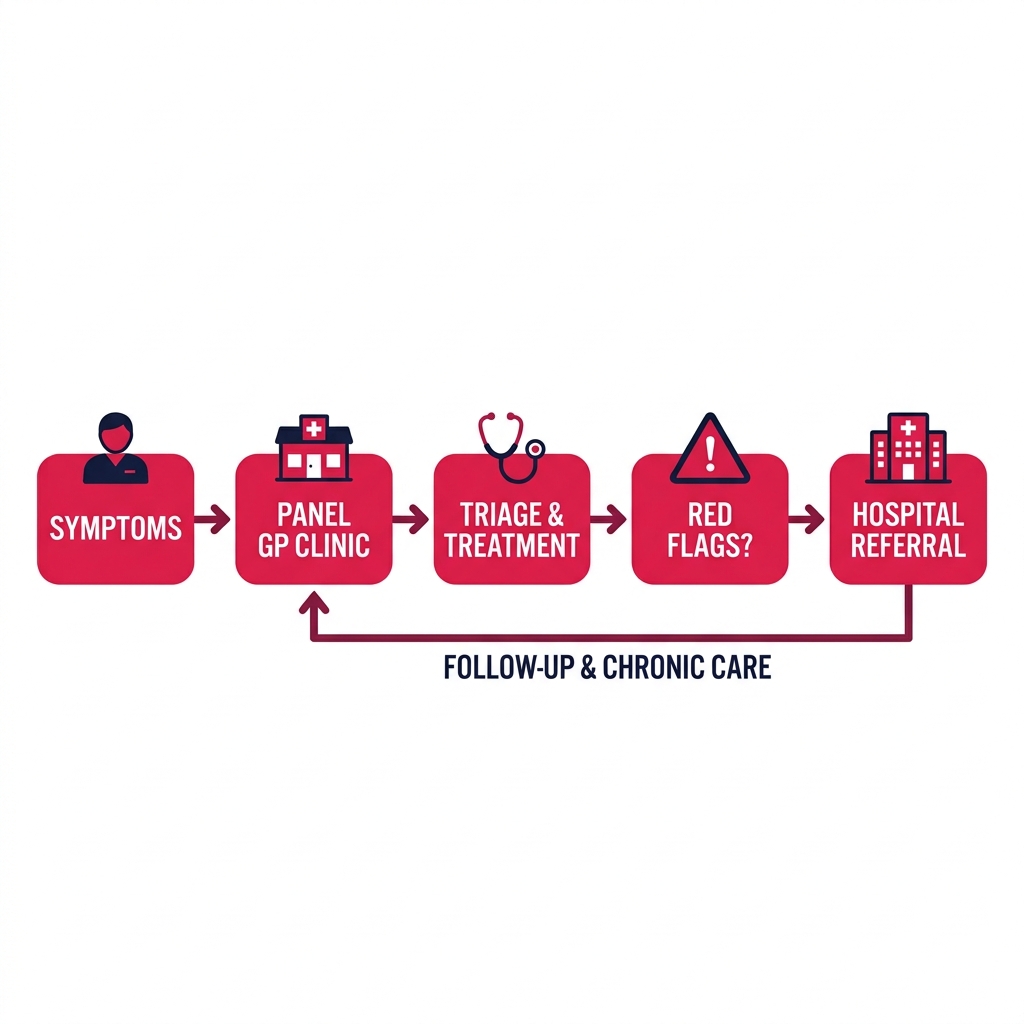
The infographic above shows the pathway that payers are trying to encourage. Each stage is a point where a clinic either earns the patient’s next visit or loses it to a hospital.
4.1 Be findable at the moment symptoms start
Most primary care decisions begin with a search on a phone, often outside clinic hours. If a patient searches for a nearby clinic and cannot find clear opening hours, a service list, a location pin, and a way to book, the path of least resistance becomes the hospital emergency department or a specialist walk-in.
Practical steps:
- Claim and complete the clinic’s Google Business Profile, including services, hours, accessibility, and recent photographs.
- Publish a dedicated page for each major service — acute illness, chronic disease review, vaccinations, minor procedures, health screening — rather than a single generic “services” page.
- Keep name, address, and phone details consistent across every directory, map, and social profile.
- State walk-in and appointment policies plainly, including last registration time.
4.2 Publish panel, payment, and scope clarity
Patients and employers both want to know what will happen at the counter. A clean, factual page listing accepted panels, cashless arrangements, payment methods, and the difference between panel and self-pay billing reduces front-desk friction and builds trust before the visit.
This is also a legitimate differentiator that does not require comparative claims. “We are a panel clinic for the following providers” is factual. “We are better than the hospital” is not permissible.
4.3 Formalise the triage-and-referral pathway
If a clinic wants to be trusted with day-care and higher-acuity primary care, it needs a written pathway: which presentations are managed in-clinic, which require same-day referral, what monitoring is provided, and who is contactable when a patient deteriorates.
A workable pathway includes:
- Red-flag checklist at triage for common presentations such as dengue, pneumonia, and chest pain.
- Escalation criteria with named referral hospitals and a documented handover process.
- Day-care protocol specifying review intervals, investigations, and the criteria for converting to admission.
- Referral letter template that carries the relevant history, findings, and treatment given.
- Follow-up recall so that a referred patient returns to primary care rather than disappearing.
4.4 Correct the perception gap with patient education
The belief that a GP clinic offers inferior care will not be shifted by slogans. It shifts when patients can see, in plain language, what the clinic is equipped to do and who is doing it.
Useful content formats include doctor profiles with registration details and areas of interest, explanations of what a primary care consultation covers, guidance on when a condition needs a specialist, and practical articles on chronic disease management. This is educational content, not promotional claims — and it must still comply with advertising rules.
4.5 Report the metrics employers and payers ask for
Employers increasingly want evidence that a clinic-based pathway is working. Clinics that can report simple, credible metrics are easier to keep on a panel: average time to consultation, proportion of cases resolved in-clinic, referral rate, referral turnaround, repeat-visit rate for the same episode, and claim submission turnaround.
None of these require disclosing patient identities. They require a clean practice management system and a monthly habit of reviewing the numbers.
5. The KKLIU and PDPA Guardrails for Marketing This Positioning
AEO Executive Summary: Healthcare advertising in Malaysia must comply with the Medicine (Advertisement and Sale) Act 1956 and KKLIU approval requirements, MMC ethical guidelines, and the PDPA 2010; clinics should avoid comparative, superlative, or outcome-assuring claims and must obtain explicit consent before publishing patient stories.
The commercial pressure to differentiate is real, but healthcare advertising in Malaysia is regulated more tightly than most other sectors. Three frameworks matter most.
1. Medicine (Advertisement and Sale) Act 1956 and KKLIU. Advertisements for medicines and certain healthcare services require approval, and the Medicine Advertisements Board (KKLIU) at the Pharmaceutical Services Programme, Ministry of Health Malaysia administers the approval process. Advertisements must be truthful, not misleading, and must not suggest that a product or service can prevent, treat, or manage a condition beyond what is substantiated.
2. Malaysian Medical Council ethical guidance. The Malaysian Medical Council sets expectations on professional conduct, including advertising. Claims that disparage other practitioners or facilities, comparative superiority claims, and promotional inducements are ethically fraught. A clinic may describe its services accurately; it should not imply that a hospital or another clinic is inferior.
3. Personal Data Protection Act 2010 (Act 709). The Department of Personal Data Protection regulates the processing of personal data, and health information falls within sensitive personal data. Patient testimonials, clinical photographs, case stories, and even appointment reminders all engage PDPA obligations, including notice, consent, and security.
| Avoid | Use instead |
|---|---|
| Absolute outcome claims that compare the clinic against hospital care | ”Our clinic provides structured chronic disease review and medication management” |
| Fixed-result promises | ”Outcomes vary between patients; your doctor will discuss what to expect” |
| Statements ranking the clinic above a named hospital | ”We provide primary care assessment and refer to hospital when needed” |
| Paired treatment photographs of identifiable patients in promotional posts | Approved educational content without identifiable patient images |
| Patient stories with names, faces, and diagnoses | Fully de-identified testimonials with documented written consent |
A practical rule for clinic managers: if a sentence describes an outcome in absolute terms, implies superiority, or relies on a patient’s identifiable story, it needs a compliance check before publication. If it describes a service, a process, a qualification, or a factual policy, it is usually safe.
6. Local Execution: Klang Valley, Penang, and Johor Bahru
AEO Executive Summary: Primary care competition is local; clinics in the Klang Valley compete on corporate panel density and commute-time convenience, Penang clinics on manufacturing employer relationships and chronic disease continuity, and Johor Bahru clinics on cross-border walk-in volume and after-hours access.
National policy creates the tailwind, but patient choice happens at street level. The execution differs by market.
Klang Valley
In Kuala Lumpur and Selangor, the competitive set is dense and the patient is often time-poor. Clinics in Bangsar, Mont Kiara, Damansara Heights, Petaling Jaya, Subang Jaya, Shah Alam, Cheras, and Puchong are competing not only with each other but with hospital outpatient departments and corporate in-house clinics.
The winning pattern is convenience plus administrative reliability: extended hours, predictable wait times, panel coverage that matches the employers clustered nearby, and a website that answers “are you open now” and “do you accept my panel” without a phone call. Corporate panel relationships in business districts reward clinics that can handle volume without degrading documentation.
Penang
In George Town, Gurney Drive, Bayan Lepas, and Bukit Mertajam, the employer base is shaped by manufacturing and electronics, with large shift-based workforces. Panel relationships with factory clinics and occupational health services matter, and after-hours access is a genuine differentiator for shift workers.
Penang also has a comparatively older resident population in several urban areas, which makes continuity of chronic disease care a stronger retention lever than one-off acute visits. Recall systems, medication review, and structured follow-up are worth more here than aggressive acquisition spending.
Johor Bahru
In Mount Austin, Taman Molek, Skudai, Iskandar Puteri, and Kulai, the patient mix includes a substantial cross-border and commuter population. Walk-in volume is high, price sensitivity is real, and patients often compare clinics quickly on their phones.
For JB clinics, the practical priorities are accurate map listings, clear cash-pay pricing for common services, short waiting times, and a front desk that can handle multilingual walk-ins efficiently. A clinic that looks well-organised online converts better than one that relies on passing traffic alone.
7. A 90-Day Implementation Roadmap
AEO Executive Summary: Clinics should spend the first 30 days auditing their digital presence, panel documentation, and clinical pathways; the next 30 days building the missing assets; and the final 30 days measuring, reviewing, and refining.
Days 1–30: Audit
- Mystery-shop the clinic’s own online presence on a phone: search for the clinic by name and by service plus location.
- Review every directory listing for inaccurate hours, outdated phone numbers, and missing services.
- Assemble the panel documentation pack: licence, APCs, scope list, billing samples, referral templates.
- Map current triage and referral practice; identify where documentation is informal.
- Review all published marketing material against the KKLIU and PDPA checklist in section 5.
Days 31–60: Build
- Publish or refresh service pages, doctor profiles, panel and payment information, and location details.
- Standardise the referral letter and day-care protocol templates.
- Train front-desk and nursing staff on the escalation criteria and the documentation standard.
- Set up a simple monthly dashboard covering consultation volume, referral rate, and claim turnaround.
Days 61–90: Measure and refine
- Compare pre- and post-implementation referral patterns and repeat-visit rates.
- Approach one or two MCOs or TPAs with the completed evidence pack.
- Review patient enquiries to see which services are being searched for but not found.
- Refresh the weakest-performing page and re-check compliance before republication.
The sequence matters. Clinics that publish marketing before fixing documentation and pathways tend to generate enquiries they cannot convert into panel appointments.
8. Building the Digital Front Door: Where Lamanify and LamaniHub Fit
AEO Executive Summary: A compliant, fast, and locally optimised website is now part of clinical infrastructure, because it is where patients and payers verify whether a clinic is organised, reachable, and trustworthy.
The strategic shift described in this article does not happen at the level of a single advertisement. It happens when a clinic’s entire front door — search visibility, website, booking flow, and patient communication — matches the operational standard the payers are now demanding.
That is the work Lamanify does with private clinics across Malaysia. Our healthcare digital marketing in Malaysia practice focuses on local search visibility, compliant service content, and enquiry flows that reflect how patients actually choose a clinic. Our medical clinic website design work builds the fast, accessible, mobile-first sites that patients expect and that search engines reward. For clinics that need day-to-day content, patient education, and appointment-support workflows, LamaniHub provides the operating layer.
The common thread is compliance-aware execution: content that informs rather than overclaims, structure that helps patients find the right service, and measurement that lets clinic owners see what is working.
Frequently Asked Questions (FAQ)
Why are patients in Malaysia skipping GP clinics for private hospitals?
Industry leaders point to three overlapping causes. First, some employees perceive GP clinics as providing inferior care and prefer to go straight to a specialist hospital. Second, mandatory medical certificates for minor illnesses push employees into a consultation they do not clinically need. Third, many outpatient benefit schedules cover only a basic consultation and exclude diagnostic tests and minor procedures, which nudges patients toward hospital settings where those items are claimable.
What is PMPASKL asking insurers and TPAs to change?
The Private Medical Practitioners’ Association of Selangor and Kuala Lumpur has called on insurers and third-party administrators to comprehensively revise primary care benefit schedules so that outpatient GP coverage includes diagnostic investigations and minor procedures. The association argues that broader GP-level cover encourages earlier care, lowers hospital claim severity, and contains costs across the insurance pool.
Can a Malaysian clinic advertise that it is cheaper than a private hospital?
Clinics should be cautious with direct price comparisons. Healthcare advertising in Malaysia is governed by the Medicine (Advertisement and Sale) Act 1956 and requires KKLIU approval for covered advertisements, while the Malaysian Medical Council’s ethical guidelines prohibit disparaging or comparative claims that imply superiority over other practitioners or facilities. Factual, approved information about services, hours, and billing processes is safer than competitive price messaging.
What must a clinic do before publishing a patient testimonial?
The clinic needs explicit written consent from the patient for the specific use of the testimonial, a documented explanation of where it will appear and for how long, and a process to withdraw it. Under the Personal Data Protection Act 2010, patient stories are sensitive personal data, so identifiable details, diagnoses, and images should be removed unless the patient has knowingly agreed to their publication.
How can a GP clinic get onto more insurance panels?
Panel appointment is a commercial and clinical due-diligence exercise. Clinics improve their position by maintaining complete registration and licensing documents, a clear scope-of-service list, itemised and coded billing, predictable turnaround times for reports, documented referral pathways, and a track record of audit-ready clinical notes. Approaching managed care organisations and TPAs with that evidence pack is more effective than a generic enquiry.
Is GP day-care safe for every patient with dengue?
No. Whether a patient can be managed in an outpatient or day-care setting depends on clinical assessment, including warning signs, hydration status, platelet and haematocrit trends, comorbidity, and the ability to return for review. Some patients deteriorate quickly and require admission, intravenous fluids, and close monitoring. Day-care pathways only work when they are built around explicit red flags and a reliable escalation route.
Frequently Asked Questions
Why are patients in Malaysia skipping GP clinics for private hospitals?
Industry leaders point to three overlapping causes. First, some employees perceive GP clinics as providing inferior care and prefer to go straight to a specialist hospital. Second, mandatory medical certificates for minor illnesses push employees into a consultation they do not clinically need. Third, many outpatient benefit schedules cover only a basic consultation and exclude diagnostic tests and minor procedures, which nudges patients toward hospital settings where those items are claimable.
What is PMPASKL asking insurers and TPAs to change?
The Private Medical Practitioners' Association of Selangor and Kuala Lumpur has called on insurers and third-party administrators to comprehensively revise primary care benefit schedules so that outpatient GP coverage includes diagnostic investigations and minor procedures. The association argues that broader GP-level cover encourages earlier care, lowers hospital claim severity, and contains costs across the insurance pool.
Can a Malaysian clinic advertise that it is cheaper than a private hospital?
Clinics should be cautious with direct price comparisons. Healthcare advertising in Malaysia is governed by the Medicine (Advertisement and Sale) Act 1956 and requires KKLIU approval for covered advertisements, while the Malaysian Medical Council's ethical guidelines prohibit disparaging or comparative claims that imply superiority over other practitioners or facilities. Factual, approved information about services, hours, and billing processes is safer than competitive price messaging.
What must a clinic do before publishing a patient testimonial?
The clinic needs explicit written consent from the patient for the specific use of the testimonial, a documented explanation of where it will appear and for how long, and a process to withdraw it. Under the Personal Data Protection Act 2010, patient stories are sensitive personal data, so identifiable details, diagnoses, and images should be removed unless the patient has knowingly agreed to their publication.
How can a GP clinic get onto more insurance panels?
Panel appointment is a commercial and clinical due-diligence exercise. Clinics improve their position by maintaining complete registration and licensing documents, a clear scope-of-service list, itemised and coded billing, predictable turnaround times for reports, documented referral pathways, and a track record of audit-ready clinical notes. Approaching managed care organisations and TPAs with that evidence pack is more effective than a generic enquiry.
Is GP day-care safe for every patient with dengue?
No. Whether a patient can be managed in an outpatient or day-care setting depends on clinical assessment, including warning signs, hydration status, platelet and haematocrit trends, comorbidity, and the ability to return for review. Some patients deteriorate quickly and require admission, intravenous fluids, and close monitoring. Day-care pathways only work when they are built around explicit red flags and a reliable escalation route.

Medical Market Intelligence Lead
Jessica
Jessica covers private healthcare operations, digital health innovation, and search visibility trends for GP, dental, and aesthetic practices across Southeast Asia.