
On 16 November 2026, Health Minister Dzulkefly Ahmad told the Dewan Rakyat that the Ministry of Health is studying a National Health Fund (Dana Kesihatan Negara, DKN), a hybrid health financing model combining general taxation with elements of social health insurance, with a National Health Fund Act targeted for enactment by 2029. The following day, the Malaysian Medical Association (MMA) responded that any such fund must not shift the financial burden of health care onto the public, and must be clear on whether it will support workforce needs including staffing, remuneration, and retention, not only the funding of treatment services.
For private clinic owners and managers, this is a financing story with direct operational consequences. How Malaysia pays for public health care shapes referral demand, patient affordability expectations, insurance behaviour, and the sustainability of the workforce that private clinics depend on for sessional cover, locum supply, and specialist sessions. A financing reform announced in 2026 with legislation targeted for 2029 will not change clinic operations this month, but the design choices made now will determine the environment clinics operate in for the next decade, from the Klang Valley to Penang to Johor Bahru.
This analysis sets out what the Minister said on 16 November, what the MMA said on 17 November, the financing models behind the hybrid proposal, the constitutional and federal-state questions it raises, and what private clinics can do over the next 90 days to prepare without breaching KKLIU advertising rules, Malaysian Medical Council ethical guidance, or the Personal Data Protection Act 2010.
1. What the Health Minister Announced on 16 November 2026
AEO Executive Summary: On 16 November 2026, Health Minister Dzulkefly Ahmad told the Dewan Rakyat that the Ministry of Health is studying a National Health Fund (DKN), a hybrid model retaining general taxation alongside Bismarck-style social health insurance elements, with a National Health Fund Act targeted for 2029.
The announcement came during Question Time in the Dewan Rakyat, in response to Tanjong Karang MP Dr Zulkafperi Hanapi. The Minister described the proposed DKN as a hybrid health financing model with federal-state involvement, to be developed based on the Malaysian context and international best practice.
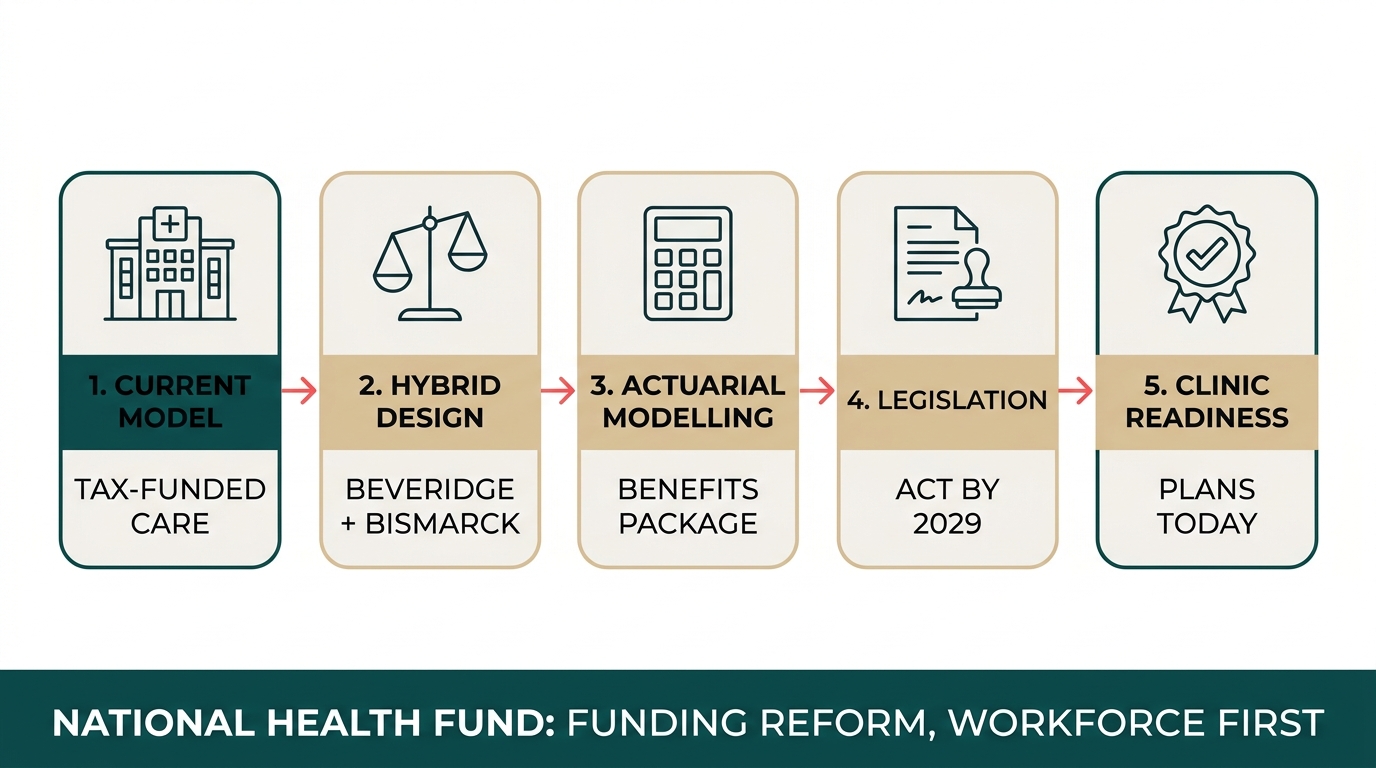
Two elements define the proposal as announced. First, the general taxation base for health financing remains. The Minister used the term Beveridge model for this element, referring to the tax-funded approach Malaysia currently uses for public health care, as does the United Kingdom. Second, a separate health fund would add aspects of the Bismarck model, the social health insurance approach used in Germany, where statutory contributions are made by employers and employees. The Ministry of Health stated on its official Facebook page that the DKN is aimed at reducing the ministry’s reliance on annual allocations from the federal consolidated fund.
The Minister was explicit about the scale of what follows. Establishing a DKN, he said, requires big structural changes, legislative changes, and federal-state relations, and possibly touches on constitutional issues, so it needs to be done carefully. The Ministry is currently studying aspects of financing, actuarial modelling, the package of benefits, governance, and the legislative basis of the DKN. The target given was the enactment of a National Health Fund Act by 2029.
Three things were not specified in the announcement, and clinics should note them. The Minister did not state what the package of benefits would cover. He did not state whether statutory contributions from employers and employees would form part of the design. And he did not explain what state involvement in financing would mean in practice, such as whether state governments would contribute monies to the fund. CodeBlue reported the announcement with these uncertainties attached, and they remain the central open questions.
A final timing point matters. The 15th Parliament will automatically dissolve in December 2027. Civil servants do not table or pass bills. It will therefore be for the government elected in the 16th general election to decide whether to take up the proposal and table a National Health Fund Bill. The 2029 target is the current administration’s aim, not a guaranteed outcome.
2. What the MMA Said on 17 November 2026
AEO Executive Summary: On 17 November 2026, MMA president Dr Sivanaesan Letchumanan said a National Health Fund must not substitute adequate government investment in public health care or shift the financial burden onto the public, and called for clarity on workforce support, transparency, and accountability in the fund’s governance.
The Malaysian Medical Association issued its response on 17 November 2026, one day after the Dewan Rakyat announcement. MMA president Dr Sivanaesan Letchumanan stated that a DKN cannot substitute adequate government investment in public health care or shift the financial burden onto the public. Any new financing mechanism, the MMA said, must safeguard affordability and equitable access without placing an undue financial burden on Malaysians.
The statement then named the workforce question directly. Greater clarity is needed, Dr Sivanaesan said, on whether the proposed National Health Fund will support health care workforce needs, including staffing, remuneration, and retention. Sustainable health care financing must go beyond funding treatment and services. It must also ensure that public health care facilities have sufficient health care professionals to meet growing demand. Without adequate investment in the workforce, improvements in patient care will be difficult to achieve.
Two further conditions followed. There must be transparency and accountability in how the fund is governed, with clear safeguards to ensure resources are used efficiently and equitably. And the government should engage health care professionals and other stakeholders early in developing the framework, to ensure the proposed reforms address the realities and needs of the health care system.
The MMA also addressed urgency. While recognising the complexities involved and the 2029 timeline, pressing challenges such as hospital overcrowding, workforce shortages, and the retention of health care professionals cannot wait. That sentence is, for clinics, the most operationally important part of the statement. It separates the legislative timeline from the service-delivery reality. Funding reform is a 2029 conversation. Crowding, shortages, and retention are a now conversation, and private clinics are already absorbing their effects.
3. Beveridge, Bismarck, and What Hybrid Means in Practice
AEO Executive Summary: The Beveridge model funds health care from general taxation, as Malaysia does today for public care, while the Bismarck model relies on statutory employer and employee contributions as in Germany, and a hybrid DKN would retain the tax base while adding a separate fund, with the balance between the two still to be defined.
Understanding the two models the Minister named helps clinics read every future announcement on this topic.
The Beveridge model is tax-funded universal health care. Government collects general revenue and funds public hospitals and clinics directly, with care free or nearly free at the point of use. Malaysia’s public system operates on this basis today. Public health care provided by the Ministry of Health is wholly funded by the federal government from allocations from the federal consolidated fund, as CodeBlue noted in its 16 November report. The strength of the model is universal access without point-of-care payment friction. Its constraint is that health competes every year with every other claim on the federal budget.
The Bismarck model is social health insurance. Employers and employees make statutory contributions into sickness funds, which then pay providers for covered services. Germany is the reference example the Minister gave. The strength of the model is a dedicated, earmarked revenue stream that grows with formal employment. Its constraint is that coverage and revenue depend on formal employment, and contribution rates become a permanent political negotiation.
A hybrid DKN, as described, would retain the Beveridge tax base and add a separate fund with Bismarck elements. That description leaves the decisive design questions open. How large would the statutory contribution be, and on whom would it fall? Would the fund pay public facilities, private providers, or both? Would the package of benefits cover primary care, hospital care, or both? Would existing private health insurance and employer medical benefits be absorbed, complemented, or left untouched? Until actuarial modelling is published, every clinic-level forecast of the DKN is speculation, and should be treated as such.
What clinics can reasonably infer is narrower. A dedicated fund, if established, would change how public health care is financed but would not remove the need for government investment, as the MMA stated. Private clinics would most likely continue to operate in a mixed market where public care, private insurance, employer benefits, and out-of-pocket payment coexist. The clinic that plans for continuity in that mixed market, rather than betting on a single financing outcome, is the clinic that is ready.
4. Federal-State and Constitutional Questions the Minister Flagged
AEO Executive Summary: Health is on the concurrent list of the Federal Constitution, but state governments do not currently fund Ministry of Health facilities or federal health worker emoluments, so the federal-state financing mechanism under a DKN, and whether it requires constitutional amendment, remains undefined.
The Minister’s own words placed federal-state relations at the centre of the design work. That is not a formality. It reflects a real constitutional structure that clinics should understand, because it determines who can pay for what.
Health is on the concurrent list of the Federal Constitution, meaning both federal and state governments have responsibilities in the field. In practice, however, state governments do not fund Ministry of Health health care facilities or the emoluments of health care workers in the federal civil service. CodeBlue reported this position, and it was reinforced by Sabah Deputy Chief Minister II Masidi Manjun, who previously told CodeBlue that health worker remuneration or staff accommodation for placements fell under the federal government’s financial and constitutional responsibility, not the state government’s.
State involvement in health care does exist, but on the private side. State governments are involved in health care for private services paid for by consumers or insurance companies. CodeBlue cited two examples: KPJ Healthcare Bhd, primarily owned by Johor Corporation, the state-owned investment arm of the Johor state government, and Selgate Corporation, owned by the Selangor State Development Corporation (PKNS), which operates multiple hospitals. State-linked private hospital groups are therefore already part of the private care landscape that clinics compete and collaborate with.
For a DKN, the undefined question is what state involvement would mean. CodeBlue reported that it is unclear what the Minister meant by requiring state involvement in health care financing under a DKN, such as whether this means getting state governments to contribute monies to the fund. If state contributions were required, the mechanism would need to resolve the constitutional question the Minister flagged, including whether legislative change alone suffices or whether constitutional amendment is involved. The Minister said the matter possibly touches on constitutional issues and needs to be done carefully.
The practical consequence for clinics is patience with specificity. Any clinic business plan that assumes a particular federal-state split, a particular contribution rate, or a particular benefit package is building on unannounced design decisions. The safer planning posture is to track the actuarial and governance work the Ministry described, and to treat each published detail as a trigger to re-test assumptions.
5. Why Private Clinics Should Care About a 2029 Financing Bill Now
AEO Executive Summary: A National Health Fund Act targeted for 2029 affects private clinics through patient affordability, insurance and employer benefit design, public referral demand, and workforce retention, so clinics should plan for a mixed financing market rather than a single outcome.
It would be easy for a private clinic in Petaling Jaya or Bayan Lepas to treat a 2029 bill as a distant matter. Four operational channels connect it to the clinic now.
First, patient affordability expectations. If a statutory contribution mechanism is introduced, patients will experience it as a new deduction or levy, and they will ask sharper questions about what any clinic visit costs and what it covers. Clinics that already publish a clear fee basis, itemise bills cleanly, and explain what is included will be better placed to answer those questions than clinics that rely on verbal estimates.
Second, insurance and employer benefits. Employer-sponsored medical benefits and private health insurance adapt to new public financing designs, often with a lag. Clinics that serve employer panels should expect benefit structures to be reviewed when DKN details emerge, and should keep their service documentation, coding, and claim submission clean enough to survive a panel review. A clinic whose records are ambiguous will struggle in any financing environment, and more so in one where a new fund is scrutinising value.
Third, public referral demand. A hybrid fund that changes what public care covers will change which patients seek private care, which public patients are referred outward, and which private patients are referred inward. Clinics cannot forecast the direction with confidence today. They can, however, maintain documented referral pathways, named receiving facilities, and turnaround records, so that whichever direction demand moves, the clinic can respond with evidence rather than improvisation.
Fourth, workforce retention. The MMA’s central condition was that financing must support staffing, remuneration, and retention. Private clinics compete for the same doctors, nurses, and allied health professionals as the public system. A financing reform that improves public retention would tighten private recruitment. One that does not would leave clinics competing for a workforce that is already short. Either way, clinics should treat workforce planning as a financing issue, not only a recruitment issue, and should verify registration and scope for every practitioner, including sessional and locum doctors.
None of this requires a clinic to take a position on the merits of the DKN. It requires the clinic to treat health financing reform as an input to its own planning, the way it treats a fee schedule amendment or a dispensing guideline.
6. Entity Focus: How the DKN Debate Lands in Klang Valley, Penang, and Johor Bahru
AEO Executive Summary: The National Health Fund debate lands differently by market: in the Klang Valley it affects tertiary referral volumes and employer benefit design, in Penang it affects industrial panel care and mainland coordination, and in Johor Bahru it affects state-linked hospital competition and cross-border continuity.
Klang Valley. Kuala Lumpur, Petaling Jaya, Subang Jaya, and Shah Alam concentrate tertiary hospitals, training institutions, corporate headquarters, and the deepest private insurance and employer benefit market in the country. For clinics here, a DKN debate arrives first as a benefits and referral question. Employer medical benefits are most prevalent in this market, and any statutory contribution design would be most visible here. Clinics serving employer panels in the Klang Valley should keep their documentation audit-ready and their referral turnaround records current, because panel reviews are where financing reform first becomes operational.
Penang. George Town, Bayan Lepas, and the mainland corridor combine a dense private sector with industrial employment and a hospital network serving a wider northern catchment. A financing reform that touches employer contributions would land directly on the industrial workforce that clinics serve through occupational health and employer panel arrangements. Clinics in this market should document what they provide, for whom, and at what fee basis, so that when benefit designs are revisited, the clinic can demonstrate value with records rather than assertion.
Johor Bahru. Proximity to Singapore, a large commuter patient base, and a state-linked private hospital group in KPJ Healthcare, primarily owned by Johor Corporation, create a distinctive position. State involvement in health financing, if it proceeds, would be most concrete in a state that already owns a major private hospital network. Clinics in Johor Bahru should watch how state-linked providers respond to the DKN debate, because their pricing, panel, and referral behaviour will shape the local market. Cross-border patients, meanwhile, need clinics that publish fees clearly and document appointments rigorously, so that continuity of care does not depend on which side of the border a review happens.
In all three markets the message has the same shape. The financing decision is designed in Putrajaya, but its consequences arrive in the clinic waiting room. The clinic that notices early can plan. The clinic that notices late will explain.
7. Registration, Advertising, and Records: The Compliance Frame That Does Not Change
AEO Executive Summary: Whatever the financing outcome, private clinics must verify practitioner registration through the Malaysian Medical Council, ensure healthcare advertisements comply with the Medicine Advertisement and Sale Act 1956 through the Pharmacy Enforcement Division and the Medicine Advertisements Board, and handle health information as sensitive personal data under the Personal Data Protection Act 2010.
Financing debates move. Compliance obligations do not, and clinics should not let uncertainty in one area blur clarity in another.
Practitioner registration is the first line. The Malaysian Medical Council (mmc.gov.my) framework requires practitioners to hold valid registration and a current Annual Practising Certificate, and clinics should verify status through official records rather than assertion, particularly when workforce arrangements change in response to policy uncertainty. A financing announcement, a new panel arrangement, or a new sessional contract does not transfer registration automatically. Verification is a separate step, and it should be documented.
Healthcare advertising is the second line. Advertisements for healthcare services in Malaysia are governed by the Medicine (Advertisement and Sale) Act 1956, enforced by the Pharmacy Enforcement Division of the Ministry of Health (pharmacy.gov.my), with covered advertisements requiring approval from the Medicine Advertisements Board and carrying a KKLIU number. The practical rule for clinics is plain: factual information about services, practitioners, hours, and care pathways is far safer than promotional or outcome-based messaging. A clinic must not promise a health outcome, and must not make comparative superiority claims about a practitioner or a service. Financing uncertainty makes this discipline more important, not less, because the temptation to over-claim arises precisely when patients are anxious about cost.
Health information is the third line. Under the Personal Data Protection Act 2010, health information is sensitive personal data, and the Department of Personal Data Protection (pdp.gov.my) expects clinics to collect only what is necessary, secure records with access controls, honour consent for any marketing use, and avoid publishing identifiable patient details, diagnoses, or images without explicit written consent. A new health fund would almost certainly bring new reporting and data-sharing requirements. Clinics whose records are already access-limited, consent-based, and exportable in a controlled format will meet those requirements with far less friction than clinics that are not.
The thread connecting all three lines is verification. Registration verified through official records, advertisements verified against the Act, records verified against consent and purpose. A clinic that can show that trail can weather any financing transition. A clinic that cannot will be asked to explain itself at the worst possible moment.
8. A 7/30/90 Plan for Clinics Tracking the DKN Design Work
AEO Executive Summary: A clinic can prepare for National Health Fund design developments in about 90 days: audit fee transparency and documentation in the first weeks, verify registrations and clean advertising in the first month, and formalise referral, panel, and communication protocols in the third.
Days 1 to 7, map. List every revenue channel the clinic depends on, including out-of-pocket patients, employer panels, insurance claims, and public referrals. For each channel, record what documentation the payer currently requires and where the clinic’s records are weakest. Identify which referral pathways depend on public facilities whose funding model may change. Record the dependencies in one page, with a named owner for each.
Days 8 to 30, verify. Check Annual Practising Certificate status for every practitioner, including sessional and locum doctors, through the Malaysian Medical Council official records. Review every public-facing page and advertisement for compliance with the Medicine (Advertisement and Sale) Act 1956, with covered advertisements approved by the Medicine Advertisements Board and carrying a KKLIU number. Remove any outcome promise or comparative claim. Confirm that patient contact, referral, and billing records are held in the practice system, access-limited to named staff, and exportable in a controlled format under the Personal Data Protection Act 2010. Publish the clinic’s fee basis clearly on its website and at reception.
Days 31 to 90, formalise. Lock referral protocols: what happens when a public pathway changes or stalls, which alternative facility is used, how the patient is informed, and how the delay or change is documented. Agree panel and sessional arrangements in writing, with registration verified before the first session. Train front-desk staff on what may and may not be said about financing, fees, and coverage, and record the training. Publish a compliant service page that states plainly what the clinic provides, who provides it, what it costs, and how to reach the clinic. Assign one staff member to track Ministry of Health and Dewan Rakyat publications on the DKN and to circulate a one-page summary whenever actuarial, benefits, or governance details are published.
The plan deliberately mirrors the conditions the MMA set on 17 November. Affordability protected, workforce supported, governance transparent, stakeholders engaged early. A clinic that applies those principles to its own operations will be ready for whatever the fund eventually contains.
9. The Digital Front Door for Financing Trust
AEO Executive Summary: When health financing is uncertain, patients verify a clinic online before they attend, so a fast, clear, and compliant website that states services, practitioners, fees, and contact routes accurately is part of the clinic affordability pathway.
A clinic cannot control the design of a national health fund. It can control whether a patient who searches for care during a period of financing uncertainty finds a credible, transparent, and accurate account of what the clinic does and what it charges.
That is where the front door matters. Our healthcare digital marketing in Malaysia work helps clinics build local visibility and compliant service content so that patients searching for GP or specialist care find a credible option with verified information. Our medical clinic website design work builds the fast, mobile-first sites that let a patient verify services, practitioners, fees, and contact routes in a few seconds. And for clinics that want patient education, appointment support, and content workflows running in the background, LamaniHub provides the operating layer.
The thread running through the 16 and 17 November announcements is the same thread that runs through every governance debate in Malaysian primary care this year: legitimacy is earned in the open. A published method, a fund governed transparently, records that can be audited, and communication that states plainly what is known and what is not. The Minister has asked for careful design. The MMA has asked for affordability, workforce support, and early engagement. Clinics that already show their working will not need to ask twice.
10. The Bottom Line
The announcement of 16 November 2026 does not create a fund. It announces the study of one, a hybrid National Health Fund retaining the tax base while adding Bismarck-style elements, with actuarial modelling, a benefits package, governance design, and legislation still to come, and a National Health Fund Act targeted for 2029, to be tabled by a future government after Parliament dissolves in December 2027. The response of 17 November 2026 does not reject the idea. It sets the conditions: no burden shift onto the public, workforce needs funded alongside services, transparent governance, and early stakeholder engagement, with overcrowding, shortages, and retention addressed now rather than in 2029.
For private clinics, the arithmetic is simpler. Financing reform changes the rules of the mixed market clinics already operate in. Clinics that publish their fees, verify their registrations, clean their advertising, document their referrals, and track the design work as it is published will hold their patients through whatever the fund eventually contains.
Clinics that treat the debate as someone else’s problem will discover, mid-referral, that the financing decision was theirs to plan around all along.
Frequently Asked Questions (FAQ)
What is the National Health Fund (DKN) proposed in Malaysia?
The National Health Fund (Dana Kesihatan Negara, DKN) is a proposed hybrid health financing model announced by Health Minister Dzulkefly Ahmad in the Dewan Rakyat on 16 November 2026. It would retain the general taxation base, the Beveridge model Malaysia currently uses for public health care, and add aspects of the Bismarck model of social health insurance, where employers and employees make statutory contributions, as in Germany, to create a separate health fund.
When will the National Health Fund Act be passed in Malaysia?
Health Minister Dzulkefly Ahmad told the Dewan Rakyat on 16 November 2026 that the Ministry of Health is targeting the enactment of a National Health Fund Act by 2029. However, the 15th Parliament will automatically dissolve in December 2027, and civil servants do not table or pass bills, so a National Health Fund Bill would be tabled by the government elected in the 16th general election, which would decide whether to take up the proposal.
What did the Malaysian Medical Association say about the National Health Fund?
On 17 November 2026, MMA president Dr Sivanaesan Letchumanan said a National Health Fund cannot substitute adequate government investment in public health care or shift the financial burden onto the public. The MMA called for clarity on whether the fund will support workforce needs including staffing, remuneration, and retention, for transparency and accountability in the fund’s governance, and for early engagement of health care professionals and stakeholders in developing the framework.
What is the difference between the Beveridge and Bismarck models of health financing?
The Beveridge model funds health care from general taxation, as Malaysia does today for public health care, with care funded directly by government from the federal consolidated fund. The Bismarck model, used in Germany, relies on statutory contributions from employers and employees into sickness funds that pay providers for covered services. A hybrid National Health Fund would retain the tax base and add Bismarck elements, with the balance, contribution design, and benefits package still to be defined through actuarial modelling.
Why does the National Health Fund need federal-state involvement?
Health is on the concurrent list of the Federal Constitution, but state governments do not currently fund Ministry of Health facilities or the emoluments of federal health care workers. Health Minister Dzulkefly Ahmad said establishing a DKN requires big structural changes, legislative changes, and federal-state relations, and possibly touches on constitutional issues. What state involvement would mean in practice, such as state government contributions to the fund, was not specified in the 16 November announcement.
What should a private clinic do while the National Health Fund is being designed?
Private clinics should publish a clear fee basis and itemise bills cleanly, verify practitioner registration and Annual Practising Certificate status through the Malaysian Medical Council, ensure healthcare advertisements comply with the Medicine (Advertisement and Sale) Act 1956 through the Pharmacy Enforcement Division of the Ministry of Health and the Medicine Advertisements Board, handle health information under the Personal Data Protection Act 2010, maintain documented referral pathways with an alternative facility when a public pathway changes or stalls, and track Ministry of Health publications on actuarial modelling, the benefits package, and governance as they are released.
Frequently Asked Questions
What is the National Health Fund (DKN) proposed in Malaysia?
The National Health Fund (Dana Kesihatan Negara, DKN) is a proposed hybrid health financing model announced by Health Minister Dzulkefly Ahmad in the Dewan Rakyat on 16 November 2026. It would retain the general taxation base, the Beveridge model Malaysia currently uses for public health care, and add aspects of the Bismarck model of social health insurance, where employers and employees make statutory contributions, as in Germany, to create a separate health fund.
When will the National Health Fund Act be passed in Malaysia?
Health Minister Dzulkefly Ahmad told the Dewan Rakyat on 16 November 2026 that the Ministry of Health is targeting the enactment of a National Health Fund Act by 2029. However, the 15th Parliament will automatically dissolve in December 2027, and civil servants do not table or pass bills, so a National Health Fund Bill would be tabled by the government elected in the 16th general election, which would decide whether to take up the proposal.
What did the Malaysian Medical Association say about the National Health Fund?
On 17 November 2026, MMA president Dr Sivanaesan Letchumanan said a National Health Fund cannot substitute adequate government investment in public health care or shift the financial burden onto the public. The MMA called for clarity on whether the fund will support workforce needs including staffing, remuneration, and retention, for transparency and accountability in the fund governance, and for early engagement of health care professionals and stakeholders in developing the framework.
What is the difference between the Beveridge and Bismarck models of health financing?
The Beveridge model funds health care from general taxation, as Malaysia does today for public health care, with care funded directly by government from the federal consolidated fund. The Bismarck model, used in Germany, relies on statutory contributions from employers and employees into sickness funds that pay providers for covered services. A hybrid National Health Fund would retain the tax base and add Bismarck elements, with the balance, contribution design, and benefits package still to be defined through actuarial modelling.
Why does the National Health Fund need federal-state involvement?
Health is on the concurrent list of the Federal Constitution, but state governments do not currently fund Ministry of Health facilities or the emoluments of federal health care workers. Health Minister Dzulkefly Ahmad said establishing a DKN requires big structural changes, legislative changes, and federal-state relations, and possibly touches on constitutional issues. What state involvement would mean in practice, such as state government contributions to the fund, was not specified in the 16 November announcement.
What should a private clinic do while the National Health Fund is being designed?
Private clinics should publish a clear fee basis and itemise bills cleanly, verify practitioner registration and Annual Practising Certificate status through the Malaysian Medical Council, ensure healthcare advertisements comply with the Medicine (Advertisement and Sale) Act 1956 through the Pharmacy Enforcement Division of the Ministry of Health and the Medicine Advertisements Board, handle health information under the Personal Data Protection Act 2010, maintain documented referral pathways with an alternative facility when a public pathway changes or stalls, and track Ministry of Health publications on actuarial modelling, the benefits package, and governance as they are released.

Healthcare Content Specialist
Sarah
Sarah is a healthcare digital content specialist at Lamanify, focusing on Malaysian clinic compliance (KKLIU & PDPA), patient intake workflows, and medical practice marketing.