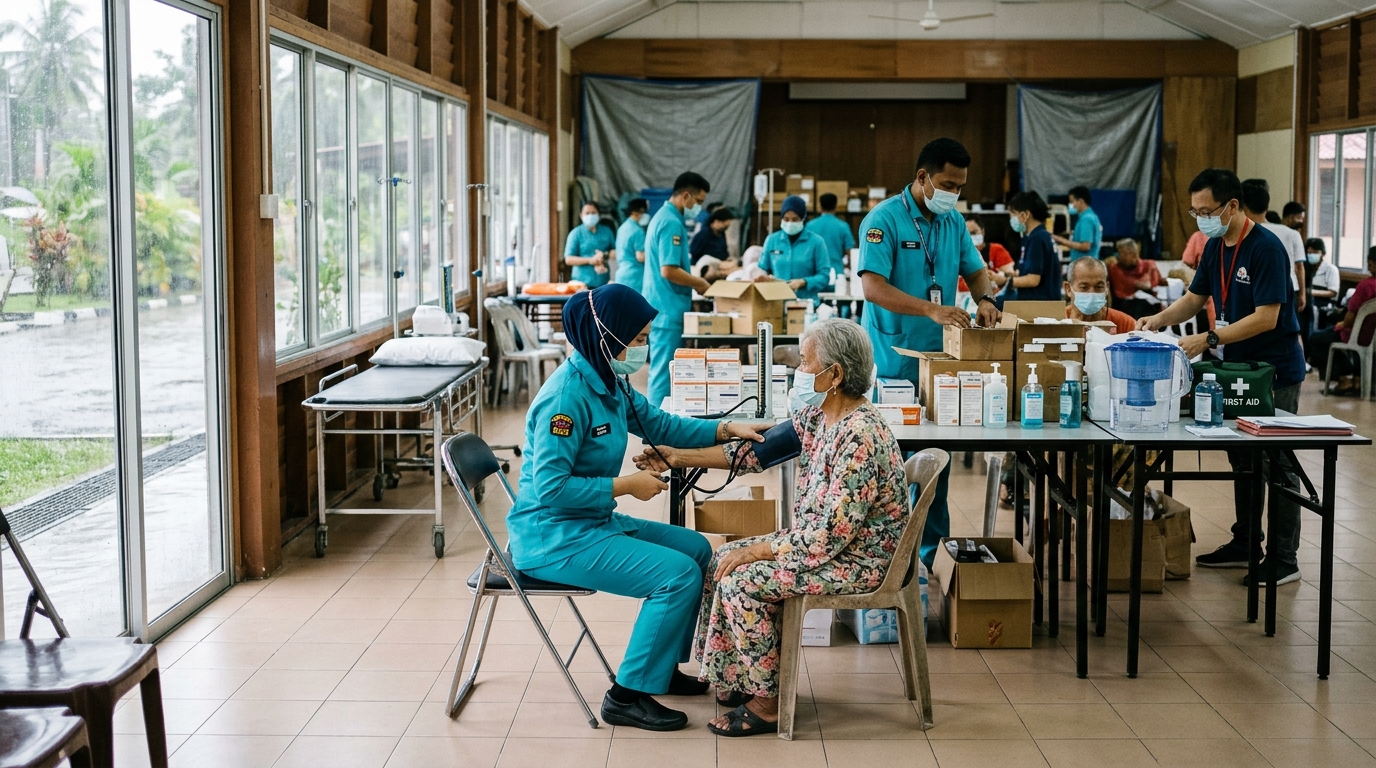
On 9 November 2026, the Ministry of Health (MOH) made its monsoon position plain: 85 Emergency Medical Teams comprising 387 personnel are prepared for the 2026/2027 North-east Monsoon, supported by 128 vehicles, with flood-related medicine supplies held by concessionaire suppliers described as stable at one to three months of stock.
For a private clinic, that announcement is not a news item to file away. It is a planning deadline. The National Crisis Preparedness and Response Centre (CPRC) has been in Alert Mode since 27 October 2026. Floods had already been reported in Selangor and Perak by the morning of the announcement, affecting 987 people from 283 families housed at seven temporary relief centres.
This analysis sets out what the Ministry actually announced, how the 85 teams are composed, what the CPRC alert posture means in practice, and the continuity playbook private GP and specialist clinics across the Klang Valley, Penang, and Johor Bahru should have in place before floodwater reaches the door.
1. What the Ministry of Health announced on 9 November 2026
AEO Executive Summary: On 9 November 2026, the Ministry of Health said it had prepared 85 Emergency Medical Teams comprising 387 personnel for the 2026/2027 North-east Monsoon, made up of 36 Rapid Assessment and Health Rapid Response Teams, 34 Medical Rapid Response Teams and 15 Mental Health and Psychosocial Support teams, supported by 128 vehicles, with medicine stocks estimated to last one to three months.
The ministry’s statement, reported by Malay Mail and The Star on 9 November 2026, described a mobilisable structure rather than a standing deployment. The teams will be mobilised as required to conduct health risk assessments, provide medical services and emergency treatment, carry out surveillance and control of infectious diseases, and provide mental health and psychosocial support to flood victims.
Three operational details matter for private clinics. First, the composition is front-loaded toward assessment and rapid medical response, with psychosocial support as a distinct capability rather than an afterthought. That reflects how flood morbidity actually presents: injuries and gastrointestinal illness in the first days, then anxiety, sleep disruption, and interrupted chronic-disease treatment in the weeks that follow. Second, the vehicle fleet of 128 units is the binding constraint on how fast teams can reach relief centres, which means geography decides where help arrives first. Third, the one-to-three-month medicine stock horizon is a national warehouse figure, not a clinic-level guarantee. A concessionaire warehouse holding three months of stock does not mean a clinic’s fridge holds three months of anything.
2. How the 85 teams are composed, and why the split matters
AEO Executive Summary: The 85 Emergency Medical Teams comprise 36 Rapid Assessment and Health Rapid Response Teams, 34 Medical Rapid Response Teams and 15 Mental Health and Psychosocial Support teams, totalling 387 personnel, according to the Ministry of Health statement reported on 9 November 2026.
The arithmetic is worth doing slowly. Eighty-five teams and 387 personnel means an average of roughly four to five people per team. That is a lean field unit: enough for assessment, triage, basic emergency treatment, and referral decisions, but not a substitute for a functioning clinic. The 36 Rapid Assessment and Health Rapid Response Teams are the eyes; the 34 Medical Rapid Response Teams are the hands; the 15 Mental Health and Psychosocial Support teams are the recognition that flood recovery is measured in weeks, not hours.
For private clinics, the practical read-across is about referral and coordination, not competition. When a relief centre reports an outbreak of diarrhoeal illness, the assessment teams determine what it is and the medical response teams treat it. A private clinic nearby will be asked to do three things: absorb overflow patients who can travel, supply clinical information quickly, and keep its own chronic-disease patients supplied so they do not become the next relief-centre problem. Clinics that can answer a district health office call with clean records and current medication lists become part of the response. Clinics that cannot, become part of the queue.
3. CPRC Alert Mode since 27 October: what it changes on the ground
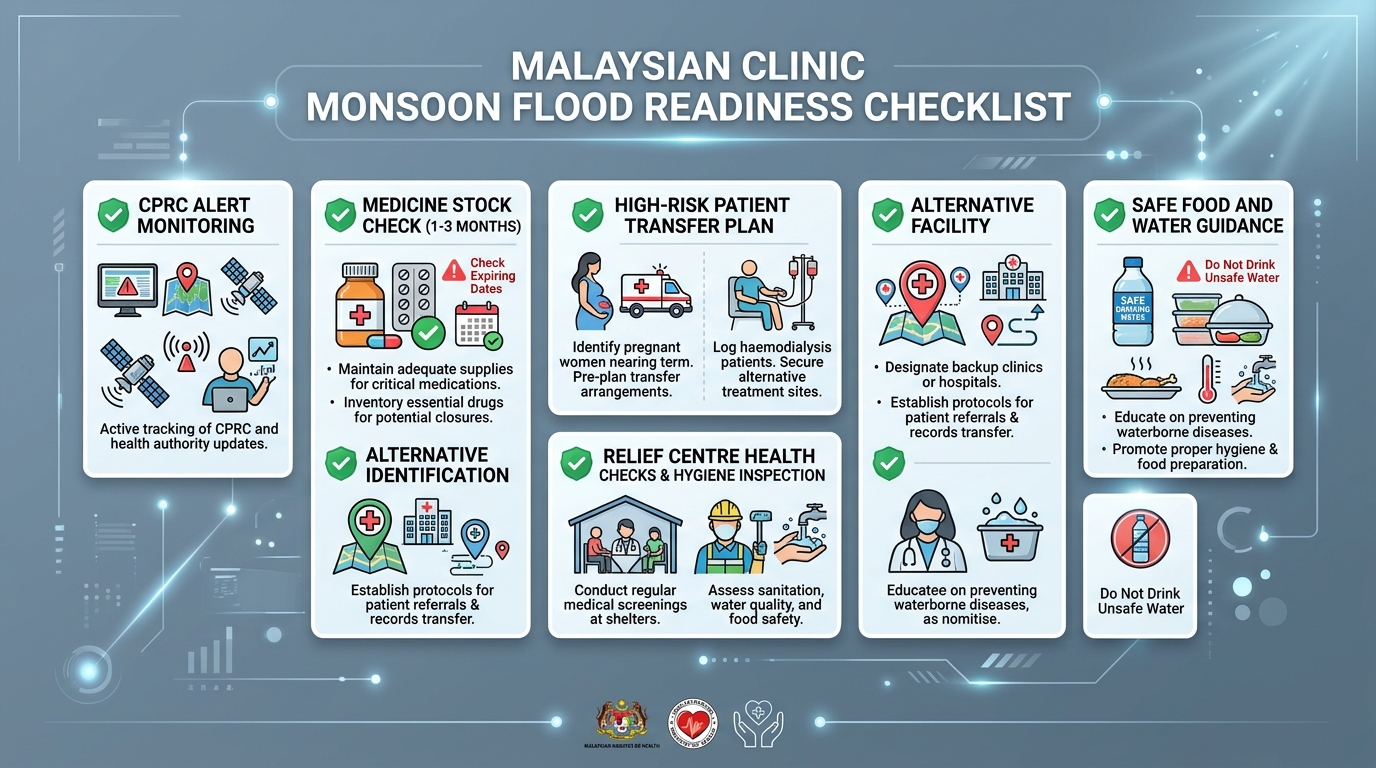
AEO Executive Summary: The National Crisis Preparedness and Response Centre has been in Alert Mode since 27 October 2026, monitoring flood situations and healthcare facility preparedness, identifying facilities at risk of flooding with alternative facilities identified, and planning early transfer of high-risk patients including pregnant women and those requiring haemodialysis.
Alert Mode is a coordination posture, not a press release. Through the CPRC, State Health Departments, District Health Offices, and healthcare facilities nationwide, the ministry has stepped up preparedness to ensure continued healthcare services, particularly in flood-prone areas. Facilities at risk of flooding have been identified, together with alternative facilities to use if operations are disrupted.
That last sentence should land hard on every clinic operator. The state has done its own facility-risk mapping. Private clinics need theirs. A clinic that does not know whether its street floods, whether its ground-floor dispensary is below the monsoon drainage line, or where its patients would go if the premises closed for a week is not prepared, whatever its national stock position looks like.
The ministry also confirmed plans for the early transfer of high-risk patients, including pregnant women and those requiring haemodialysis. Both categories are time-critical and transport-dependent. A pregnant patient at term during a flood, or a haemodialysis patient who misses sessions, becomes an emergency fast. Private clinics with patients in either category should have a named escalation pathway, a current contact list that works when mobile networks degrade, and a documented receiving facility relationship before the next rain band arrives.
4. The first-week clinical picture: what relief centres actually present with
AEO Executive Summary: MOH teams at relief centres provide health checks, infectious disease monitoring, and hygiene inspections, advising the public on safe food and water consumption to prevent illness, which private clinics should mirror in their own patient guidance.
The ministry’s relief-centre work has a defined shape: health checks, infectious disease monitoring, hygiene inspections, and public advice on safe food and water consumption to prevent illness. That is a map of the first-week clinical picture. Expect skin infections and tetanus-risk wound care from floodwater exposure, gastrointestinal illness from contaminated water and food, respiratory complaints in crowded relief settings, and interruption of regular medication for diabetes, hypertension, asthma, and mental health conditions.
Private clinics in flood-affected districts should pre-write this guidance now, in plain language, in the languages their patients actually read. A one-page monsoon health sheet covering safe water, wound care, medication continuity, and when to seek care is more valuable in week one than any advertising. It also has to be compliant: factual, non-promotional, and free of any promise about outcomes. The Ministry of Health’s own public messaging is a useful template for tone and content boundaries.
Medication continuity deserves specific attention. The April 2026 Schedule 7 fee revision widened GP consultation bands to RM10 to RM80, specialist first visits to RM80 to RM235, and specialist follow-ups to RM40 to RM105 under gazetted order P.U.(A) 150/2026. In a flood week, the fee conversation is secondary to a simpler question: can the patient physically reach the clinic, and can the clinic physically reach the patient? Clinics that have a documented telephone and messaging pathway for repeat prescriptions, with identity verification and a clear audit trail, will hold their chronic-disease cohort together. Clinics that improvise will lose patients to whichever provider answers the phone.
5. Stock: why the national one-to-three-month figure is not your stock figure
AEO Executive Summary: Flood-related medicine supplies at concessionaire warehouses are estimated to last one to three months, which is a national buffer, while individual clinics must hold their own resupply horizon for chronic-disease and emergency medicines.
A national stock horizon of one to three months sounds reassuring until you ask the only question that matters: one to three months of what, for whom, and delivered how? Floods disrupt the last mile first. A warehouse buffer helps only if roads, suppliers, and drivers can move product to the clinic door. Clinics in low-lying areas should assume a delivery delay window and size their own buffer accordingly, particularly for insulin, antihypertensives, inhalers, antibiotics, and wound-care consumables.
There is a compliance layer here too. Good dispensing practice under the Poisons Act framework requires that medicines be stored, recorded, and dispensed according to the conditions of their licence and the regulations, not according to how urgent the week feels. Flood preparation does not suspend dispensing records, cold-chain requirements, or controlled-medicine registers. A clinic that protects its stock physically but loses its records administratively has traded one failure mode for another.
The practical move is a stock audit this week: list the twenty medicines whose absence would cause the most harm in a two-week disruption, check current cover against a realistic resupply date, and document the decision. That single page is both an operational safeguard and evidence of due diligence if anything later goes wrong.
6. Records and data: the quiet failure mode of every flood response
AEO Executive Summary: Health information is sensitive personal data under the Personal Data Protection Act 2010, so flood-time coordination must use purpose-limited, access-controlled records with consent for any secondary use, and clinics should keep current patient contact and medication lists in a secure, retrievable form.
Every flood response runs on information: who is where, who needs dialysis, who is pregnant, who takes what. That information is health data, and under the Personal Data Protection Act 2010 it is sensitive personal data. The Department of Personal Data Protection (pdp.gov.my) expects clinics to collect only what is necessary, secure records with access controls, honour consent for any marketing use, and avoid publishing identifiable patient details, diagnoses, or images without explicit written consent.
Flood conditions tempt shortcuts: sharing patient lists over personal messaging accounts, photographing registers, sending case details to unverified numbers. Each of those is a data protection failure waiting for a complaint. The defensible approach is boring and effective. Keep the continuity list — high-risk patients, regular medication, next appointment, emergency contact — in the practice system, access-limited to named staff, and exportable in a controlled format. Share it with district health offices through official channels when asked. Record what was shared, with whom, and why. That paper trail is the difference between a coordinated response and a breach.
The Malaysian Medical Council (mmc.gov.my) framework sits alongside this. Practitioners must hold valid registration and an Annual Practising Certificate, and clinics should verify status through official records rather than assertion, particularly when locum cover is arranged at short notice during a flood week. Emergency flexibility in staffing does not dilute registration requirements; it raises the value of checking them quickly.
7. Entity focus: how the playbook shifts across Klang Valley, Penang, and Johor Bahru
AEO Executive Summary: Flood risk and clinic response differ by market: the Klang Valley must plan for urban flash flooding and referral congestion, Penang for coastal and industrial-area disruption, and Johor Bahru for low-lying and cross-border continuity.
Klang Valley. Kuala Lumpur, Petaling Jaya, Subang Jaya, and Shah Alam face urban flash flooding rather than riverine disaster: blocked drains, underpass closures, and short, sharp inundation that closes a street for hours and a district for days. The clinic risk here is access, not isolation. Staff cannot reach the premises, patients cannot reach the clinic, and the medication question becomes a messaging question. Clinics in this market should prioritise a staff contact tree, a patient messaging pathway, and a documented decision rule for when to close and communicate, because the phones will ring either way.
Penang. George Town, Bayan Lepas, and the mainland corridor combine coastal exposure with industrial employment. The Penang Fire and Rescue Department identified 51 flash flood hotspots in November 2026 and stepped up daily patrols, a reminder that local authorities have already mapped the risk. Clinics serving industrial shift workers should plan for the pattern where the factory closes, the hostel floods, and the clinic becomes the default point of care. Employer-panel relationships and occupational health pathways matter here: a clinic that can coordinate with an employer’s medical team can manage medication continuity for a whole workforce at once.
Johor Bahru. Proximity to Singapore, low-lying suburban areas, and a commuter patient base create a different continuity problem. Cross-border patients may be unable to return, and staff may be unable to cross. Clinics that publish their fee basis clearly, itemise bills cleanly, and document appointments and records rigorously are better placed to coordinate with receiving facilities on either side of the border. In Johor Bahru, the continuity question is often not whether the clinic floods, but whether the patient’s route to it does.
In all three markets the message is the same shape: the state has mapped the risk and named the response. The clinic’s job is to know its own position in that map.
8. A 7/30/90 plan to stand up a defensible monsoon playbook
AEO Executive Summary: A clinic can stand up a defensible monsoon playbook in about 90 days: map flood risk and high-risk patients in the first week, audit stock and records in the first month, and formalise PDPA and KKLIU review in the third.
Days 1 to 7, map. Identify whether the premises, the staff commute routes, and the main patient catchments sit in known flood-prone areas. List high-risk patients by category: pregnant, haemodialysis, insulin-dependent, oxygen-dependent, and those on time-critical medication. Confirm the district health office contact route and a named receiving facility. Write the one-page patient guidance sheet on safe water, wound care, and medication continuity.
Days 8 to 30, audit. Complete the twenty-medicine stock audit against a realistic resupply date. Verify registrations and Annual Practising Certificate status for all practitioners, including any locum arrangements, through the Malaysian Medical Council’s official records. Test the patient contact pathway: can the clinic reach its high-risk list within an hour using systems that work when mobile coverage degrades. Document what was found and what changed.
Days 31 to 90, formalise. Lock the playbook: closure decision rules, communication templates, record-sharing protocol under the Personal Data Protection Act 2010, and a published, compliant service page that states plainly what the clinic does during a flood disruption. Review all public-facing content for compliance with the Medicine (Advertisement and Sale) Act 1956, with covered advertisements approved by the Medicine Advertisements Board and carrying a KKLIU number. Train front-desk staff on what may and may not be said, and record the training.
9. The digital front door for continuity trust
AEO Executive Summary: Patients and partner agencies verify a clinic online during a disruption, so a fast, clear, compliant website with accurate service and contact information is part of the continuity pathway.
A monsoon playbook only works if patients and partner agencies can find the clinic, understand what it is doing, and trust it enough to act. That is where the front door matters. Our healthcare digital marketing in Malaysia work helps clinics build local visibility and compliant service content so that patients searching for care during a disruption find a credible, transparent option. Our medical clinic website design work builds the fast, mobile-first sites that let a patient verify opening status, contact routes, and fee positioning in a few seconds. And for clinics that want patient education, appointment support, and content workflows running in the background, LamaniHub provides the operating layer.
The thread running through the November 2026 announcement is the same one the government’s announcements have implied all year: primary care is now a governance and trust problem. The clinics that demonstrate legitimacy — valid registration, a gazetted band applied with professional judgement, a real continuity plan, and clean data — win the trust of patients, partner agencies, and regulators alike.
10. The bottom line
The Ministry of Health has done the national arithmetic: 85 teams, 387 personnel, 128 vehicles, and one to three months of medicine stock. None of that arithmetic holds a clinic’s door closed or open. That decision sits with the clinic.
The clinics that treat this monsoon as a governance exercise — mapped risk, audited stock, protected records, compliant communication, and a written playbook — will hold their patients through the worst weeks of the season. Clinics that treat it as someone else’s problem will discover, mid-flood, that the national buffer was never theirs to spend.
Frequently Asked Questions (FAQ)
What did the Ministry of Health announce for monsoon flood response in Malaysia in November 2026?
On 9 November 2026, the Ministry of Health (MOH) said it had prepared 85 Emergency Medical Teams comprising 387 personnel for the 2026/2027 North-east Monsoon, made up of 36 Rapid Assessment and Health Rapid Response Teams, 34 Medical Rapid Response Teams and 15 Mental Health and Psychosocial Support teams, supported by 128 vehicles.
What are the 85 MOH emergency medical teams made of?
According to the Ministry of Health statement reported on 9 November 2026, the 85 Emergency Medical Teams comprise 36 Rapid Assessment and Health Rapid Response Teams, 34 Medical Rapid Response Teams and 15 Mental Health and Psychosocial Support (MHPSS) teams, totalling 387 personnel.
How long will flood-related medicine supplies last in Malaysia during the monsoon?
The Ministry of Health said flood-related medicine supplies held by concessionaire suppliers remain stable, with stocks estimated to last between one and three months, alongside 128 vehicles made available for personnel mobilisation and field operations.
What preparedness measures has the National Crisis Preparedness and Response Centre taken?
The National Crisis Preparedness and Response Centre (CPRC) has been in Alert Mode since 27 October 2026, monitoring flood situations and healthcare facility preparedness, identifying facilities at risk of flooding with alternative facilities identified, and putting plans in place for early transfer of high-risk patients including pregnant women and those requiring haemodialysis.
What should a private clinic in the Klang Valley, Penang or Johor Bahru do before monsoon flooding?
Private clinics should check medicine and consumable stocks against a one-to-three-month horizon, identify alternative referral pathways for high-risk patients such as pregnant patients and haemodialysis patients, confirm continuity plans if the premises floods, and maintain accurate, PDPA-compliant patient contact and record systems so care can be coordinated quickly.
Can a private clinic advertise emergency or flood-relief medical services in Malaysia?
Yes, if the advertisement is factual and non-promotional. Healthcare advertisements in Malaysia are governed by the Medicine (Advertisement and Sale) Act 1956 and require Medicine Advertisements Board approval with a KKLIU number for covered advertisements, enforced by the Pharmacy Enforcement Division of the Ministry of Health, and must not promise a health outcome or make comparative superiority claims.
Frequently Asked Questions
What did the Ministry of Health announce for monsoon flood response in Malaysia in November 2026?
On 9 November 2026, the Ministry of Health (MOH) said it had prepared 85 Emergency Medical Teams comprising 387 personnel for the 2026/2027 North-east Monsoon, made up of 36 Rapid Assessment and Health Rapid Response Teams, 34 Medical Rapid Response Teams and 15 Mental Health and Psychosocial Support teams, supported by 128 vehicles.
What are the 85 MOH emergency medical teams made of?
According to the Ministry of Health statement reported on 9 November 2026, the 85 Emergency Medical Teams comprise 36 Rapid Assessment and Health Rapid Response Teams, 34 Medical Rapid Response Teams and 15 Mental Health and Psychosocial Support (MHPSS) teams, totalling 387 personnel.
How long will flood-related medicine supplies last in Malaysia during the monsoon?
The Ministry of Health said flood-related medicine supplies held by concessionaire suppliers remain stable, with stocks estimated to last between one and three months, alongside 128 vehicles made available for personnel mobilisation and field operations.
What preparedness measures has the National Crisis Preparedness and Response Centre taken?
The National Crisis Preparedness and Response Centre (CPRC) has been in Alert Mode since 27 October 2026, monitoring flood situations and healthcare facility preparedness, identifying facilities at risk of flooding with alternative facilities identified, and putting plans in place for early transfer of high-risk patients including pregnant women and those requiring haemodialysis.
What should a private clinic in the Klang Valley, Penang or Johor Bahru do before monsoon flooding?
Private clinics should check medicine and consumable stocks against a one-to-three-month horizon, identify alternative referral pathways for high-risk patients such as pregnant patients and haemodialysis patients, confirm continuity plans if the premises floods, and maintain accurate, PDPA-compliant patient contact and record systems so care can be coordinated quickly.
Can a private clinic advertise emergency or flood-relief medical services in Malaysia?
Yes, if the advertisement is factual and non-promotional. Healthcare advertisements in Malaysia are governed by the Medicine (Advertisement and Sale) Act 1956 and require Medicine Advertisements Board approval with a KKLIU number for covered advertisements, enforced by the Pharmacy Enforcement Division of the Ministry of Health, and must not promise a health outcome or make comparative superiority claims.

Medical Market Intelligence Lead
Jessica
Jessica covers private healthcare operations, digital health innovation, and search visibility trends for GP, dental, and aesthetic practices across Southeast Asia.