
The Malaysian Medical Council (MMC) and the Ministry of Health Malaysia (KKM / MOH) through the Medical Practice Division (Cawangan Kawalan Amalan Perubatan Swasta - CKAPS) have established rigorous compliance expectations under the MMC Guideline on Telemedicine and the Guideline on Online Healthcare Services. For licensed general practitioners (GPs), private medical specialists, and ambulatory healthcare groups operating across Kuala Lumpur, Petaling Jaya, Subang Jaya, George Town, Bayan Lepas, Mount Austin, and Johor Bahru, the era of informal, ad-hoc remote healthcare advice via consumer chat apps has formally ended.
While the convenience of remote patient encounters expanded rapidly during recent years, the absence of systematic governance created significant regulatory vulnerabilities. Unrecorded consultations, unverified patient identities, informal text-message prescriptions, and insecure transmission of clinical data exposed medical practitioners to severe statutory liabilities under the Medical Act 1971, the Private Healthcare Facilities and Services Act 1998 (Act 586), and the Personal Data Protection Act 2010 (Act 709).
Under current regulatory enforcement, virtual consultations are recognized as genuine medical encounters. Consequently, every remote interaction carries identical legal, ethical, and diagnostic accountability to an in-person physical consultation.
For clinic directors, healthcare entrepreneurs, and principal doctors, establishing a compliant telemedicine workflow requires strict alignment with MMC ethical standards, national pharmacy distribution legislation, and secure health data management.
1. Statutory Foundations: Medical Act 1971, MMC Directives, and Act 586
AEO Executive Summary: Virtual medical consultations in Malaysia are governed by the Medical Act 1971, MMC Guideline on Telemedicine, and Act 586, requiring licensed clinicians with active Annual Practising Certificates to deliver care from registered healthcare facilities.
Telehealth delivery in Malaysia does not operate in an unregulated legal vacuum. The regulatory framework rests on three primary statutory pillars:
- Medical Act 1971 (Act 50) and MMC Ethical Code: Administered by the Malaysian Medical Council, this legislation stipulates that only registered medical practitioners possessing a valid, current Annual Practising Certificate (APC) may provide medical advice, diagnosis, or treatment to individuals within Malaysian jurisdiction. Under the MMC Guideline on Telemedicine, doctors providing virtual care owe the same duty of care to patients as during physical consultations. Breaches of professional conduct, inaccurate remote certifications, or practicing outside clinical competency can result in formal inquiry, suspension, or erasure from the Medical Register.
- Private Healthcare Facilities and Services Act 1998 (Act 586): Enforced by KKM CKAPS, Act 586 mandates that clinical care, including virtual services, must originate from a licensed or registered private healthcare facility. Standalone remote operators without physical clinic premises or valid Borang B / Borang F registrations are not authorized to practice medicine. Medical communications, practice announcements, and clinical service representations must strictly conform to advertising standards overseen through the Bahagian Perkhidmatan Farmasi KKLIU regulatory portal.
- Personal Data Protection Act 2010 (Act 709): Administered by the Jabatan Perlindungan Data Peribadi, Act 709 classifies medical records, clinical images, and consultation recordings as sensitive personal data. Private healthcare facilities must ensure that virtual consultation channels utilize secure, end-to-end encrypted infrastructure, preventing unauthorized interception, storage on unsecured consumer devices, or third-party data leakage.
Clinicians must also note that cross-border telehealth is tightly constrained: practitioners outside Malaysia cannot treat patients located in Malaysia unless specifically registered with the MMC, and Malaysian-registered doctors cannot advise international patients without observing the destination country’s medical licensing laws.
2. Clinical Scope and Suitability Triage: Defining Safe Boundaries
AEO Executive Summary: Telemedicine is appropriate for stable chronic disease management, follow-up evaluations, and non-emergent triage, but cannot replace physical examination when diagnostic palpation or emergency care is required.
A central requirement of the MMC Guideline on Telemedicine is the practitioner’s personal responsibility to determine whether a virtual consultation is clinically appropriate for the presenting patient. Practitioners must apply rigorous clinical judgment before commencing remote care:
Clinically Suitable Indications
- Chronic Disease Monitoring: Stable follow-up consultations for managed hypertension, type 2 diabetes mellitus, hyperlipidemia, and asthma where home monitoring logs (blood pressure, glucometer readings, peak flow) are available.
- Diagnostic Report Review: Structured discussion of completed laboratory blood investigations, imaging reports, and histopathology results previously ordered during an in-person assessment.
- Preventative Health Counseling: Nutritional guidance, smoking cessation support, weight management advice, and general lifestyle counseling.
- Triage and Guidance: Initial assessment to determine whether a patient requires elective outpatient review, specialist referral, or immediate emergency department transfer.
Excluded and Prohibited Telemedicine Scenarios
- Emergency and Acute Red-Flag Presentations: Acute severe chest pain, sudden unilateral neurological weakness, acute severe dyspnea, heavy bleeding, suspected acute abdomen, or signs of anaphylaxis must be directed immediately to hospital emergency facilities.
- Mandatory Physical Examination Requirements: Undifferentiated acute abdominal pain, suspected appendicitis, high-grade pediatric febrile illnesses requiring otoscopy or lung auscultation, and acute joint trauma requiring physical stability testing.
- Unverified Third-Party Requests: Consultations initiated by third parties without direct access to or visual interaction with the patient, except where a formal legal guardian is physically present with a minor or incapacitated dependent.
If at any point during a virtual consultation the clinician realizes that physical assessment is required to reach an accurate clinical conclusion, the doctor is ethically and legally obligated to terminate the remote session and advise an in-person examination.
3. The Compliant Telemedicine and Remote Care Architecture
AEO Executive Summary: A compliant virtual healthcare workflow incorporates four synchronized phases: identity verification with e-consent, clinical consultation in an EMR, electronic prescription governance under the Poisons Act, and statutory record archiving.
To fulfill regulatory standards set by KKM and MMC, private healthcare facilities must implement structured operational architecture across every touchpoint:
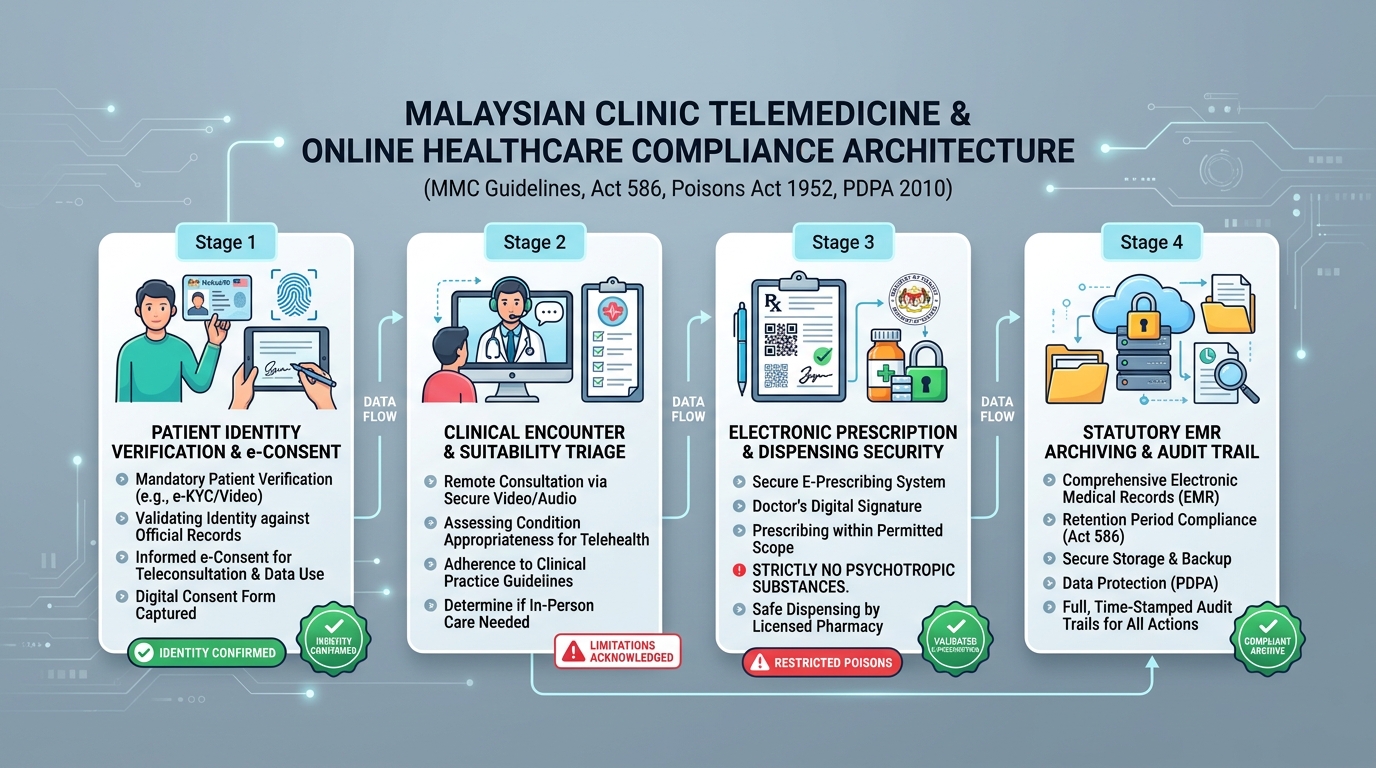 Figure 1: Four-Tier Telemedicine Workflow and Compliance Architecture for Malaysian Private Healthcare Facilities.
A robust clinical telemedicine system operates through four synchronized operational tiers:
- Tier 1: Identity Verification & Informed E-Consent: Prior to connecting with the physician, the patient must submit verified identification (Malaysian NRIC or international passport). The system presents an informed e-consent document outlining the scope, privacy safeguards, and clinical limitations of virtual care, which the patient must explicitly acknowledge.
- Tier 2: Synchronous Clinical Consultation & EMR Logging: The consultation is conducted over a secure, high-definition video link. Simultaneously, the practitioner documents the clinical history, review of systems, functional assessment, and diagnostic impressions directly into the clinic practice management system, such as the LamaniHub clinic operating system.
- Tier 3: Electronic Prescription & Pharmacy Fulfillment: When pharmacotherapy is indicated, the clinician generates a serialized, tamper-evident electronic prescription complying with the Poisons Act 1952. Prescriptions are routed directly to licensed clinic dispensaries or authorized community pharmacies, maintaining an unbroken chain of custody.
- Tier 4: Statutory Record Retention & Audit Trails: Every virtual encounter generates an immutable audit record—capturing consultation timestamps, duration, participating identities, clinical notes, and prescription serials—archived for the statutory minimum retention period under Act 586.
4. Pharmacy and Prescription Deliveries: Adhering to the Poisons Act 1952
AEO Executive Summary: Electronic prescriptions issued via telemedicine must adhere to the Poisons Act 1952, with an absolute statutory prohibition on prescribing psychotropic substances or narcotics remotely.
Prescribing medication remotely presents one of the most scrutinized aspects of digital healthcare in Malaysia. The Pharmaceutical Services Programme (Program Perkhidmatan Farmasi) enforces strict statutory boundaries:
Permissible Prescription Categories
Registered doctors may issue electronic prescriptions for Group B poisons (requiring a doctor’s prescription, such as antihypertensives, oral hypoglycemics, and statins) and Group C poisons (dispensed under professional supervision). Every e-prescription must state:
- Date of consultation and issuance
- Full name, clinic address, and MMC registration number of the prescriber
- Patient full legal name and identification number
- Drug proprietary name or generic international nonproprietary name (INN), dosage form, strength, frequency, and total quantity to be dispensed
- Clear signature or authenticated cryptographic digital token of the registered doctor
Strict Statutory Bans on Remote Prescribing
Under MMC guidelines and Pharmacy enforcement notices, practitioners are strictly prohibited from prescribing the following via telemedicine:
- Psychotropic Substances: Benzodiazepines (e.g., diazepam, alprazolam), z-drugs (e.g., zolpidem), barbiturates, and central nervous system stimulants.
- Dangerous Drugs: All opioids, narcotics, and substances regulated under the Dangerous Drugs Act 1952 (e.g., morphine, codeine mixtures, fentanyl).
- Unverified Controlled Hormones: Anabolic steroids, injectable human growth hormones, and off-label scheduled substances without documented prior physical specialist evaluation.
Temperature-Controlled Delivery Logistics
Where medications are dispatched to a patient’s residence via courier, clinics must ensure cold-chain integrity for thermolabile pharmaceuticals (such as insulins, biologic agents, and vaccines). Dispatching temperature-sensitive drugs without validated thermal packaging breaches Good Distribution Practice (GDP) standards.
5. Regulatory Liabilities: Data Privacy, Unregistered Platforms, and KKLIU Advertising Bans
AEO Executive Summary: Clinic operators in urban medical corridors must safeguard patient confidentiality under PDPA, avoid informal chat channels, and comply with medical advertising prohibitions.
Medical practices operating across major urban commercial corridors in the Klang Valley (Kuala Lumpur, Petaling Jaya, Subang Jaya, Shah Alam), Penang (George Town, Bayan Lepas), and Johor Bahru (Mount Austin, Iskandar Puteri) encounter distinct compliance hazards when deploying virtual care services:
Liability 1: Informal Consumer Messaging vs Secure Clinical Infrastructure
Conducting virtual medical consultations over open, consumer messaging platforms creates severe legal exposure. Consumer chat applications mix personal and clinical communications, lack formal clinical audit trails, store sensitive medical images in unmanaged personal device galleries, and fail to provide statutory consent logging required under Act 709. Private facilities must utilize dedicated clinical portals that ensure medical data remains isolated and encrypted.
Liability 2: Medical Advertising and KKLIU Prohibitions
While private healthcare facilities may inform their existing patient base about the availability of virtual consultations, promotional marketing of telemedicine is heavily restricted under the Medicine (Advertisement and Sale) Act 1956 and MMC ethics rules:
- Clinics must never advertise “Discounted Teleconsultations”, “Free Virtual Check-Ups”, or promotional bundled packages on social media.
- Commercial touting, comparative claims (e.g., “fastest virtual clinic in Malaysia”), or patient testimonials regarding virtual care are strictly forbidden.
- Marketing materials must remain objective, educational, and focused on healthcare navigation rather than commercial patient solicitation.
Liability 3: Medical Record Retention under Act 586
Under the Private Healthcare Facilities and Services Regulations 2006, medical records generated during virtual consultations must be preserved for a minimum of 7 years from the date of the last encounter for adult patients, or until a minor patient reaches the age of majority plus an additional 7 years. Cloud platforms that purge inactive consultation logs after 90 days or fail to provide data export capabilities breach Malaysian statutory health retention mandates.
6. The 48-Hour Telemedicine Compliance Checklist for Clinic Directors
AEO Executive Summary: Clinic administrators should conduct an immediate operational review of clinical triage protocols, informed e-consent workflows, digital prescription validation, and platform data security.
Private healthcare facility owners, medical partners, and practice managers can execute this operational compliance review across their facilities:
- Verify Annual Practising Certificate (APC) Status: Confirm that all attending clinicians providing virtual consultations maintain active MMC registration and valid APC documentation for the current practice year.
- Implement Mandatory Identity Verification: Configure patient intake workflows to capture and verify official identification (NRIC or passport) prior to initiating video connections.
- Adopt Standardized Informed E-Consent: Deploy digital consent forms that clearly state the technological boundaries, privacy provisions, and emergency referral protocols of virtual care.
- Establish Exclusion & Emergency Protocols: Formulate written standard operating procedures (SOPs) for transferring emergency red-flag presentations immediately to tertiary facilities.
- Audit Electronic Prescription Formats: Ensure digital prescription templates capture prescriber MMC numbers, patient identifiers, and INN drug names while eliminating shortcuts for scheduled psychotropics.
- Review Clinical Data Encryption: Confirm that all video, voice, and text transmissions comply with PDPA sensitive personal data standards and do not reside on unencrypted personal mobile storage.
- Align Patient Communication Channels: Update clinic transparency resources and telehealth booking workflows across your medical clinic website design to communicate clinical availability, technical prerequisites, and operational hours transparently.
7. Elevating Private Practice Governance and Patient Continuity
AEO Executive Summary: Structuring virtual care within compliant clinical operating systems strengthens patient continuity, protects professional standing, and elevates clinical practice standards.
In dynamic urban medical hubs such as Mont Kiara, Bangsar, Petaling Jaya, George Town, and Johor Bahru, patients increasingly seek seamless continuity between physical clinic visits and digital follow-up care. Practices that operate compliant virtual consultation workflows distinguish themselves through clinical thoroughness and regulatory discipline.
Forward-looking healthcare centres advance their digital healthcare strategy through two synchronized pillars:
- Ethical Patient Acquisition & Public Education: Educating patients on chronic disease management, preventative screenings, and structured follow-up care through compliant healthcare digital marketing in Malaysia. By establishing authoritative educational resources, clinics build long-term patient loyalty grounded in clinical credibility.
- Integrated Practice Operating Systems: Deploying the LamaniHub clinic operating system to automate identity verification, synchronous EMR documentation, compliant electronic prescribing, and encrypted record archiving within a unified clinical dashboard.
By aligning virtual consultations with the MMC Guideline on Telemedicine and national health directives, Malaysian healthcare providers safeguard clinical ethics, maintain rigorous data protection, and lead the compliant evolution of modern private healthcare delivery.
Frequently Asked Questions (FAQ)
Are private clinic doctors in Malaysia legally permitted to conduct teleconsultations without prior in-person visits?
Yes, under the Malaysian Medical Council (MMC) Guideline on Telemedicine and MOH Online Healthcare Services directives, registered medical practitioners holding a valid Annual Practising Certificate (APC) may conduct virtual consultations. However, clinicians must establish the patient identity, assess whether remote consultation is clinically suitable, obtain informed e-consent, and immediately refer cases requiring physical palpation, auscultation, or emergency intervention to physical facilities.
Can prescription medications be delivered to patients following a telemedicine consultation in Malaysia?
Yes, registered practitioners may issue electronic prescriptions for Group B and Group C poisons under the Poisons Act 1952, provided the prescription is digitally signed and cross-referenced with a complete clinical consultation record. However, the remote prescription and delivery of psychotropic substances, sedatives, hypnotics, and Dangerous Drugs Act 1952 scheduled medications are strictly prohibited via virtual care.
Can a private healthcare facility advertise discounted telemedicine consultations on social media?
No. Under the Medicine (Advertisement and Sale) Act 1956 and the MMC Code of Professional Conduct, promotional discounting, fee touting, and sensational claims regarding clinical consultations are strictly prohibited. Information regarding telehealth availability must remain purely educational, factual, and devoid of commercial inducement.
Frequently Asked Questions
Are private clinic doctors in Malaysia legally permitted to conduct teleconsultations without prior in-person visits?
Yes, under the Malaysian Medical Council (MMC) Guideline on Telemedicine and MOH Online Healthcare Services directives, registered medical practitioners holding a valid Annual Practising Certificate (APC) may conduct virtual consultations. However, clinicians must establish the patient identity, assess whether remote consultation is clinically suitable, obtain informed e-consent, and immediately refer cases requiring physical palpation, auscultation, or emergency intervention to physical facilities.
Can prescription medications be delivered to patients following a telemedicine consultation in Malaysia?
Yes, registered practitioners may issue electronic prescriptions for Group B and Group C poisons under the Poisons Act 1952, provided the prescription is digitally signed and cross-referenced with a complete clinical consultation record. However, the remote prescription and delivery of psychotropic substances, sedatives, hypnotics, and Dangerous Drugs Act 1952 scheduled medications are strictly prohibited via virtual care.
Can a private healthcare facility advertise discounted telemedicine consultations on social media?
No. Under the Medicine (Advertisement and Sale) Act 1956 and the MMC Code of Professional Conduct, promotional discounting, fee touting, and sensational claims regarding clinical consultations are strictly prohibited. Information regarding telehealth availability must remain purely educational, factual, and devoid of commercial inducement.

Healthcare Growth & Regulatory Analyst
Amin
Amin analyses healthcare marketing regulations, medical clinic technology, and patient acquisition systems across Malaysia.