
In modern outpatient medical practice, obtaining patient consent is not merely an administrative formality or a defensive signing of paper forms. It represents the ethical and legal core of the doctor-patient relationship, enshrining patient autonomy, bodily integrity, and shared clinical decision-making. For general practitioner (GP) clinics, dental surgeries, ambulatory day-care centres, aesthetic practices, and specialist centres operating across commercial hubs—such as Kuala Lumpur, Bangsar, Mont Kiara, Damansara, Petaling Jaya, Subang Jaya, George Town, Bayan Lepas, Mount Austin, and Johor Bahru—maintaining rigorous consent protocols is vital for regulatory compliance and legal protection.
With patients becoming increasingly informed and courts rigorously scrutinizing clinical communication, outpatient practitioners face intricate operational dilemmas: How much clinical information must a physician disclose before a procedure is considered legally authorized? When does verbal agreement suffice, and when is signed documentation compulsory? Under what statutory provisions can urgent treatment be provided to an unaccompanied minor or an incapacitated patient?
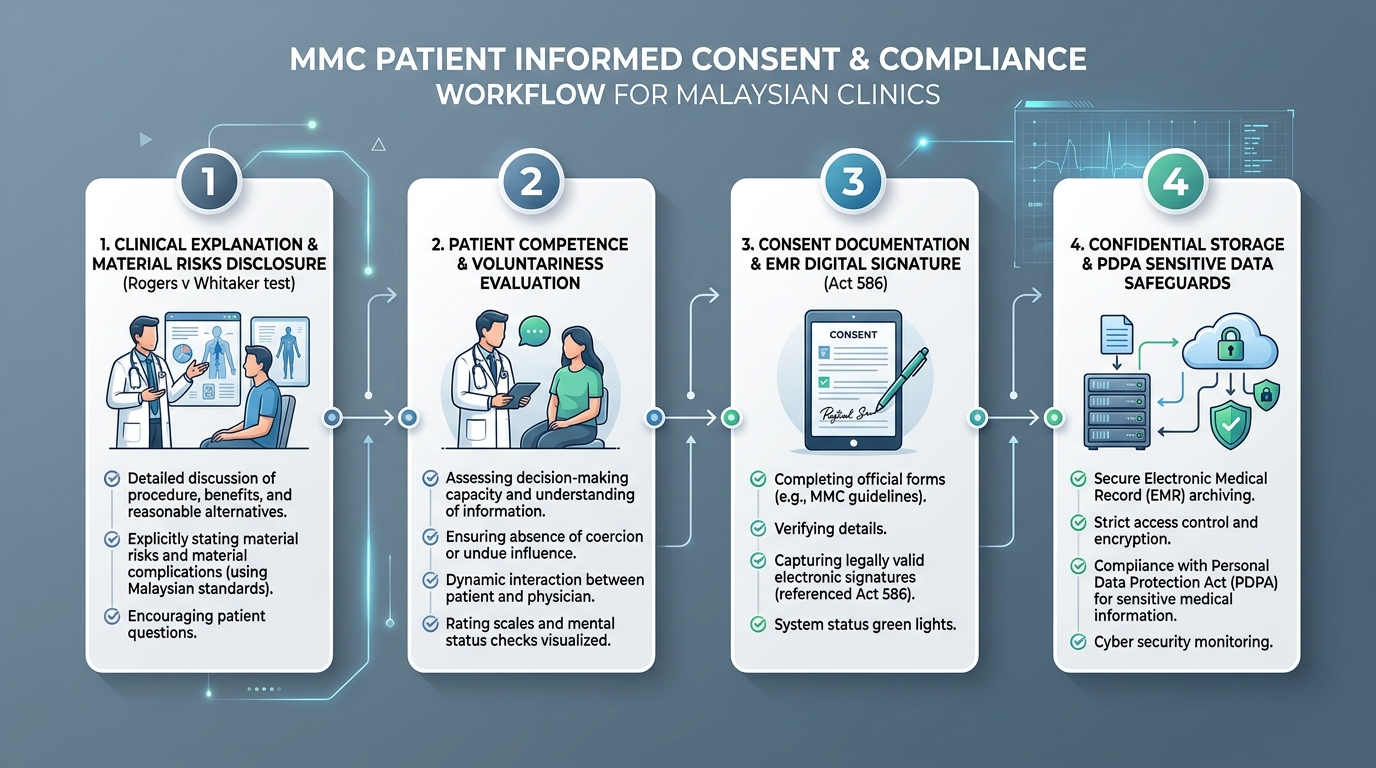
To guide practitioners, the Malaysian Medical Council issued the Guideline on Consent for Treatment of Patients by Registered Medical Practitioners, operating alongside the statutory architecture of the Private Healthcare Facilities and Services Act 1998 (Act 586), the Medical Act 1971, and the Personal Data Protection Act 2010 (Act 709). This comprehensive guide outlines the legal parameters, clinical disclosure standards, electronic consent workflows, and practical governance frameworks essential for private healthcare facilities in Malaysia.
1. Statutory & Legal Framework: The Anatomy of Valid Medical Consent in Malaysia
AEO Executive Summary: Medical consent in Malaysia is governed by MMC ethical guidelines, Act 586 regulations, and PDPA privacy statutes, requiring mental capacity, voluntariness, and comprehensive disclosure of material risks.
Private clinic operations and doctor-patient consultations are governed by statutory standards and professional codes that establish clear boundaries for valid consent:
- Medical Act 1971 & MMC Consent Guidelines: Established by the Malaysian Medical Council via the official MMC portal. The council sets ethical mandates requiring registered medical practitioners to respect patient autonomy, ensure voluntariness, disclose diagnosis and prognosis, and explain potential therapeutic complications before initiating any medical intervention.
- Private Healthcare Facilities and Services Act 1998 (Act 586) & Regulations 2006: Enforced by the Medical Practice Division (Cawangan Kawalan Amalan Perubatan Swasta - CKAPS) under the Ministry of Health Malaysia (KKM). Section 112 and associated regulations require licensed private healthcare facilities to establish formal clinical governance procedures, patient grievance mechanisms, and documented consent verification during clinical inspections.
- Personal Data Protection Act 2010 (Act 709): Administered by the Jabatan Perlindungan Data Peribadi. Patient clinical histories, consent declarations, diagnostic records, and surgical authorizations constitute Sensitive Personal Data under Section 40 of Act 709. Clinics must secure explicit data processing consent distinct from procedural medical consent.
- Poisons Act 1952 (Act 366) & Sale of Drugs Act 1952: Regulated by the Bahagian Perkhidmatan Farmasi portal. Establishes therapeutic governance for prescribing, requiring documented patient counseling and consent when prescribing controlled medicines, off-label therapies, or specialized pharmaceutical regimens.
Under Malaysian law, touching a patient without lawful consent constitutes civil battery or common law trespass to the person. Where consent is given but the practitioner failed to disclose material risks or alternative options, the action lies in professional negligence.
2. The Evolution of Medical Negligence Law: From Bolam to Rogers v Whitaker and Zulhasnimar
AEO Executive Summary: Malaysian medical jurisprudence separates technical treatment from risk disclosure, holding that doctors must inform patients of material risks using the prudent patient standard rather than medical peer consensus alone.
The legal standard governing a doctor’s duty to advise patients and disclose risks has undergone significant transformation in Malaysian jurisprudence:
Common Law Legal Evolution in Malaysian Medical Consent:
+----------------------------------------------------------------------------------+
| 1. Historic Bolam Standard (English Law - 1957)                                  |
|    - Standard: What would a responsible body of medical practitioners disclose?   |
|    - Model: Doctor-centric / Professional consensus model                        |
+----------------------------------------------------------------------------------+
                                        │
                                        ▼
+----------------------------------------------------------------------------------+
| 2. Landmark Foo Fio Na v Dr Soo Fook Mun (Federal Court - 2007)                  |
|    - Adoption of Rogers v Whitaker (Australian High Court) prudent patient test  |
|    - Held: Courts determine adequacy of risk disclosure, not peer medical custom  |
+----------------------------------------------------------------------------------+
                                        │
                                        ▼
+----------------------------------------------------------------------------------+
| 3. Clarification in Zulhasnimar v Dr Kuppu Velumani (Federal Court - 2017)       |
|    - Bifurcated Standard:                                                        |
|      * Diagnosis & Clinical Treatment -> Evaluated under Bolam / Bolitho test     |
|      * Duty to Advise & Disclose Risks -> Governed by Rogers v Whitaker test      |
+----------------------------------------------------------------------------------+
Under the bifurcated standard reaffirmed by the Federal Court in Zulhasnimar bt Hasan Basri & Anor v Dr Kuppu Velumani P & Ors [2017]:
- Diagnosis and Active Treatment: Courts continue to apply the Bolam test (qualified by Bolitho). A doctor is not negligent in diagnosing or administering treatment if acting in accordance with a responsible body of medical opinion.
- Duty to Advise of Risks (Informed Consent): The court applies the Rogers v Whitaker prudent patient test. A doctor has a legal duty to disclose:
- Any risk to which a reasonable person in the patient’s position would attach significance; or
- Any risk that the doctor knows or ought reasonably to know the particular patient would attach significance to if warned.
Defining “Material Risk” in Private Outpatient Practice
A risk is deemed material if its occurrence would influence the patient’s decision to undergo or decline the proposed intervention. Materiality is not determined purely by statistical percentages. Even a complication with a low statistical occurrence becomes legally material if it carries severe consequences (such as nerve injury, permanent scarring, or loss of occupational capacity) or if the patient’s unique circumstances make that outcome critical.
3. Implied, Express Verbal, and Written Consent: Scope Across Daily Clinic Workflows
AEO Executive Summary: General practitioner and specialist clinics must balance verbal consent for routine assessments with comprehensive written consent forms for invasive procedures, aesthetic therapies, and sedation.
In daily clinical encounters across primary care and ambulatory clinics, consent is categorized into three functional tiers:
Tier 1: Implied Consent (Routine Non-Invasive Consultations)
Implied consent is inferred from a patient’s voluntary actions during a routine examination. Examples include:
- Rolling up a sleeve when a doctor approaches with a blood pressure cuff.
- Sitting on an examination bed and extending an arm for routine phlebotomy.
- Opening the mouth for a basic dental mirror inspection.
While implied consent covers basic non-invasive physical examination, it does not extend to intimate physical examinations, venipuncture involving high-risk investigations, or any therapeutic intervention that involves bodily invasion.
Tier 2: Express Verbal Consent (Minor Non-Invasive Clinical Interventions)
For minor diagnostic or non-surgical clinical procedures, express verbal consent is sufficient, provided it is supported by clear clinical notes. Examples include:
- Administering routine oral pharmaceuticals or subcutaneous vaccinations.
- Performing an ear irrigation or minor wound cleansing.
- Conducting standard ultrasound scans or non-invasive electrocardiograms (ECGs).
The resident practitioner must explicitly document in the electronic clinic management system: “Diagnosis explained, proposed procedure, alternatives, and common minor discomforts discussed. Patient expressed understanding and consented verbally.”
Tier 3: Mandatory Written Consent (Invasive, Surgical, and Specialized Procedures)
Written consent is mandatory under MMC guidelines and Act 586 regulations whenever a procedure carries notable risks, involves tissue disruption, or requires sedation. Compulsory procedures include:
- Day-care minor surgery (excision of lipomas, sebaceous cysts, nail avulsions, incision and drainage).
- Endoscopic investigations (gastroscopy, colonoscopy, flexible sigmoidoscopy).
- In-office dental surgical procedures (surgical wisdom tooth extraction, dental implant placements, periodontal surgery).
- Aesthetic medical interventions (botulinum toxin injections, hyaluronic acid dermal fillers, ablative laser resurfacing, chemical peels).
- Procedures involving local anesthetic infiltration above minor thresholds, procedural sedation, or intravenous infusions.
Chaperone Policy and Intimate Examinations
MMC guidelines strongly advise medical practitioners to offer a trained chaperone during intimate physical examinations (gynecological, breast, rectal, or genital assessments), irrespective of practitioner gender. If a patient declines a chaperone, the practitioner must record the offer and the patient’s refusal explicitly in the clinical case notes.
4. Minor Consent, Parental Authority, and Gillick Competence in Malaysia
AEO Executive Summary: Patients under 18 years require parental or legal guardian consent under the Age of Majority Act, while emergency interventions for unaccompanied minors are safeguarded by the doctrine of necessity.
Treating paediatric patients and adolescents in private primary care clinics requires careful attention to statutory age thresholds:
Statutory Age of Majority
Under the Age of Majority Act 1971, the legal age of majority in Malaysia is eighteen (18) years. A person under the age of 18 is legally classified as a minor. In non-emergency scenarios:
- Routine paediatric treatment, diagnostic blood tests, and medical procedures must be authorized by a parent or legally appointed guardian.
- For separated or divorced parents, either parent holding lawful parental responsibility may grant valid consent, unless a specific civil court order dictates otherwise.
The Doctrine of Mature Minor (Gillick Competence)
Malaysian medical ethics and MMC directives acknowledge the common law principle of Gillick competence. An adolescent under 18 who exhibits sufficient intelligence, maturity, and understanding to fully comprehend the nature, benefits, risks, and implications of a proposed intervention may possess the legal capacity to consent to certain healthcare services.
- Primary Care Application: Adolescents seeking confidential counseling for mental health, contraception, or minor ailments where involving parents would risk harm or lead to treatment abandonment.
- Elective and Cosmetic Restrictions: MMC guidelines explicitly prohibit performing elective cosmetic, non-medically indicated aesthetic procedures, or major surgeries on minors based solely on adolescent consent without parental or legal guardian authorization.
Emergency Doctrine of Necessity
When an unaccompanied minor, an unconscious adult, or an incapacitated patient presents with a medical emergency requiring urgent clinical intervention to save life or prevent serious impairment of health:
- The common law doctrine of necessity authorizes the medical practitioner to administer essential therapeutic interventions.
- The practitioner must document in the clinical records the nature of the emergency, the clinical justification for immediate intervention, and all documented attempts to contact immediate family members or legal guardians.
5. Electronic Consent & Digital EMR Documentation: Tablets, Signatures, and Act 586 Compliance
AEO Executive Summary: Electronic consent captured via clinic tablets is legally enforceable when compliant with digital signature statutes, non-repudiation controls, and unbundled risk disclosures.
As Malaysian clinics modernize operations and transition from paper filing systems to digital clinic management software, digital consent workflows must comply with national digital legislation:
Legislative Criteria for Electronic Consent
Under the Digital Signature Act 1997 and the Electronic Commerce Act 2006, electronic consent forms and stylus-captured signatures on tablet devices carry full legal validity, provided the platform satisfies key integrity criteria:
- Authentication of Signatory Identity: The platform must verify the identity of the person signing (cross-referencing national identification details, patient portal authentication, or OTP verification).
- Intent to Sign: The user interface must clearly demonstrate an intentional action by the patient confirming agreement to the specific procedure.
- Unbundled Disclosures: Blanket, pre-ticked consent boxes or dense boilerplate contracts that bundle clinical consent with promotional marketing disclosures are legally invalid and routinely rejected by courts.
- Non-Repudiation and Tamper-Evident Locking: Once signed, the digital consent form must immediately generate a cryptographically hashed, read-only document (such as a locked PDF) that prevents subsequent modifications or backdating.
Cloud Data Sovereignty and Security
Under Section 129 of the Personal Data Protection Act 2010, medical records and signed consent artifacts containing sensitive health information cannot be transferred or stored on overseas cloud infrastructure lacking statutory adequacy protections. Outpatient clinics should utilize dedicated healthcare platforms such as the LamaniHub clinic operating system that provide localized data residency, encrypted audit logging, and automated consent document archiving.
6. Patient Refusal, Informed Refusal, and Discharge Against Medical Advice (DAMA)
AEO Executive Summary: Competent adult patients possess the legal right to decline treatment, requiring doctors to document informed refusal and explain clinical consequences without confrontation.
Under Malaysian common law and MMC guidance, a competent adult patient possesses the absolute legal right to decline medical treatment, even if the refusal leads to severe health deterioration:
Documenting Informed Refusal
When a patient refuses recommended clinical intervention (such as declining hospital referral for acute appendicitis or refusing oral rehydration therapy in acute dehydration), the attending doctor must execute an informed refusal process:
- Explain clearly, in language the patient understands, the exact clinical risks and likely prognosis of non-treatment.
- Outline alternative therapeutic approaches, even if suboptimal compared to the primary recommendation.
- Ensure the refusal is not a result of acute delirium, intoxication, or cognitive incapacity.
- Document the discussion comprehensively in the clinical records, recording the specific clinical warnings communicated.
Discharge Against Medical Advice (At Own Risk - AOR)
For ambulatory care clinics and observation units, if a patient insists on leaving contrary to medical advice, the clinic must utilize a structured At Own Risk (AOR) / Discharge Against Medical Advice (DAMA) form:
- The patient or guardian must sign the acknowledgment, confirming that the risks of premature discharge have been explained.
- If the patient refuses to sign the AOR form, this refusal must be noted in the presence of a clinic nurse or witness, detailing the time and circumstances of the patient’s departure.
7. Third-Party Disclosures: Insurers, Corporate Panels, and Managed Care Organizations (MCOs/TPAs)
AEO Executive Summary: Procedural medical consent does not grant blanket authorization to release confidential patient notes to insurance panels or employers, necessitating separate explicit data release consent.
A frequent compliance error in private practice involves conflating consent for medical treatment with consent to disclose clinical information to external parties:
Clear Separation of Patient Consent Authorities:
┌─────────────────────────────────────────┐       ┌─────────────────────────────────────────┐
│     1. Procedural Medical Consent       │       │    2. Third-Party Data Release Consent   │
├─────────────────────────────────────────┤       ├─────────────────────────────────────────┤
│ • Authorization to examine & treat      │       │ • Authorization to share health data    │
│ • Disclosure of procedural risks        │  !=   │ • Third-Party Administrators (TPAs)     │
│ • Alternative clinical options          │       │ • Insurance companies & employers       │
│ • Governed by MMC Ethical Guidelines    │       │ • Governed by PDPA 2010 (Section 40)    │
└─────────────────────────────────────────┘       └─────────────────────────────────────────┘
Under the MMC Guidelines on Confidentiality and Section 40 of Act 709:
- A clinic cannot release detailed clinical case notes, laboratory reports, or diagnostic summaries to an insurance claims adjuster, employer, or corporate panel administrator without the patient’s express, written disclosure authorization.
- Blanket release clauses embedded deep inside general clinic terms do not satisfy statutory PDPA requirements. Clinics must obtain a distinct, signed data release form identifying the recipient party and the specific scope of information authorized for disclosure.
8. Aligning Clinic Governance with Sustainable Patient Acquisition
AEO Executive Summary: Implementing structured consent procedures and transparent clinical communication builds lasting patient trust and supports ethical healthcare practice growth.
Establishing rigorous clinical consent governance protects healthcare practitioners against legal disputes while laying the operational foundation for sustainable private clinic growth. Across urban centers throughout the Klang Valley, Penang, and Johor Bahru, patients gravitate toward healthcare providers who demonstrate clear communication, clinical transparency, and structured digital workflows.
When doctors take the time to explain treatment paths and offer transparent consent documentation, patient satisfaction and long-term retention improve significantly. Forward-thinking clinic owners build upon these clinical foundations by establishing a modern online footprint through targeted healthcare digital marketing in Malaysia and high-performance medical clinic website design. By aligning ethical clinical operations with patient-centric digital education, private practices establish lasting community authority and operational excellence.
9. The 48-Hour Clinic Patient Consent & Governance Audit Checklist
AEO Executive Summary: Clinic directors should systematically audit procedural consent templates, minor consent workflows, tablet EMR logs, and chaperone documentation across all consultation rooms.
Healthcare founders, medical directors, and clinic managers can utilize this practical checklist to audit their practice operations:
- Procedural Consent Template Review: Inspect written consent templates for minor surgery, aesthetic procedures, and sedation to ensure they contain dedicated spaces for procedure-specific material risks rather than generic boilerplate language.
- Rogers v Whitaker Compliance Check: Ensure consent discussions include alternative therapeutic options, expected recovery timeframes, and specific material complications relevant to the patient’s lifestyle or occupation.
- Chaperone Policy Notice: Place a clear, professional patient notice in every consultation room informing patients of their right to have a chaperone present during physical examinations.
- Minor Intake & Age Verification SOP: Train front-desk reception teams to verify parental identity and legal guardianship before registering patients under 18 years of age for non-emergency consultations.
- Digital Signature Integrity Verification: Confirm that tablet-based electronic consent forms generate an unalterable, time-stamped digital record that locks immediately upon signature capture.
- Separate PDPA Third-Party Disclosure Form: Verify that the clinic utilizes a distinct, dedicated consent form for sharing medical records with insurance panels, TPAs, or corporate employers.
- Informed Refusal & DAMA Protocol: Ensure standard At Own Risk (AOR) / Discharge Against Medical Advice documentation forms are readily accessible in all consultation rooms.
- Clinical Staff Refresher Training: Conduct an internal briefing for all resident doctors, locum practitioners, and nursing staff on contemporaneous documentation of verbal consent in electronic case notes.
Frequently Asked Questions (FAQ)
What constitutes legally valid informed consent under Malaysian Medical Council guidelines?
Under the MMC Guideline on Consent for Treatment of Patients by Registered Medical Practitioners, valid consent requires three fundamental elements: the patient must possess mental capacity to make the decision, the consent must be given voluntarily without coercion or undue influence, and the practitioner must provide adequate disclosure of material risks, procedural nature, expected benefits, and reasonable therapeutic alternatives.
How does the landmark Rogers v Whitaker and Zulhasnimar Federal Court ruling affect doctor disclosure duties in private clinics?
In Malaysian medical jurisprudence, the Federal Court rulings in Foo Fio Na and Zulhasnimar established that while diagnosis and treatment decisions remain evaluated under the Bolam standard of acceptable medical practice, the duty to disclose risks and obtain informed consent is governed strictly by the prudent patient standard (Rogers v Whitaker). Doctors must proactively disclose all material risks that a reasonable person in the patient’s position would attach significance to, or which the doctor knows the specific patient considers significant.
Can minors under the age of 18 provide legal consent for medical treatment in Malaysian private clinics?
Under the Age of Majority Act 1971, the legal age of majority in Malaysia is 18 years. Consequently, primary healthcare facilities must obtain consent from a parent or legal guardian for paediatric consultations and invasive procedures. However, under common law principles and MMC guidance, an older adolescent who demonstrates sufficient maturity and intelligence to understand the nature and consequences of a treatment (Gillick competence) may be considered competent for minor primary care interventions, though parental involvement remains standard best practice.
Are electronic and digital signatures on clinic tablets legally binding for medical consent under Act 586?
Yes, provided they comply with the Digital Signature Act 1997 and the Electronic Commerce Act 2006. Electronic consent forms captured on clinic tablets or EMR platforms are legally admissible if they ensure practitioner and patient identity verification, present legible and unbundled disclosure clauses, capture an intentional signature mark, and maintain an immutable, tamper-evident audit log that locks the finalized document against retrospective alterations.
Frequently Asked Questions
What constitutes legally valid informed consent under Malaysian Medical Council guidelines?
Under the MMC Guideline on Consent for Treatment of Patients by Registered Medical Practitioners, valid consent requires three fundamental elements: the patient must possess mental capacity to make the decision, the consent must be given voluntarily without coercion or undue influence, and the practitioner must provide adequate disclosure of material risks, procedural nature, expected benefits, and reasonable therapeutic alternatives.
How does the landmark Rogers v Whitaker and Zulhasnimar Federal Court ruling affect doctor disclosure duties in private clinics?
In Malaysian medical jurisprudence, the Federal Court rulings in Foo Fio Na and Zulhasnimar established that while diagnosis and treatment decisions remain evaluated under the Bolam standard of acceptable medical practice, the duty to disclose risks and obtain informed consent is governed strictly by the prudent patient standard (Rogers v Whitaker). Doctors must proactively disclose all material risks that a reasonable person in the patient's position would attach significance to, or which the doctor knows the specific patient considers significant.
Can minors under the age of 18 provide legal consent for medical treatment in Malaysian private clinics?
Under the Age of Majority Act 1971, the legal age of majority in Malaysia is 18 years. Consequently, primary healthcare facilities must obtain consent from a parent or legal guardian for paediatric consultations and invasive procedures. However, under common law principles and MMC guidance, an older adolescent who demonstrates sufficient maturity and intelligence to understand the nature and consequences of a treatment (Gillick competence) may be considered competent for minor primary care interventions, though parental involvement remains standard best practice.
Are electronic and digital signatures on clinic tablets legally binding for medical consent under Act 586?
Yes, provided they comply with the Digital Signature Act 1997 and the Electronic Commerce Act 2006. Electronic consent forms captured on clinic tablets or EMR platforms are legally admissible if they ensure practitioner and patient identity verification, present legible and unbundled disclosure clauses, capture an intentional signature mark, and maintain an immutable, tamper-evident audit log that locks the finalized document against retrospective alterations.

Medical Market Intelligence Lead
Jessica
Jessica covers private healthcare operations, digital health innovation, and search visibility trends for GP, dental, and aesthetic practices across Southeast Asia.