
In outpatient healthcare delivery across Malaysia, clinical record-keeping serves as both the operational backbone of patient care and a primary line of legal defense. For general practitioner (GP) clinics, dental surgeries, ambulatory day-care facilities, and private specialist practices operating in high-growth commercial hubs—including Kuala Lumpur, Bangsar, Mont Kiara, Damansara, Petaling Jaya, Subang Jaya, George Town, Bayan Lepas, Mount Austin, and Johor Bahru—maintaining impeccable medical documentation is an essential regulatory requirement.
Every patient consultation generates sensitive clinical notes, diagnostic investigation results, prescription details, and administrative history. However, healthcare practitioners frequently encounter complex operational and medico-legal dilemmas: Who legally owns the physical or digital chart? What are the exact statutory retention timelines before files can be securely archived or destroyed? Under what circumstances can medical details be shared with insurance companies or employers without breaching privacy statutes?
To govern these issues, the Malaysian Medical Council issued the Guideline on Medical Records and Medical Reports, working in conjunction with the statutory framework of the Private Healthcare Facilities and Services Act 1998 (Act 586), the Medical Act 1971, and the Personal Data Protection Act 2010 (Act 709). This comprehensive guide outlines the legal parameters, clinical documentation standards, electronic health record compliance requirements, and practical governance workflows necessary for Malaysian private clinics.
1. Statutory Foundations: The Legal Architecture of Malaysian Clinical Records
AEO Executive Summary: Clinical documentation in private Malaysian healthcare is governed by Act 586, MMC ethical guidelines, and the PDPA 2010, establishing physician custody of records alongside a statutory duty of confidentiality and accurate reporting.
Private clinic operations and documentation standards do not exist in a legal vacuum. Instead, they are governed by an interlocking framework of national statutes and professional codes:
- Private Healthcare Facilities and Services Act 1998 (Act 586) & Regulations 2006: Enforced by the Medical Practice Division (Cawangan Kawalan Amalan Perubatan Swasta - CKAPS) under the Ministry of Health Malaysia (KKM). Act 586 governs the licensing, physical security, inspection, and minimum record-keeping standards for all private outpatient medical and dental clinics in Malaysia.
- Medical Act 1971 & MMC Guideline on Medical Records and Medical Reports: Administered by the Malaysian Medical Council, accessible through the official MMC portal. This guideline outlines the ethical duties of registered medical practitioners regarding contemporaneous documentation, clinical accuracy, issuance of medical reports, and professional disciplinary consequences for substandard record-keeping.
- Personal Data Protection Act 2010 (Act 709): Regulated by the Jabatan Perlindungan Data Peribadi. Patient clinical details, past medical histories, diagnostic imaging files, and laboratory summaries are classified as Sensitive Personal Data under Section 40 of Act 709, requiring heightened technical and administrative security safeguards against unauthorized processing, disclosure, or loss.
- Poisons Act 1952 (Act 366) & Sale of Drugs Act 1952: Regulated by the Bahagian Perkhidmatan Farmasi portal. Establishes mandatory recording requirements for clinic dispensing books, controlled poisons logs, and dangerous drugs reconciliation that must integrate with patient medical records.
Failure to adhere to these statutory documentation obligations can expose clinic owners and resident doctors to regulatory sanctions, including compounding fines from KKM, suspension of clinic operating licenses under Act 586, and disciplinary inquiries by the MMC.
2. Ownership vs. Access: Distinguishing Physical Records from Clinical Information
AEO Executive Summary: Under Malaysian common law, the clinic or doctor owns the physical chart and electronic database, while the patient holds the right to access the clinical information through an objective medical report.
A frequent source of conflict in private healthcare administration arises when a patient demands their original consultation notes or laboratory films. Understanding the legal distinction between the physical carrier and the information itself is essential for clinic receptionists and practice administrators.
Custody and Ownership of the Physical or Digital Record
Under established Malaysian legal doctrine and MMC ethical guidance, the physical medical folder, paper case notes, digital database entries, and raw diagnostic tracings (such as ECG strips or audiograms) are the property of the medical practitioner or the licensed healthcare facility that created them.
The practitioner has invested professional skill, administrative resources, and clinical judgment into compiling these notes. Consequently:
- Patients are not entitled to seize, confiscate, or demand the permanent release of the original physical clinic folder.
- Clinics are legally responsible for safeguarding the physical integrity of these records against loss, alteration, or external theft.
The Patient’s Legal Right to Clinical Information
While the healthcare facility owns the physical carrier, the patient has a legitimate right to be informed about their health status, diagnostic evaluations, treatment plans, and prognoses.
Rather than releasing raw, hand-written clinical notes—which often contain technical shorthand, differential diagnostic working hypotheses, or notes meant solely for clinical continuity—the established statutory mechanism for fulfilling patient access rights is the preparation of an official, typed Medical Report compiled and signed by the attending registered medical practitioner.
3. Mandatory Retention Periods: The 7-Year Rule and Paediatric Custody
AEO Executive Summary: Adult medical records must be retained for at least 7 years from the date of the last consultation, while paediatric records must be preserved until the individual reaches at least 25 years of age.
Clinics operating in major metropolitan centres face mounting storage overheads, whether maintaining physical filing cabinets or paying for expanded secure cloud database storage. However, premature disposal of patient records constitutes a severe statutory breach under Act 586.
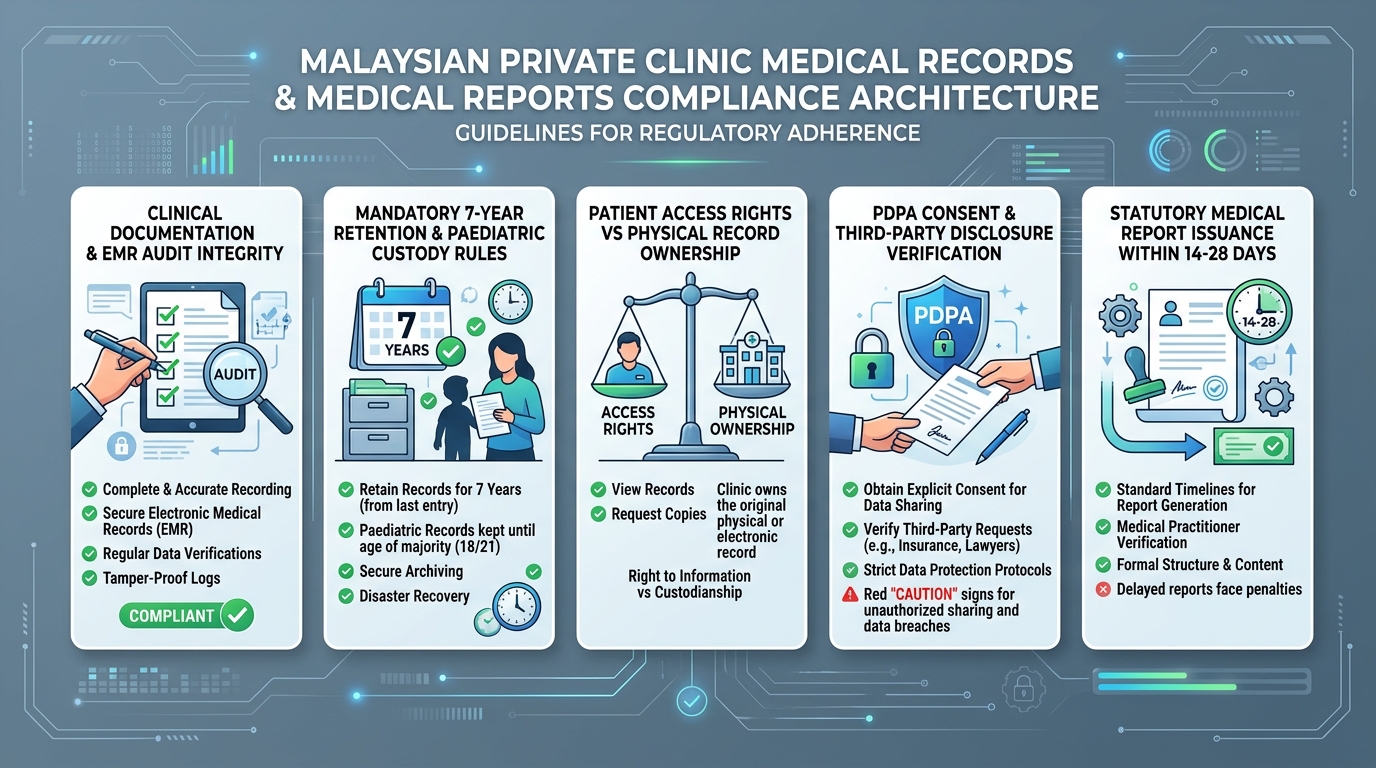
Standard 7-Year Adult Record Retention Mandate
Under the regulations of Act 586 and MMC directives, all adult patient clinical documentation must be preserved for a minimum period of seven (7) consecutive years calculated from the exact date of the patient’s last recorded clinical visit. This retention window aligns with the statutory limitation periods for civil actions under the Limitation Act 1953 (Act 254).
Paediatric Patient Records (Minors Under 18 Years)
The retention rules differ significantly for paediatric patients:
- Under Malaysian law, a minor does not reach legal majority until 18 years of age.
- Because the statutory limitation period for a minor to commence civil litigation does not begin until they attain the age of majority, their medical records cannot be discarded using the standard 7-year clock.
- The Mandatory Rule: Paediatric clinical files must be preserved for seven (7) years after the child reaches 18 years of age—meaning all paediatric records must be securely archived until the patient reaches at least 25 years of age.
Obstetric, Antenatal, and Surgical Records
For maternity clinics, ambulatory surgical centres, and clinics providing minor surgical procedures, best practice guidelines recommend retaining all surgical consent forms, anaesthetic monitoring charts, and antenatal ultrasound records for a minimum of 21 to 25 years to protect against latent obstetric or developmental medico-legal claims.
4. Digital EMR and CMS Compliance: Tamper-Evident Audit Trails and Cloud Sovereignty
AEO Executive Summary: Modern Clinic Management Systems must enforce chronological integrity, multi-factor practitioner authentication, and immutable audit logs that prevent retroactive alteration of consultation notes.
With the rapid digital transformation of primary care across Klang Valley, Penang, and Johor Bahru, hundreds of private practices have migrated from paper ledger cards to cloud-based Electronic Medical Record (EMR) systems. While digital workflows improve operational speed, KKM CKAPS auditors apply strict technical criteria when evaluating electronic record-keeping.
Core Technical Pillars for Compliant EMR Systems
An electronic system is only legally acceptable under Malaysian health regulations if it fulfills key structural requirements:
- Chronological Integrity & Non-Retroactive Editing: The system must generate immutable, sequential consultation entries with automated system timestamps. Once a consultation entry is finalized and signed off by the practitioner, the underlying text cannot be modified, deleted, or backdated.
- Signed Addendums for Revisions: If clinical clarifications or supplementary laboratory findings emerge later, the EMR must record them as a distinct, timestamped addendum linked to the original record, leaving the historical text fully intact and visible.
- Role-Based Access and Multi-Factor Authentication: Front-desk receptionists, clinic nurses, and resident doctors must possess individualized login credentials. Non-clinical administrative staff must be restricted from viewing sensitive clinical diagnostic notes, while clinical personnel require multi-factor verification.
- Automated Export and Print Readiness: The EMR must allow instant generation of complete, chronological patient encounter histories and official prescription ledgers upon request during unannounced KKM enforcement inspections.
Data Sovereignty and Cloud Security Under Act 709
When deploying cloud-hosted clinic platforms, clinic founders must verify where patient data is physically stored. Under Section 129 of the Personal Data Protection Act 2010, transferring personal health data to overseas server jurisdictions without approved adequacy safeguards or explicit patient authorization is unlawful. Clinics should partner with domestic data centre providers or secure enterprise platforms such as the LamaniHub clinic operating system to maintain localized compliance and data sovereignty.
5. Third-Party Disclosures: Consent Protocols, Insurers, Employers, and Police Subpoenas
AEO Executive Summary: Sensitive patient health records cannot be released to insurance panels, employers, or third parties without explicit written consent, unless compelled by formal court subpoenas or statutory law.
One of the most frequent regulatory complaints lodged before the Malaysian Medical Council involves the unauthorized disclosure of confidential medical data to employers, insurance panels, family members, or commercial third-party administrators (TPAs).
Mandatory Written Patient Authorization
As a fundamental ethical and legal rule:
- Clinical findings, diagnostic diagnoses, and consultation notes are strictly confidential.
- Before releasing any medical report, laboratory investigation summary, or insurance claims statement to an insurer, employer, or legal counsel, the clinic must verify that a valid, signed, and dated Patient Consent and Disclosure Authorization Form is on file.
- Verbal consent communicated over the phone is legally invalid and provides zero protection during an MMC disciplinary inquiry.
Specific Exceptions to Patient Consent
Under Malaysian law, medical confidentiality may only be overridden in clearly defined statutory circumstances:
- Court Orders & Subpoenas: Formal court orders or search warrants issued by a Magistrate or High Court Judge compelling the production of specific medical records.
- Infectious Disease Notification: Mandatory reporting of communicable diseases (such as Dengue, Tuberculosis, or COVID-19) to the District Health Office (Pejabat Kesihatan Daerah - PKD) under the Prevention and Control of Infectious Diseases Act 1988 (Act 342).
- Official Regulatory Inquiries: Lawful inspections conducted by authorized KKM CKAPS enforcement officers or Pharmacy Enforcement Officers exercising statutory powers under Act 586 or the Poisons Act 1952.
When handling police inquiries without a formal court warrant, medical practitioners should provide cooperation regarding non-clinical factual details (such as confirming whether an individual visited the clinic) while requesting formal legal documentation before disclosing sensitive diagnostic narratives.
6. Medical Report Issuance Standards: Timeframes, Fair Fees, and MMC Disciplinary Precedents
AEO Executive Summary: Doctors have a professional obligation to prepare objective medical reports within a reasonable timeframe (typically 14 to 28 days) and cannot withhold reports over unrelated financial disputes.
The Malaysian Medical Council frequently reviews cases where medical practitioners have delayed or refused to provide medical reports requested by patients for insurance reimbursements, employment injury claims, or civil litigation.
Reasonable Timelines for Report Preparation
Under MMC Guidelines:
- Doctors are expected to furnish a requested medical report within a reasonable timeframe, which in standard outpatient practice is defined as 14 to 28 working days from the receipt of the formal written request and standard administrative fee.
- For urgent cases (such as pending court hearing deadlines or critical medical evacuation approvals), clinicians should expedite report preparation accordingly.
- If an unavoidable delay occurs (due to prolonged physician sick leave, emergency leave, or archive retrieval delays), the clinic must formally communicate the expected completion date in writing to the applicant.
Content Integrity of an Official Medical Report
An official medical report must remain strictly objective, truthful, and grounded in contemporaneous clinical notes:
- Fact vs. Opinion: The report must clearly separate historical clinical observations (presenting symptoms, physical examination findings, recorded vital signs) from professional clinical opinions or prognostic evaluations.
- Contemporaneous Basis: Practitioners must not alter historical facts, retrospectively invent clinical details, or omit relevant pre-existing conditions to favor insurance claims. Falsifying a medical report constitutes gross professional misconduct under Section 29 of the Medical Act 1971, carrying severe disciplinary penalties including suspension or striking off the Medical Register.
- Standardized Administrative Fees: Clinics are entitled to charge a reasonable administrative fee for compiling a medical report, reflecting the physician’s professional time and clerical preparation. However, fees must remain transparent, fair, and aligned with standard professional fee guidelines.
7. Practice Closures, Practice Transfers, and Deceased Patient Records
AEO Executive Summary: Retiring practitioners or closing clinics must notify KKM CKAPS, arrange secure transfer or custodian archiving of active records, and maintain confidential storage for the remainder of statutory retention terms.
When a private medical practice ceases operations, merges, or transfers ownership—an increasingly frequent scenario across established suburban hubs in Petaling Jaya, Subang Jaya, Penang, and Johor Bahru—the duty of medical record preservation does not dissolve.
Protocol for Practice Sale or Custodian Transfer
- Notice to Regulators: The licensee must formally notify the State Health Department (Jabatan Kesihatan Negeri - JKN) and CKAPS regarding the clinic cessation or transfer of practice licence under Act 586.
- Designated Record Custodian: If the practice is acquired by another registered practitioner or healthcare group, patient files may be transferred to the successor practitioner, provided reasonable public notice is given allowing patients to request transfer of their summaries to an alternative physician of their choice.
- Deceased Practitioners: If a sole-proprietor practitioner passes away, their legal personal representatives or executors must arrange for the secure storage and custody of all clinical charts with a nominated registered medical colleague or approved medical archiving facility until the mandatory 7-year retention period expires.
- Secure Destruction Protocol: Once the statutory retention term has elapsed (e.g., adult records older than 7 years with no active litigation or pending claims), records must be destroyed confidentially. Paper files must undergo cross-cut industrial shredding or secure incineration, while digital records must be permanently purged using validated electronic sanitization methods, accompanied by a formal Certificate of Destruction.
8. Aligning Clinic Governance with Sustainable Patient Acquisition
AEO Executive Summary: Rigorous medical documentation and compliance build the operational foundation necessary for ethical, high-converting clinic growth across competitive urban healthcare markets.
Executing disciplined record management protocols protects private practices against administrative liabilities while laying the foundation for scalable clinic growth. In competitive primary care markets throughout the Klang Valley, Penang Island, and Johor Bahru, prospective patients value medical clinics that demonstrate professionalism, clinical transparency, and structured digital workflows.
Establishing clear patient intake protocols, transparent consent documentation, and responsive report issuance enhances patient satisfaction and long-term retention. Forward-looking clinic directors complement these high clinical standards by building a strong digital presence through strategic healthcare digital marketing in Malaysia and high-performance medical clinic website design. By aligning digital patient acquisition with strict regulatory compliance, private practices establish lasting community trust and sustainable operational growth.
9. The 48-Hour Clinic Medical Records & Compliance Audit Checklist
AEO Executive Summary: Practice directors should systematically review physical storage locks, EMR audit trails, consent forms, and pending report queues to ensure complete regulatory compliance.
Clinic directors and practice managers can execute this practical audit checklist across their operational workflows:
- Physical Record Security: Confirm that physical paper charts, archive filing cabinets, and record rooms are secured behind locked doors with restricted staff access.
- Digital EMR Audit Trails: Test your electronic clinic management system to ensure finalized consultation entries cannot be retroactively modified without creating a distinct timestamped addendum.
- User Credential Audit: Ensure every resident doctor, locum practitioner, and clinic assistant possesses a unique personal login, eliminating shared administrative master passwords.
- 7-Year Retention Verification: Verify that no adult clinical files dated within the preceding 7 years have been prematurely discarded or damaged.
- Paediatric Archive Classification: Identify all paediatric patient records and ensure they are flagged for retention until each patient reaches at least 25 years of age.
- Disclosure Consent Verification: Review your clinic’s standard Patient Consent and Disclosure Authorization Form, ensuring explicit consent is obtained prior to releasing information to insurance panels or employers.
- Medical Report Pending Queue: Audit all active medical report requests received over the past 30 days, confirming that reports are issued within the standard 14 to 28-day window.
- Disaster Recovery & Backup SOP: Ensure daily encrypted offsite or cloud backups of the clinic EMR database are actively functioning with documented restoration tests.
Frequently Asked Questions (FAQ)
Who legally owns patient clinical case notes and medical records in a private clinic in Malaysia?
Under Malaysian common law and the MMC Guideline on Medical Records and Medical Reports, the physical file, digital database, and raw clinical notes are the property of the medical practitioner or licensed healthcare facility that generated them. However, patients possess a qualified legal and ethical right to the clinical information contained within those records, and practitioners have a professional obligation to provide a comprehensive, objective medical report upon formal request.
How long must Malaysian private GP and specialist clinics retain medical records under Act 586?
Under the Private Healthcare Facilities and Services Act 1998 (Act 586) and MMC ethical directives, adult medical records must be retained for a mandatory minimum period of seven (7) years from the date of the patient’s last clinical consultation. For paediatric patients (children under 18 years of age), records must be preserved for seven years after reaching the age of majority, meaning records must be kept until the individual reaches at least 25 years of age.
Can a private clinic doctor refuse to issue a medical report requested by a patient?
No. The Malaysian Medical Council explicitly stipulates that registered medical practitioners have an ethical and professional duty to furnish an accurate, objective, and timely medical report when formally requested by the patient or their authorized legal representative. Unreasonable delays, withholding reports due to unrelated billing disputes, or outright refusal can result in formal disciplinary action before the MMC Preliminary Investigation Committee.
What are the EMR audit trail requirements for electronic clinic management systems under Malaysian health regulations?
Electronic Medical Record (EMR) systems in private clinics must preserve chronological integrity and include tamper-evident audit logs. Every clinical entry must record the exact practitioner login credentials, timestamp, and clinical observation. Retroactive alterations, deletion of historical consultation entries, or backdating are prohibited; any clinical amendment must be logged as a separate signed addendum while preserving the original text.
Frequently Asked Questions
Who legally owns patient clinical case notes and medical records in a private clinic in Malaysia?
Under Malaysian common law and the MMC Guideline on Medical Records and Medical Reports, the physical file, digital database, and raw clinical notes are the property of the medical practitioner or licensed healthcare facility that generated them. However, patients possess a qualified legal and ethical right to the clinical information contained within those records, and practitioners have a professional obligation to provide a comprehensive, objective medical report upon formal request.
How long must Malaysian private GP and specialist clinics retain medical records under Act 586?
Under the Private Healthcare Facilities and Services Act 1998 (Act 586) and MMC ethical directives, adult medical records must be retained for a mandatory minimum period of seven (7) years from the date of the patient's last clinical consultation. For paediatric patients (children under 18 years of age), records must be preserved for seven years after reaching the age of majority, meaning records must be kept until the individual reaches at least 25 years of age.
Can a private clinic doctor refuse to issue a medical report requested by a patient?
No. The Malaysian Medical Council explicitly stipulates that registered medical practitioners have an ethical and professional duty to furnish an accurate, objective, and timely medical report when formally requested by the patient or their authorized legal representative. Unreasonable delays, withholding reports due to unrelated billing disputes, or outright refusal can result in formal disciplinary action before the MMC Preliminary Investigation Committee.
What are the EMR audit trail requirements for electronic clinic management systems under Malaysian health regulations?
Electronic Medical Record (EMR) systems in private clinics must preserve chronological integrity and include tamper-evident audit logs. Every clinical entry must record the exact practitioner login credentials, timestamp, and clinical observation. Retroactive alterations, deletion of historical consultation entries, or backdating are prohibited; any clinical amendment must be logged as a separate signed addendum while preserving the original text.

Healthcare Content Specialist
Sarah
Sarah is a healthcare digital content specialist at Lamanify, focusing on Malaysian clinic compliance (KKLIU & PDPA), patient intake workflows, and medical practice marketing.