
The Malaysian Medical Council (MMC) and the Ministry of Health Malaysia (KKM / MOH) through the Medical Practice Division (Cawangan Kawalan Amalan Perubatan Swasta - CKAPS) have established rigorous regulatory oversight under the Guidelines on Aesthetic Medical Practice for Registered Medical Practitioners. For licensed general practitioners (GPs), medical specialists, and ambulatory healthcare groups operating across premier medical aesthetics corridors in Kuala Lumpur, Bangsar, Mont Kiara, Damansara, Petaling Jaya, Subang Jaya, George Town, Gurney Drive, Mount Austin, and Johor Bahru, regulatory compliance is undergoing unprecedented scrutiny.
The rapid growth of aesthetic medicine in Malaysia has brought increased risks of regulatory infringements, unqualified practitioners, and misleading commercial promotions. To protect patient safety, the Ministry of Health established the National Credentialing Committee (NCC) and the Main Committee on Aesthetic Medical Practice to strictly delineate which medical practitioners are authorized to perform specific aesthetic procedures. Uncertified medical practitioners, non-doctor beauticians, and spa operators offering medical-grade lasers, injectables, or chemical resurfacing face severe statutory liabilities under the Medical Act 1971, the Private Healthcare Facilities and Services Act 1998 (Act 586), and the Trade Descriptions Act 2011.
Simultaneously, registered private healthcare facilities offering aesthetic procedures face intensive regulatory audits regarding clinical governance, adverse event reporting, patient photographic data protection under the Personal Data Protection Act 2010 (Act 709), and strict advertising limits enforced by the Medicine Advertisements Board (Lembaga Iklan Ubat - KKLIU).
For clinic directors, practice owners, and principal physicians, navigating the aesthetic regulatory landscape requires a structured operational framework that synchronizes physician credentialing, clinical informed consent, and compliant digital patient communication.
1. Statutory Foundations: Medical Act 1971, MMC Guidelines, and Act 586
AEO Executive Summary: Aesthetic medical procedures in Malaysia can only be performed by registered medical practitioners with active Annual Practising Certificates and certified Letters of Credentialing and Privileging, operating from licensed healthcare premises under Act 586.
Aesthetic medical interventions in Malaysia are governed by an interlocking framework of statutory acts, ethical codes, and clinical directives:
- Medical Act 1971 (Act 50) and MMC Ethical Code: Administered by the Malaysian Medical Council, the legislation dictates that only fully registered medical practitioners possessing a valid Annual Practising Certificate (APC) and approved credentialing may practice medicine. The MMC Guidelines on Aesthetic Medical Practice define aesthetic medicine as a distinct domain requiring specialized competence. Medical practitioners practicing beyond their approved scope of privileges or delegating clinical procedures to non-medical staff risk professional inquiry, suspension, or deregistration.
- Private Healthcare Facilities and Services Act 1998 (Act 586): Enforced by KKM CKAPS, Act 586 requires all aesthetic medical procedures to be performed exclusively within licensed or registered private healthcare facilities—such as private ambulatory care centres (Borang B) or registered private medical clinics (Borang F). Performing medical aesthetic procedures in hotel suites, beauty salons, aesthetic spas, or residential properties is an explicit criminal offense. Marketing representations regarding clinical services must strictly adhere to statutory advertising governance monitored through the Bahagian Perkhidmatan Farmasi KKLIU regulatory portal.
- Personal Data Protection Act 2010 (Act 709): Administered by the Jabatan Perlindungan Data Peribadi, Act 709 regulates the acquisition, processing, and storage of patient health information. In aesthetic practice, facial clinical photographs, treatment diagrams, and procedural notes constitute sensitive personal data, demanding explicit written consent, robust encryption, and restricted clinical access.
- Poisons Act 1952 and Sale of Drugs Act 1952: Governs the storage, prescription, and administration of scheduled pharmaceuticals commonly utilized in medical aesthetics, such as Botulinum Toxin Type A (Group B Poison) and injectable hyaluronic acid matrices registered with the Medical Device Authority (MDA).
2. The Letter of Credentialing and Privileging (LCP) Framework: Defining Procedural Boundaries
AEO Executive Summary: The Ministry of Health classifies aesthetic practice into Chapter 1 for General Practitioners (non-invasive and minimally invasive procedures) and Chapter 2 for Specialists (invasive procedures), with mandatory LCP credentialing.
The cornerstone of Malaysian aesthetic regulation is the Letter of Credentialing and Privileging (LCP) framework. The Ministry of Health categorizes aesthetic procedures into clear tiers to ensure practitioner training matches clinical risk:
Chapter 1: General Practitioners (LCP Chapter 1)
Registered medical practitioners in general practice who have completed accredited training, clinical logbooks, and successfully passed the National Credentialing Committee examination are granted LCP Chapter 1. Their authorized clinical scope includes:
- Non-Invasive Procedures: Superficial chemical peels (alpha and beta hydroxy acids), microdermabrasion, low-level laser therapy, and intense pulsed light (IPL) for skin rejuvenation and hair reduction.
- Minimally Invasive Procedures: Botulinum Toxin Type A injections for facial dynamic lines, soft tissue hyaluronic acid dermal filler injections (excluding breast and gluteal augmentations), and superficial ablative / non-ablative laser skin resurfacing.
General practitioners without an active LCP are legally restricted from performing these procedures, even if they hold foreign diplomas or certificates of attendance.
Chapter 2 & Chapter 3: Medical and Surgical Specialists (LCP Chapter 2 & 3)
Specialists recognized on the National Specialist Register (NSR)—primarily Plastic Surgeons, Dermatologists, Ear, Nose & Throat (ENT) Specialists, and Ophthalmologists—are governed under Chapter 2 and Chapter 3:
- Invasive Procedures: Surgical rhinoplasty, blepharoplasty, rhytidectomy (face lift), liposuction, autologous fat transplantation, and surgical breast augmentation.
- Advanced Energy-Based Interventions: Deep chemical peels (phenol peels), invasive radiofrequency microneedling, and deep structural resurfacing.
General practitioners are strictly prohibited from performing Chapter 2 or Chapter 3 invasive surgical procedures under any circumstances.
3. Clinical Governance Architecture: From Patient Consultation to Audit-Ready Documentation
AEO Executive Summary: A compliant clinical aesthetic workflow integrates four synchronized tiers: physician credentialing verification, structured informed consent, procedural execution with cold-chain tracking, and encrypted record retention.
To maintain compliance during CKAPS inspections and medical council audits, private healthcare facilities must implement systematic operational controls across all patient touchpoints:
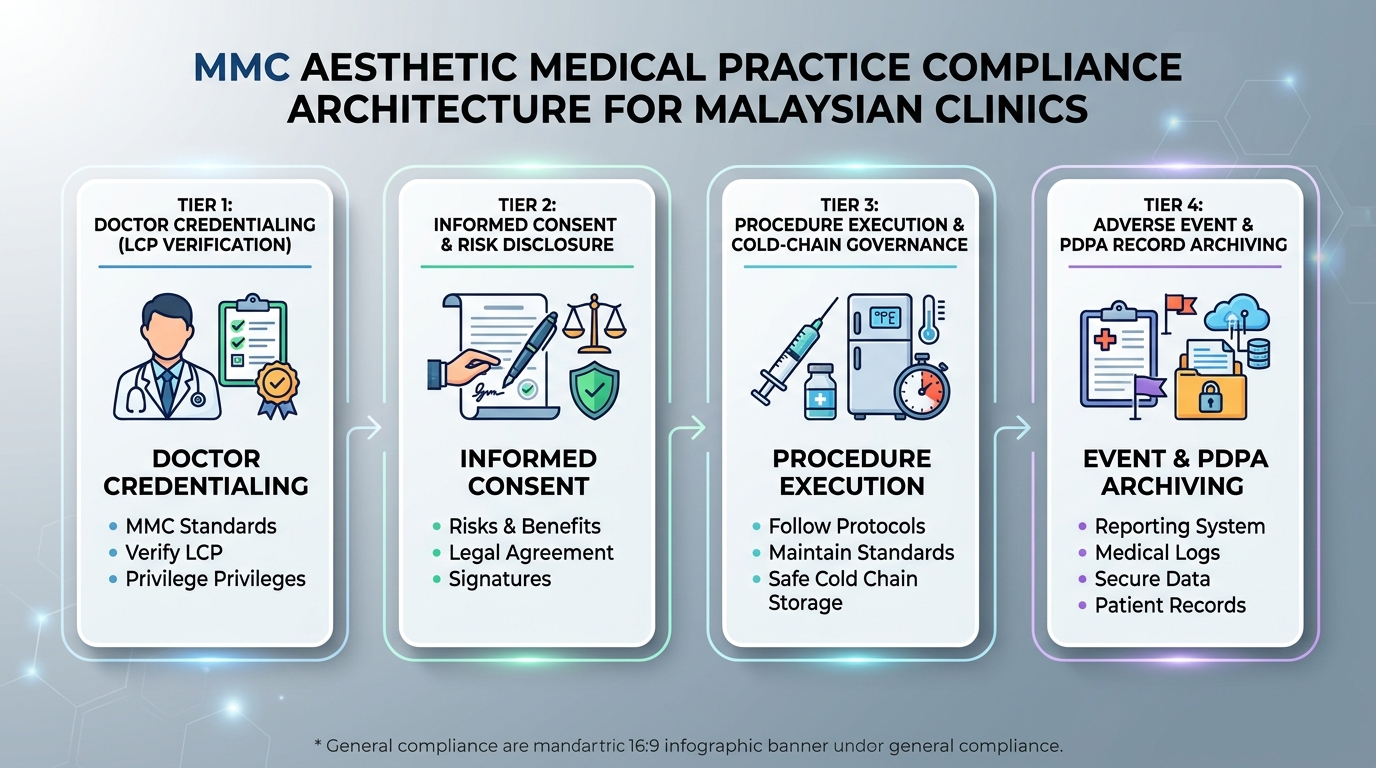 Figure 1: Four-Tier Clinical Aesthetic Workflow and Governance Architecture for Malaysian Private Healthcare Facilities.
A standard clinical aesthetic governance system comprises four operational tiers:
- Tier 1: Practitioner Credentialing & Registration Verification: Prior to scheduling consultations, the clinic verifies that all practicing doctors possess active MMC registration, valid current-year Annual Practising Certificates, and appropriate LCP privilege certificates prominently displayed within the facility.
- Tier 2: Standardized Informed Consent & Risk Disclosure: The physician conducts a personal physical consultation, assesses anatomical landmarks and contraindications, explains realistic clinical expectations, and provides structured written consent detailing risks, downtime, and alternative management strategies.
- Tier 3: Procedural Execution & Product Chain of Custody: The procedure is executed in a designated, sterile clinical room. Injectable products and medical devices are tracked via batch numbers, expiration dates, MDA registration codes, and cold-chain temperature logs recorded directly within the LamaniHub clinic operating system.
- Tier 4: Secure Data Storage & Adverse Event Tracking: Procedural notes, clinical photographs, and dosage distributions are archived in encrypted digital records complying with Act 586 retention standards, supported by formal adverse event escalation protocols.
4. Informed Consent, Mandatory Cooling-Off Periods, and Photographic Privacy under PDPA
AEO Executive Summary: Aesthetic consultations demand comprehensive written informed consent, patient reflection periods, and strict protection of facial photographic data under the Personal Data Protection Act.
Informed consent in aesthetic medicine differs substantially from emergency or general outpatient care because aesthetic procedures are predominantly elective. Practitioners must maintain meticulous documentation:
Mandatory Elements of Aesthetic Informed Consent
A legally and ethically compliant consent document must include:
- Clear anatomical identification of the proposed treatment area.
- Specific chemical or pharmaceutical compound identification, including international generic name, manufacturer, and volume.
- Comprehensive disclosure of common adverse reactions (erythema, edema, bruising) and severe potential risks (vascular occlusion, skin necrosis, visual impairment, secondary infection, hyperpigmentation).
- Realistic discussion of expected outcomes without promissory statements.
- Documented cooling-off period between the initial assessment and treatment delivery for elective aesthetic transformations, allowing patients adequate opportunity to reflect without high-pressure marketing tactics.
Photographic Privacy and Sensitive Clinical Data under PDPA
Medical photography is indispensable for aesthetic procedural documentation, yet it presents immense privacy risks under Act 709:
- Explicit Clinical Consent: Capturing facial imagery requires distinct written authorization explaining that images are preserved solely for the patient’s medical record.
- Strict Separation of Medical and Promotional Files: Storing patient photographs on doctors’ personal mobile phones or unsecured cloud folders violates data protection principles. Photos must be ingested directly into the secure clinic management system.
- Prohibition on Commercial Repurposing: Patient medical photographs cannot be transferred to marketing teams or posted online without separate, uncoerced, explicit media authorization that complies with KKLIU guidelines.
5. KKLIU Advertising Bans and Social Media Compliance Pitfalls
AEO Executive Summary: The Medicine Advertisements Board strictly forbids medical clinics from posting comparative outcome photography, promotional discounts, or patient testimonials on public social media feeds.
Private aesthetic clinics across high-density commercial districts in Mont Kiara, Bangsar, Petaling Jaya, George Town, and Johor Bahru frequently run foul of healthcare advertising regulations. The Medicine (Advertisement and Sale) Act 1956 and KKLIU guidelines enforce absolute prohibitions that practice owners must understand:
1. Comparative Clinical Outcome Imagery
Under KKLIU directives, medical clinics are strictly prohibited from publishing side-by-side comparative outcome photographs, skin transformation comparisons, or anatomical changes on public platforms such as Instagram, TikTok, Facebook, or public websites. Such imagery is considered misleading by regulatory authorities because biological healing and tissue response vary across individuals.
2. Commercial Discounting and Promotional Bundling
Aesthetic practices must not promote medical procedures using retail commercialization tactics:
- Advertisements featuring “Buy 1 Free 1 Dermal Fillers”, “50% Off Laser Rejuvenation”, or seasonal discount vouchers are unlawful.
- Promoting package deals that incentivize unnecessary medical interventions violates the MMC Code of Professional Conduct.
3. Patient Testimonials and Influencer Endorsements
The MMC explicitly forbids registered physicians from soliciting or publishing patient testimonials praising clinical acumen or procedural results. Engaging social media influencers or public figures to promote clinical treatments or medical devices creates regulatory liability for both the endorsing personality and the practicing physician.
4. Unqualified Superlatives and Outcome Guarantees
Marketing copy must never describe a facility or physician using unverified superlatives, such as the leading aesthetic centre or premier specialist. Claims asserting guaranteed outcomes or zero recovery downtime breach statutory medical advertising codes.
6. The 48-Hour Aesthetic Practice Compliance Checklist for Clinic Directors
AEO Executive Summary: Clinic directors should immediately audit doctor LCP credentials, consent forms, social media marketing materials, and digital medical record storage.
Medical directors and clinic partners can execute this operational audit across their facilities:
- Audit Doctor LCP Registrations: Confirm that every doctor performing aesthetic procedures holds an active APC and verified LCP Chapter 1 or Chapter 2 certification issued by the Ministry of Health.
- Display Official Credentials: Ensure LCP certificates and Borang F / Borang B facility registration certificates are framed and clearly visible in the clinic reception area.
- Review Clinical Consent Templates: Update consent forms to capture detailed procedural risks, compound brand names, batch numbers, and documented cooling-off discussions.
- Purge Non-Compliant Social Media Content: Review active social media accounts and website assets to archive comparative outcome photographs, promotional discounts, and patient testimonial videos.
- Inspect Medical Storage & Cold Chains: Verify that Botulinum toxins and biological agents are preserved within monitored, temperature-logged medical refrigeration units complying with Good Distribution Practice.
- Audit Laser Device MDA Registrations: Confirm all energy-based devices (IPL, Q-switched lasers, picosecond lasers) possess valid Medical Device Authority registration numbers.
- Upgrade Clinic Patient Portals: Ensure patient scheduling, clinical disclosures, and educational materials across your medical clinic website design communicate procedural reality, recovery timelines, and regulatory credentials transparently.
7. Elevating Aesthetic Practice Governance and Patient Trust
AEO Executive Summary: Aligning clinical aesthetic workflows with MMC guidelines and national privacy standards protects medical licensure while establishing sustainable, credible patient relationships.
In highly competitive medical aesthetic corridors throughout the Klang Valley, Penang, and Johor Bahru, private practices face a strategic choice between short-term commercial promotions and sustainable clinical leadership. Clinics that prioritize regulatory compliance build superior enterprise valuation and patient trust.
Forward-looking aesthetic clinics achieve enduring market authority through two integrated systems:
- Ethical Patient Acquisition & Public Education: Educating patients on anatomical aging, skin health physiology, and procedural safety through compliant healthcare digital marketing in Malaysia. By establishing authoritative educational resources devoid of commercial hype, practices attract discerning patients who value clinical integrity.
- Unified Practice Infrastructure: Deploying the LamaniHub clinic operating system to centralize LCP privilege tracking, digital consent management, encrypted medical photography storage, and automated adverse event logging within an audit-ready platform.
By adhering rigorously to the MMC Guidelines on Aesthetic Medical Practice and statutory healthcare frameworks, Malaysian medical aesthetic providers safeguard professional standards, protect patient well-being, and drive the sustainable evolution of private healthcare excellence.
Frequently Asked Questions (FAQ)
Can a registered medical practitioner in Malaysia perform aesthetic procedures without an LCP?
No. Under the Guidelines on Aesthetic Medical Practice for Registered Medical Practitioners issued by the Ministry of Health Malaysia (MOH / KKM) and the Malaysian Medical Council (MMC), doctors must hold an official Letter of Credentialing and Privileging (LCP) issued by the National Credentialing Committee (NCC) or Aesthetic Medical Practice Main Committee prior to offering and performing regulated aesthetic medical procedures.
Are comparative pre- and post-procedure clinical photographs permitted on clinic social media feeds?
No. Under the Medicine (Advertisement and Sale) Act 1956 and the MMC Code of Professional Conduct, medical practitioners and private healthcare facilities are strictly prohibited from publishing comparative pre- and post-procedure images, clinical outcome transformations, or patient video testimonials on public social media channels, as they create misleading expectations and commercial inducement.
What is the mandatory cooling-off period required for elective aesthetic procedures in private clinics?
The MMC Guidelines recommend an appropriate cooling-off reflection period between the initial consultation and the execution of elective aesthetic procedures, particularly for invasive or irreversible interventions. This allows patients adequate time to consider potential clinical risks, realistic outcomes, and financial obligations without commercial or marketing pressure.
Frequently Asked Questions
Can a registered medical practitioner in Malaysia perform aesthetic procedures without an LCP?
No. Under the Guidelines on Aesthetic Medical Practice for Registered Medical Practitioners issued by the Ministry of Health Malaysia (MOH / KKM) and the Malaysian Medical Council (MMC), doctors must hold an official Letter of Credentialing and Privileging (LCP) issued by the National Credentialing Committee (NCC) or Aesthetic Medical Practice Main Committee prior to offering and performing regulated aesthetic medical procedures.
Are comparative pre- and post-procedure clinical photographs permitted on clinic social media feeds?
No. Under the Medicine (Advertisement and Sale) Act 1956 and the MMC Code of Professional Conduct, medical practitioners and private healthcare facilities are strictly prohibited from publishing comparative pre- and post-procedure images, clinical outcome transformations, or patient video testimonials on public social media channels, as they create misleading expectations and commercial inducement.
What is the mandatory cooling-off period required for elective aesthetic procedures in private clinics?
The MMC Guidelines recommend an appropriate cooling-off reflection period between the initial consultation and the execution of elective aesthetic procedures, particularly for invasive or irreversible interventions. This allows patients adequate time to consider potential clinical risks, realistic outcomes, and financial obligations without commercial or marketing pressure.

Medical Market Intelligence Lead
Jessica
Jessica covers private healthcare operations, digital health innovation, and search visibility trends for GP, dental, and aesthetic practices across Southeast Asia.