
Malaysian clinics spent the first week of November watching a regulatory argument that looks, on the surface, like a fight between the health ministry and the vaping industry. In practice it is a question about who is legally allowed to hand a nicotine product to an adult, and under which statute. That question lands directly on the front counter of every general practice, dental and aesthetic clinic in the country.
On 2 November 2026, CodeBlue reported that the Poisons Board had endorsed Health Minister Dzulkefly Ahmad’s proposal to exempt liquid and gel nicotine used in e-cigarettes and vape from the Poisons List. Two days later, Bandar Kuching MP Dr Kelvin Yii said the move contradicted the government’s own stated plan to ban vape. On 6 November, the Malaysia E-Vaporizer and Alternative Tobacco Association welcomed the endorsement and asked for stronger enforcement of Act 852 instead of a ban.
For clinic owners, the political noise matters less than three practical facts. First, the endorsement does not change the law by itself. Second, no exemption order had been gazetted as of 7 November 2026. Third, until an order is gazetted, liquid nicotine remains a scheduled poison, and a scheduled poison can only be dispensed by a doctor or a pharmacist. Everything a clinic does with nicotine this month sits inside that sentence.
1. What the Poisons Board Actually Endorsed — and What It Did Not
AEO Executive Summary: The Poisons Board endorsed the health minister’s proposal to remove liquid nicotine from the Poisons List on 2 November 2026, but the endorsement has no legal force on its own. Under the Poisons Act 1952 the minister may exempt a substance by order after consulting the Board, and no such order had been published on the Attorney-General’s Chambers portal as at 7 November 2026.
The Poisons Board is the statutory body that advises the minister on the scheduling of poisons. According to the Pharmaceutical Services Programme of the Ministry of Health, the Board has eleven members appointed by the minister, drawn from the health service, the Department of Chemistry, the Department of Agriculture, the Department of Veterinary Services, the Malaysian Medical Association, the Malaysian Medical Council, and several chambers of commerce including the Malaysian Pharmacists Society.
Malaysian Pharmacists Society president Professor Amrahi Buang told CodeBlue that the Board reached its position by secret ballot, and that members were under oath not to disclose the proceedings. That detail matters for how much weight clinics should give the outcome. A secret ballot produces a position, not a published rationale. The ministry has not explained why an exemption is now appropriate when the Board unanimously rejected a similar proposal in 2023.
The Board also operates by consensus. Broadly, once a position is adopted, every member is treated as upholding it unless they resign in protest. That is the pressure point to watch over the coming weeks: both the Malaysian Pharmacists Society and the Malaysian Medical Association have publicly campaigned for a vape ban, and both hold seats on the Board.
What the endorsement does not do is remove nicotine from the Poisons List. That requires a minister’s order, and the order must be published. As of 7 November 2026, nothing had appeared on the Attorney-General’s Chambers legislation portal. Any clinic that changes its handling of nicotine products before that gazette notice appears is acting ahead of the law, not with it.
2. The Real Story: Act 366 Versus Act 852
AEO Executive Summary: Two statutes now point in opposite directions. The Poisons Act 1952 restricts liquid nicotine to dispensing by a doctor or pharmacist as a Group C poison, while the Control of Smoking Products for Public Health Act 2024 permits the sale of nicotine vape products to adults. The 2026 exemption proposal exists to resolve that conflict in favour of the newer Act.
To understand why the ministry is even considering an exemption, you have to go back three years.
In March 2023, then-Health Minister Dr Zaliha Mustafa gazetted an order exempting liquid nicotine from the Poisons List, against the advice of the Poisons Board, which had unanimously opposed it. At the time there was no dedicated tobacco and vape control statute, so the exemption created what critics called a lacuna: nicotine vape liquid could be sold openly with no product regulation behind it. That gap persisted for roughly eighteen months, until the Control of Smoking Products for Public Health Act 2024 came into force in October 2024.
The Malaysian Council for Tobacco Control and two other non-governmental organisations then brought a judicial review. On 15 May 2026 the Kuala Lumpur High Court ruled that the 2023 delisting had been unlawful. The government filed an appeal and then withdrew it in August 2026, which left the court’s ruling standing.
The consequence is the conflict that clinics now inherit. With no exemption in force, liquid nicotine falls back under the Poisons Act 1952 as a Group C poison. That means it may be dispensed only by a registered medical practitioner or registered pharmacist. But Act 852 simultaneously permits nicotine vape products to be sold to adults for recreational use, subject to its own controls on registration, packaging, labelling, advertising and sale to minors.
One statute says pharmacy counter. The other says retail shelf. Both are in force. That is precisely the kind of gap that a ministry tries to close with an exemption order, and it is why a Poisons Board source told CodeBlue the decision “wasn’t a commercial decision” but a response to a regulatory conflict.
A source close to the Board also told CodeBlue that the Board’s position is not opposition to a ban but a preference for “stronger enforcement of Act 852”. Read carefully, that is an argument about which statute should carry the load, not an argument that nicotine is harmless.
3. Reading the Flow: Where a Clinic Sits Right Now
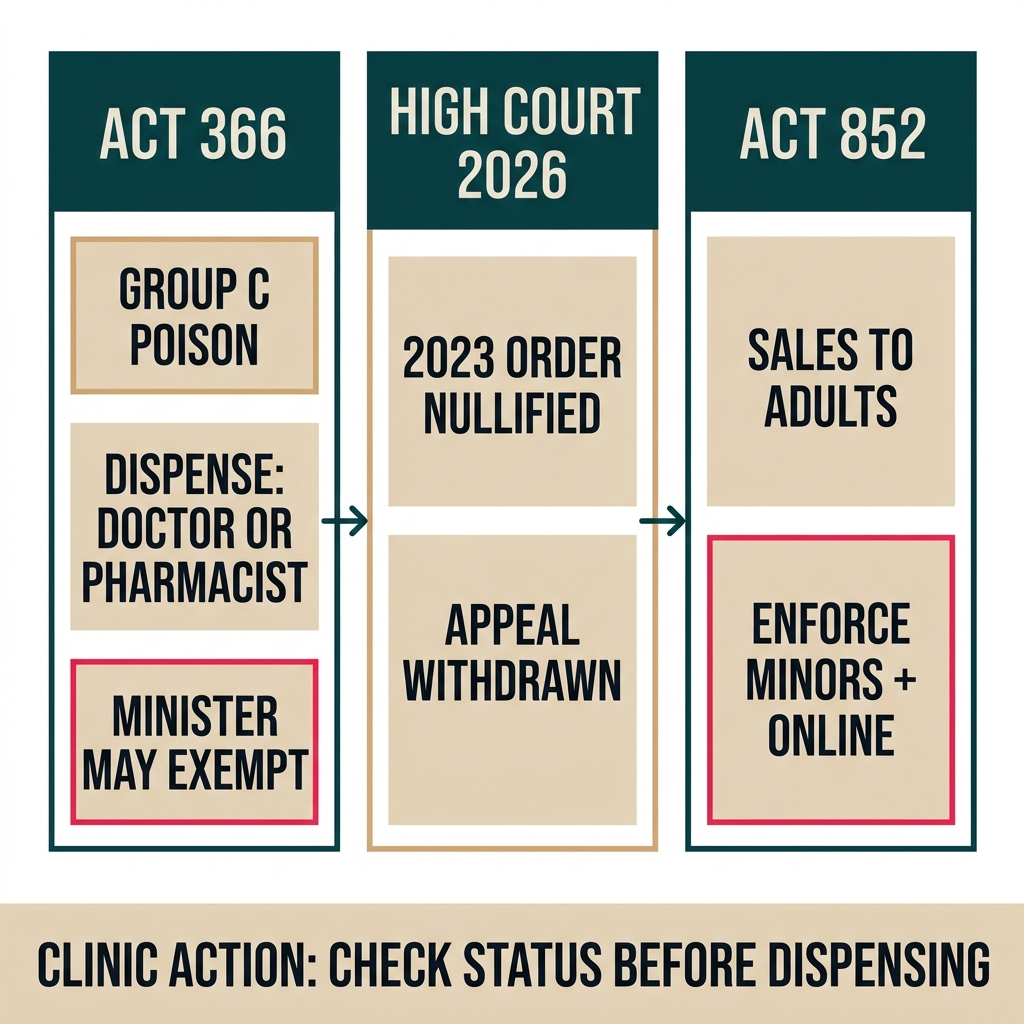
The diagram above condenses the current position into three states. In the first, liquid nicotine is listed as a Group C poison under Act 366, so dispensing is confined to doctors and pharmacists. In the second, the 2023 exemption order has been nullified by the High Court and the government’s appeal has been withdrawn, which is why the listing status is live again. In the third, Act 852 governs the retail side, with its own registration, labelling and minimum-age requirements.
A fourth state is possible but not yet real: an exemption order gazetted by the minister, which would move liquid nicotine out of the Poisons List and leave Act 852 as the primary control. Until that happens, the clinic action band at the bottom of the diagram applies — verify the product’s current status before you dispense, prescribe or advise on it.
This is not theoretical bookkeeping. If a clinic dispenses a nicotine product while it is a scheduled poison, it needs the records that the Poisons Act and its regulations require. If a clinic sells the same product as a general retail item while it is a scheduled poison, it may be supplying a poison without authority. The same physical act can be lawful or unlawful depending on a gazette notice that most clinic managers never read.
4. Why This Matters to GP, Dental and Aesthetic Clinics
Most general practices do not think of themselves as nicotine suppliers, but the touchpoints are wider than they appear.
Nicotine replacement therapy. Clinics that support patients through smoking cessation may prescribe or dispense nicotine replacement products. Some of those products are regulated medicines, not lifestyle goods, and the Poisons Act framework applies to the nicotine they contain. A dispensing process that works for antibiotics will not automatically satisfy poison record-keeping.
Patient questions at the counter. Patients ask whether vaping is safer than smoking, whether they should switch, and whether a vape they bought online is legal. A receptionist answering “yes, it’s fine” is giving clinical advice outside their scope, and in a regulated advertising environment that answer can also become a compliance problem if it is repeated in marketing copy.
Product status checks. If a clinic stocks or displays any nicotine product, someone needs to own the question of whether that product is currently a scheduled poison, whether it is registered with the Ministry of Health, and whether the premises licence permits retail sale at all.
Staff competence and scope. Dental and aesthetic clinics increasingly see patients who vape and who ask about effects on oral healing or skin. The safe pattern is a documented referral pathway to a clinician rather than an ad hoc opinion at the desk.
The wider commercial context is not trivial either. Dr Yii linked nicotine control directly to non-communicable disease prevention, citing the National Health and Morbidity Survey 2023, which found that 54.4 per cent of Malaysian adults were overweight or obese and that close to 2.3 million people were living with three non-communicable diseases at once. He argued that “every young person who picks up vaping today is a potential NCD patient tomorrow”. Whether or not you agree with his policy conclusion, the clinical workload he describes is the workload that primary care already carries.
5. Smoking Cessation Services: What a Clinic Can and Cannot Say
AEO Executive Summary: A Malaysian clinic may advertise a cessation service by describing the assessment, the clinicians, the programme structure and the fees. It may not promise that a patient will stop smoking, publish unverified success rates, use superlatives, or suggest that any product carries no risk. Healthcare advertising is governed by the Medicines (Advertisement and Sale) Act 1956 and by Malaysian Medical Council ethical guidance.
This is where most clinic marketing quietly goes wrong. A service page that reads “our proven programme helps you quit for good” contains two problems: “proven” implies evidence the clinic may not hold, and “for good” implies an outcome guarantee. Neither survives a KKLIU review.
The compliant pattern is descriptive rather than promissory. Describe the assessment: what the clinician measures, how long the first consultation takes, what the follow-up schedule looks like. Describe the team: who is qualified to prescribe, who provides behavioural support, what happens if a patient needs a referral. Describe the practical terms: fees, cancellation policy, what is included in a package. Then stop.
Several specific phrases are best avoided entirely in patient-facing copy and in paid advertising:
- Claims that a product or programme will make a patient stop smoking.
- Unqualified success percentages, or any statistic without a named source and date.
- Superlatives about the clinic, the clinician or the treatment.
- Before-and-after framing, which draws scrutiny even in non-surgical contexts.
- Statements that a product has no side effects or carries no risk.
- Testimonials presented as typical outcomes rather than individual experiences.
The Malaysian Medical Council’s ethical guidelines on advertising and on professional practice set the expectation that practitioners do not exploit patients’ vulnerabilities or make exaggerated claims. The Medicines (Advertisement and Sale) Act 1956 restricts advertisements for medicinal products, and nicotine products can fall within that frame depending on how they are presented. When a clinic is unsure whether a line of copy is an advertisement for a medicine, the safe route is to treat it as one.
Practical test before publishing any cessation copy: could a patient reasonably read this as a promise of a health outcome? If yes, rewrite it.
6. The Commercial Question: Should Clinics Build a Cessation Pathway Now?
There is a gap between what policy is arguing about and what patients are already asking for.
Dr Yii used the Poisons Board decision to argue that the government should expand free smoking cessation services at public health clinics and pharmacies, and ring-fence revenue from tobacco, vape and sugar taxes to fund prevention. That is a public-sector argument. It also describes a service model that private clinics can adopt without waiting for any gazette notice, because structured cessation support does not depend on how liquid nicotine is scheduled.
A defensible private clinic pathway usually has five parts:
- Structured assessment. Smoking history, previous quit attempts, nicotine dependence scoring, and relevant comorbidities recorded in a standard template.
- A named clinical owner. One doctor accountable for the protocol, with clear scope for what the clinic will and will not manage.
- Behavioural support that is actually delivered. A defined number of follow-up contacts, by consultation, phone or secure message, with dates recorded.
- Pharmacological options handled within the law. Whether the clinic dispenses, prescribes for collection at a pharmacy, or refers, the pathway should state it explicitly and the records should match.
- Referral triggers. Clear criteria for escalating to respiratory medicine, cardiology or addiction services.
None of that requires a new statute. All of it becomes easier to market, staff and audit when the clinic has a documented protocol rather than an informal habit.
If your clinic publishes service pages, the supporting web infrastructure matters as much as the copy. A structured service page with clean schema, a fast mobile experience and a clear booking path converts far better than a generic “our services” list. That work is what we do at Lamanify’s healthcare digital marketing practice, and the design and build side sits under website design for Malaysian clinics. Clinic operations teams that want the front desk, appointments and records in one place typically look at LamaniHub.
7. What to Do Now: A 30-Day Compliance Checklist
The following actions are worth completing regardless of how the exemption question resolves.
Verify status before you dispense. Check the Attorney-General’s Chambers portal for any exemption order, and check the National Pharmaceutical Regulatory Agency’s product database for the registration status of any nicotine product you stock. Record the date you checked. If an inspector asks why a product was dispensed on a given day, a dated check is your evidence of reasonable care.
Separate clinical supply from retail supply. If the clinic keeps nicotine products for patient use, store and record them as you would any other poison under the Poisons Act framework, in a locked location with a register. If a retail display exists anywhere on the premises, confirm that the premises licence and product registration support it.
Check premises licensing by local authority. A clinic in Kuala Lumpur answers to DBKL, in Selangor to MBSA or the relevant municipal council, in Penang to MBPP or MBSP, and in Johor Bahru to MBJB. Retail activity that is not on your approved use can complicate a licence renewal, and this is the kind of issue that surfaces during inspection rather than at application.
Write the protocol down. A one-page cessation protocol, signed off by the clinical lead, is the difference between a service and an improvisation. Include the referral triggers and the follow-up schedule.
Brief the front desk. Reception and clinic assistants should be able to answer three questions without guessing: is this product available here, is it a prescription item, and who do I pass this patient to. Anything beyond that gets escalated to a clinician.
Audit your existing patient-facing copy. Search the clinic website and social profiles for the phrases listed in section 5. Remove outcome promises and unsourced statistics. If a claim cannot be evidenced in writing, delete it rather than soften it.
Region-specific note. Clinics in the Klang Valley, Penang and Johor Bahru face the same federal statutes but different enforcement tempo and different patient demographics. Urban Klang Valley practices see more patients who have already tried vape as a smoking substitute and want a clinical opinion on it. Penang practices see a strong pharmacy-adjacent market where patients compare clinic dispensing against pharmacy purchase. Johor Bahru practices see cross-border purchasing behaviour, which makes product-status verification more important than average. The compliance answer is identical in all three; the patient conversation is not.
8. Patient Data, PDPA and Cessation Registers
A cessation programme generates exactly the kind of data the Personal Data Protection Act 2010 was written for: health information, linked to an identified individual, held over time and shared with third parties when a referral happens.
The Personal Data Protection (Amendment) Act 2024 raised the bar. It introduced obligations around mandatory breach notification, the appointment of a data protection officer in specified circumstances, and data portability rights for data subjects. The practical implications for a clinic are unglamorous but concrete:
- Purpose limitation. If a patient gives their number for appointment reminders, that number cannot be repurposed into a smoking-cessation marketing list.
- Retention. A cessation register should have a stated retention period and a deletion process, not an indefinite archive.
- Access control. Clinical notes belong behind role-based access, not on a shared drive that every staff member can browse.
- Breach response. Someone must own the decision tree for what happens if a device or mailbox is compromised. The Personal Data Protection Commissioner’s guidance at pdp.gov.my sets out the notification expectations.
- Third-party sharing. Panel arrangements, employer programmes and referral partners all involve disclosure. Each needs a basis and a record.
The most common failure is not a malicious one. It is a clinic assistant exporting a patient list into a personal spreadsheet to send appointment reminders, and that spreadsheet then living on a laptop for years. If you are running any cessation follow-up at scale, build the register inside your clinic system, not beside it.
9. What to Watch Over the Next Quarter
Four developments will decide how this lands for clinics.
The gazette notice. If an exemption order is published, liquid nicotine leaves the Poisons List and the dispensing restriction in Act 366 stops applying to it. That is the single event that changes clinic procedure. Until it appears, the current listing stands.
The Cabinet position. Dr Yii’s argument was procedural as much as substantive: he asked that the exemption not be gazetted before the Cabinet has settled its position on a generational vape ban. A ministry decision and a Cabinet decision are not the same thing, and the gap between them is where policy reversals happen.
The excise refund question. CodeBlue reported that reverting to a listed status, and then re-exempting, could expose the government to refunding more than 354 million ringgit in excise duties collected on nicotine vape liquids between 2023 and any new order. That is a Treasury problem rather than a clinic problem, but it explains why the timeline may slip.
Board composition. If the Malaysian Pharmacists Society or the Malaysian Medical Association concludes that its position has been overridden and withdraws from the Poisons Board, the advisory process loses the clinical voices that clinics rely on. Watch for resignations, not just statements.
For clinics, the discipline is the same as it was during the 2023 episode and the 2024 transition: read the gazette, not the press release. A minister’s statement is a signal. A published order is law. Between the two, keep your dispensing records clean, keep your patient-facing copy descriptive, and keep the protocol written down.
Frequently Asked Questions
Did the Poisons Board legalise nicotine vape in Malaysia?
No. On 2 November 2026 the Poisons Board endorsed the health minister’s proposal to exempt liquid and gel nicotine from the Poisons List, but only the minister can effect that change through an exemption order under the Poisons Act 1952. No order had been published on the Attorney-General’s Chambers portal as at 7 November 2026, so liquid nicotine remains a scheduled poison.
What does Group C poison classification mean for a GP clinic?
While liquid nicotine is listed as a Group C poison, it may only be dispensed by a registered medical practitioner or registered pharmacist, with records kept as the Poisons Act 1952 and its regulations require. A clinic offering nicotine replacement therapy needs a documented dispensing process, controlled storage, and a register that can be produced on inspection.
Can a clinic sell vape products in its retail area?
A clinic should not assume so. Nicotine vape sales are regulated under the Control of Smoking Products for Public Health Act 2024, which imposes registration, packaging, labelling and point-of-sale rules, and local authority premises licensing applies separately. Without the correct approvals, vape retail is out of scope for a clinic.
Why did the High Court rule on liquid nicotine in 2026?
The Kuala Lumpur High Court ruled on 15 May 2026 that the 2023 exemption order issued by then-Health Minister Dr Zaliha Mustafa was unlawful, in a judicial review brought by the Malaysian Council for Tobacco Control and two other non-governmental organisations. The government appealed and then withdrew the appeal in August 2026.
What can a clinic say when advertising smoking cessation services?
A clinic may describe the service, the assessment process, the clinicians involved, the programme structure and the fees. It must not promise that a patient will stop smoking, publish unverified success rates, use superlatives, or suggest a product carries no risk. Advertising of medicinal products is restricted under the Medicines (Advertisement and Sale) Act 1956, and the Malaysian Medical Council’s ethical guidance at mmc.gov.my applies to practitioner conduct.
Does a cessation programme create extra obligations under the PDPA?
Yes. Smoking status, prescriptions and consultation notes are personal data, and health information requires a higher standard of care. Clinics need a stated purpose, a lawful basis, retention limits, access controls, a breach response process and staff training. The 2024 amendments to the Personal Data Protection Act added obligations on breach notification, data protection officers and data portability.
Sources
- CodeBlue, “Poisons Board Endorses Proposed Exemption Of Liquid Nicotine”, 2 November 2026.
- CodeBlue, “Liquid Nicotine Exemption Contradicts Planned Vape Ban: Bandar Kuching MP”, 2 November 2026.
- CodeBlue, “Vape Group Hails Poisons Board’s Endorsement Of Proposed Nicotine Exemption”, 6 November 2026.
- Poisons Act 1952 (Act 366), Laws of Malaysia.
- Control of Smoking Products for Public Health Act 2024 (Act 852), Laws of Malaysia.
- Medicines (Advertisement and Sale) Act 1956 (Act 290), Laws of Malaysia.
- Personal Data Protection Act 2010 (Act 709) and Personal Data Protection (Amendment) Act 2024.
- Pharmaceutical Services Programme, Ministry of Health Malaysia — Poisons Board: pharmacy.moh.gov.my
- Malaysian Medical Council — ethical guidelines: mmc.gov.my
- Department of Personal Data Protection: pdp.gov.my
- National Health and Morbidity Survey 2023, Institute for Public Health, Ministry of Health Malaysia.
Frequently Asked Questions
Did the Poisons Board legalise nicotine vape in Malaysia?
Not by itself. On 2 November 2026 the Poisons Board endorsed Health Minister Dzulkefly Ahmad's proposal to exempt liquid and gel nicotine from the Poisons List, but only the minister can make that change through an exemption order under section 6 of the Poisons Act 1952. As of 7 November 2026 no such order had been published on the Attorney-General's Chambers legislation portal, so liquid nicotine remains a scheduled poison until a gazette notice appears.
What does Group C poison classification mean for a GP clinic?
While liquid nicotine sits on the Poisons List as a Group C poison, it may only be dispensed by a registered medical practitioner or a registered pharmacist, and the supply must be recorded in the manner required by the Poisons Act 1952 and its regulations. A clinic that provides nicotine replacement therapy therefore needs a documented dispensing process, controlled storage, and a register that can be produced on inspection.
Can a Malaysian clinic sell vape products in its retail area?
A clinic should not assume it can. Selling nicotine vape products is regulated under the Control of Smoking Products for Public Health Act 2024, which imposes registration, packaging, labelling and point-of-sale restrictions, and local authority premises licensing applies separately. Unless the clinic holds the correct approvals, it should treat vape retail as out of scope and keep its role to clinical assessment and prescribing.
Why did the High Court rule on liquid nicotine in 2026?
The Kuala Lumpur High Court ruled on 15 May 2026 that the 2023 exemption order issued by then-Health Minister Dr Zaliha Mustafa was unlawful. The challenge was brought by the Malaysian Council for Tobacco Control and two other non-governmental organisations. The government initially appealed but withdrew the appeal in August 2026.
What can a clinic say when advertising smoking cessation services?
A clinic may describe the service, who it is for, what the consultation involves, the qualifications of the clinicians, and the fees. It must not promise that a patient will stop smoking, publish success rates without a verifiable source, use superlatives such as best or safest, or imply that any product is free from side effects. Healthcare advertising in Malaysia is subject to the Medicines (Advertisement and Sale) Act 1956 and to Malaysian Medical Council ethical guidance.
Does a cessation programme create extra obligations under the PDPA?
Yes. Smoking status, prescriptions and consultation notes are personal data, and health information attracts a higher standard of care. Clinics need a stated purpose, a lawful basis, retention limits, access controls, a breach response process, and staff training. The Personal Data Protection (Amendment) Act 2024 added obligations on breach notification, data protection officers and data portability.

Medical Market Intelligence Lead
Jessica
Jessica covers private healthcare operations, digital health innovation, and search visibility trends for GP, dental, and aesthetic practices across Southeast Asia.