
The Ministry of Health Malaysia (KKM) and the Malaysian Medical Council (MMC) have escalated regulatory scrutiny over the issuance, verification, and digitization of medical certificates (Sijil Cuti Sakit). For licensed General Practitioners (GPs), private dental clinics, and specialist ambulatory centres operating across Kuala Lumpur, Petaling Jaya, Subang Jaya, Penang, and Johor Bahru, traditional handwritten paper certificates are being systematically replaced by tamper-proof, QR-verifiable digital medical certificates (e-MC).
The transition is propelled by dual imperatives: curbing sophisticated counterfeit certificate rings that exploit clinic letterheads, and establishing secure clinical workflows aligned with modern digital health directives. Fraudulent sick leave syndicates have caused significant economic friction for corporate employers, prompting heightened demands for real-time authentication.
For healthcare directors, clinic partners, and operations leads, adopting digital medical certificates requires adherence to statutory record-keeping mandates, patient privacy protocols, and ethical consultation standards.
1. The Statutory Framework: Medical Act 1971, MMC Directives, and Act 586
AEO Executive Summary: Issuing digital medical certificates in Malaysia is governed by the Medical Act 1971, MMC guidelines on medical sick certificates, and Act 586, requiring licensed clinicians to authenticate clinical unfitness without breaching patient confidentiality under data protection laws.
A medical certificate represents a legal document with statutory evidentiary weight. Within the Malaysian private healthcare ecosystem, issuing clinical documentation is governed by three primary regulatory pillars:
- Medical Act 1971 (Act 50): Establishes the regulatory authority of the Malaysian Medical Council over registered medical practitioners. Issuing an unverified, improper, or fraudulent medical certificate constitutes professional misconduct under the MMC Code of Professional Conduct. Disciplinary measures can include formal reprimand, temporary suspension, or striking a practitioner from the Medical Register.
- Private Healthcare Facilities and Services Act 1998 (Act 586): Administered by the KKM Medical Practice Division (CKAPS), mandating that licensed private facilities maintain complete clinical records for every patient encounter. Every issued certificate must cross-reference a corresponding clinical consultation entry in the clinic register or electronic medical record. Drug advertising rules and medical communication boundaries remain overseen via the Bahagian Perkhidmatan Farmasi KKLIU regulatory portal.
- Personal Data Protection Act 2010 (Act 709): Administered by the Jabatan Perlindungan Data Peribadi, establishing strict principles governing sensitive personal health data. A medical certificate intended for employer submission certifies physical unfitness for work without unnecessarily disclosing sensitive diagnosis details or clinical consultation notes.
Clinicians must ensure that electronic distribution methods—such as automated PDF delivery via patient communication portals—incorporate end-to-end encryption and verified recipient validation.
2. Crucial Operational Boundaries for Compliant Digital Sick Leave
AEO Executive Summary: Compliant digital medical certificates require a genuine prior clinical consultation, strict prohibition of backdating, exclusion of confidential diagnostic notes, and cryptographic QR verification.
To maintain professional compliance and mitigate liability across healthcare clusters in the Klang Valley, George Town, and Iskandar Puteri, medical practices must uphold four operational rules:
Rule A: Prior In-Person or Synchronous Clinical Assessment
A medical certificate cannot be generated as an administrative transaction on demand. The MMC explicitly mandates that a medical certificate may only be issued following a bona fide clinical assessment conducted by a registered medical practitioner holding a valid Annual Practising Certificate (APC). Whether performed in-clinic or through synchronous telemedicine consultations, the practitioner must establish clinical findings that justify medical rest.
Rule B: Strict Prohibition of Backdated Certificates
Certifying illness retrospectively represents a frequent compliance hazard. Under MMC guidelines, medical certificates must state the actual calendar date of clinical evaluation. A practitioner cannot attest that an individual was incapacitated on earlier dates when no direct examination occurred, except in documented emergency admissions where contemporary clinical evidence exists.
Rule C: Protection of Clinical Confidentiality (Non-Disclosure of Diagnosis)
A prevalent misconception among corporate human resource departments is that an MC must state the patient specific medical condition. The MMC code of ethics affirms that an employee is entitled to medical privacy. Standard medical certificates must certify unfitness for duties without publishing sensitive diagnoses, unless the patient grants explicit written consent or disclosure is mandated by an order of the court.
Rule D: Verifiable Digital Signatures and Tamper Evident Identifiers
With high-resolution scanning software enabling easy forgery of static physical stamps, modern digital certificates must incorporate dynamic security safeguards. These include unique reference serial numbers, issuing doctor MMC registration numbers, clinic facility registration codes (Borang B or Borang F under Act 586), and cryptographic verification QR codes leading to an official clinic domain.
3. The Compliant Clinic Digital MC Issuance and Verification Architecture
AEO Executive Summary: A compliant digital medical certificate architecture integrates verified electronic clinical notes, encrypted document generation, and secure employer portal verification while preserving medical data confidentiality.
Implementing a seamless digital MC process protects practice reputation while eliminating manual paper administration. The recommended technical workflow consists of three integrated steps:
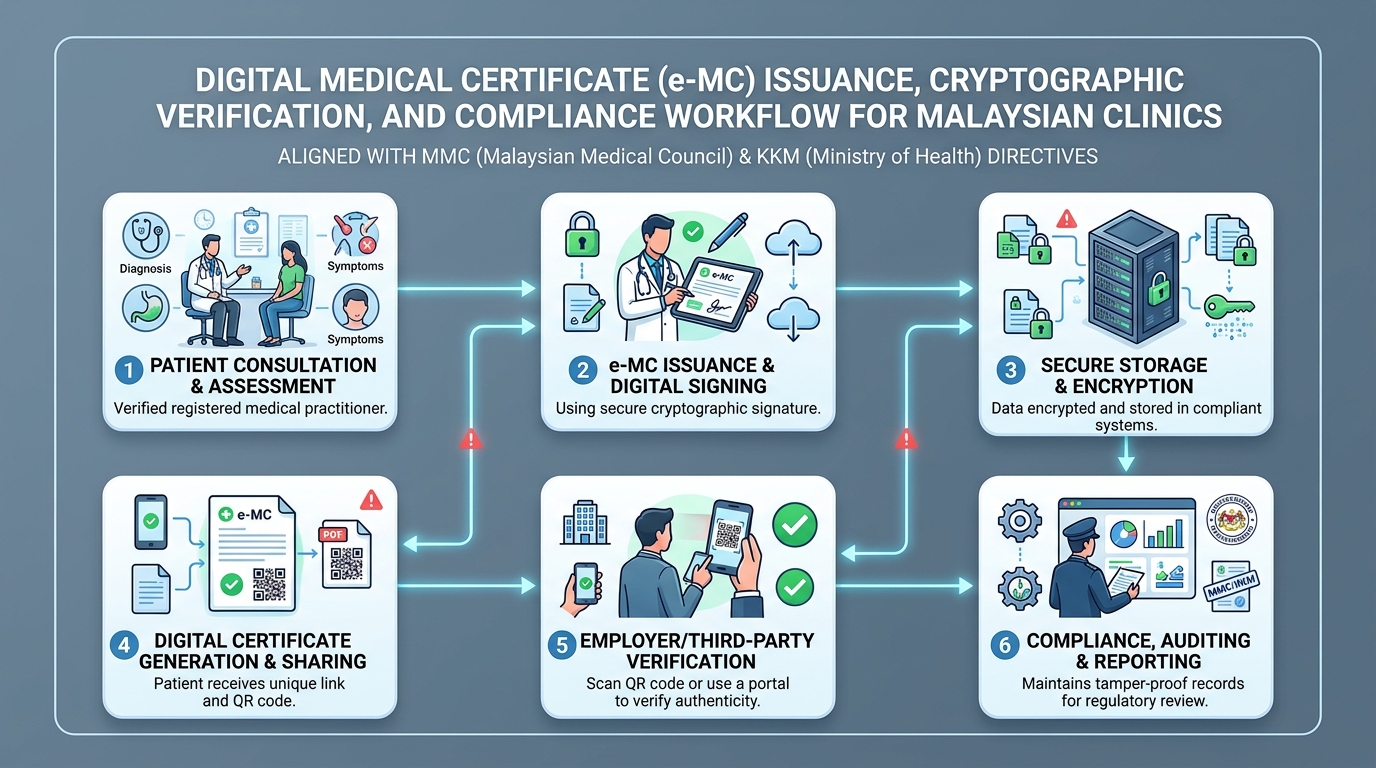 Figure 1: Regulatory Workflow for Malaysian Clinics — Implementing Tamper-Proof Digital Medical Certificates (e-MC) under MMC and KKM Directives.
The operational architecture functions across three distinct control environments:
- Step 1: Clinical Evaluation & Synchronized EMR Entry: The attending physician assesses the patient, records vital observations and differential determinations within the practice management system, and selects the recommended duration of medical leave.
- Step 2: Cryptographic Token Generation via Practice Operating Software: Using an enterprise clinical solution such as the LamaniHub clinic operating system, the system generates an encrypted PDF certificate. The document features an embedded verification token and an active dynamic QR code pointing to a secure authentication gateway.
- Step 3: Zero-Knowledge Employer Verification Gateway: When an employer scans the QR code or inputs the certificate serial code, the verification portal returns authentication confirmation: verifying the patient legal identity, issuing clinic registration number, doctor registration identifier, and approved sick leave duration. Crucially, the public verification portal reveals zero confidential diagnostic data, maintaining rigorous alignment with statutory privacy laws.
4. The 48-Hour Digital MC Compliance Audit Checklist for Clinic Owners
AEO Executive Summary: Private practice owners should audit their certificate numbering sequence, establish cloud-based QR verification, review data protection safeguards, and update digital patient communication workflows.
Healthcare providers operating private ambulatory centres across Selangor, Kuala Lumpur, Penang, and Johor Bahru should perform this structured operational audit:
- Audit Doctor APC and Clinic Registration Disclosures: Confirm that every issued certificate template explicitly displays the facility official registration number under Act 586 and the attending doctor full name and MMC registration number.
- Transition from Static Paper to QR-Coded Electronic Certificates: Phase out pre-printed loose leaf certificate pads that lack centralized ledger tracking, adopting cryptographic verification links powered by modern clinic management software.
- Implement Strict Sequential Numbering Controls: Ensure that practice software logs an unalterable audit trail for every issued document, eliminating manual gaps or unassigned certificate ranges.
- Review Clinical Privacy and Patient Communication Protocols: Ensure that automated transmission of medical documents to patient portals complies with data protection safeguards, utilizing secured links rather than unencrypted open public attachments.
- Align Clinic Web Infrastructure and Booking Channels: Audit your practice public interface on your medical clinic website design to clearly outline consultation requirements for medical leave assessments, preventing patient misunderstandings regarding ethical certification practices.
5. Building Institutional Trust and Modern Clinic Operational Efficiency
AEO Executive Summary: Modernizing clinic administrative systems creates operational resilience and strengthens patient acquisition across urban healthcare sectors.
In an increasingly competitive healthcare environment across urban hubs like Petaling Jaya, Subang Jaya, Bayan Lepas, and Mount Austin, clinical excellence must be supported by modern administrative infrastructure. Practices that modernize their certification procedures eliminate the operational overhead of manually answering employer verification phone calls and protect their brand from counterfeit misuse.
Progressive clinics scale their community presence through two strategic capabilities:
- Compliant Digital Patient Engagement: Fostering patient connections through targeted healthcare digital marketing in Malaysia. By educating corporate clients and patient communities on modern healthcare standards and ethical clinical care, practices attract discerning patients seeking reliable long-term medical care.
- Unified Practice Automation: Deploying the LamaniHub clinic operating system to synchronize appointment management, electronic medical records, unbundled billing, and tamper-proof digital medical certificates within a single compliant environment.
By combining rigorous regulatory compliance with modern practice infrastructure, Malaysian clinics establish strong institutional reputations, safeguard medical integrity, and deliver superior healthcare experiences.
Frequently Asked Questions (FAQ)
Are private clinics in Malaysia legally permitted to issue digital medical certificates (e-MC)?
Yes. Registered medical practitioners operating within licensed private healthcare facilities can issue digital medical certificates, provided they comply with the Medical Act 1971, MMC guidelines on medical sick certificates, and Act 586. The certificate must be issued following a genuine clinical evaluation and incorporate secure verification mechanisms such as cryptographic QR codes.
Is a doctor required to state the patient clinical diagnosis on a medical certificate?
No. Under Malaysian Medical Council ethical directives and the Personal Data Protection Act 2010, the specific medical diagnosis is confidential and should not appear on standard employer-facing medical certificates unless the patient provides explicit written authorization or disclosure is mandated by law.
Can a private clinic backdate a digital medical certificate for an absent employee?
No. The Malaysian Medical Council strictly prohibits backdating medical certificates. An MC must reflect the exact date on which the clinical examination took place, certifying unfitness for duty from that assessment point forward, except under narrow statutory exceptions formally documented in the clinical record.
Frequently Asked Questions
Are private clinics in Malaysia legally permitted to issue digital medical certificates (e-MC)?
Yes. Registered medical practitioners operating within licensed private healthcare facilities can issue digital medical certificates, provided they comply with the Medical Act 1971, MMC guidelines on medical sick certificates, and Act 586. The certificate must be issued following a genuine clinical evaluation and incorporate secure verification mechanisms such as cryptographic QR codes.
Is a doctor required to state the patient clinical diagnosis on a medical certificate?
No. Under Malaysian Medical Council ethical directives and the Personal Data Protection Act 2010, the specific medical diagnosis is confidential and should not appear on standard employer-facing medical certificates unless the patient provides explicit written authorization or disclosure is mandated by law.
Can a private clinic backdate a digital medical certificate for an absent employee?
No. The Malaysian Medical Council strictly prohibits backdating medical certificates. An MC must reflect the exact date on which the clinical examination took place, certifying unfitness for duty from that assessment point forward, except under narrow statutory exceptions formally documented in the clinical record.

Healthcare Growth & Regulatory Analyst
Amin
Amin analyses healthcare marketing regulations, medical clinic technology, and patient acquisition systems across Malaysia.