
On 16 November 2026, the Sessions Court in Petaling Jaya fined a 38-year-old dentist 70,000 ringgit for something that happens in hundreds of Malaysian clinics every week: a member of staff doing clinical work without a registration.
The facts, as reported by The Star, are unremarkable until you get to the sentence. A Selangor Health Department enforcement team visited the clinic on Jalan SS21/1 in Damansara Utama and found a female staff member performing a dental scan on a patient using an iTero Element digital intraoral scanner. The woman was not registered with the Malaysian Dental Council. The dentist, as the registered practitioner on site, could not produce the staff member’s annual certificate of practice. The staff member held an SPM qualification.
There were two charges, and two fines. Thirty thousand ringgit, in default six months’ jail, for employing a person not registered under the Dental Act. Forty thousand ringgit, in default seven months’ jail, for allowing that person to practise dentistry at the clinic.
For clinic directors across the Klang Valley, Penang and Johor Bahru, the interesting part is not the amount. It is the defence.
What the Sessions Court actually decided
Quick answer: A dentist was fined 70,000 ringgit on two Dental Act 2018 charges because an unregistered staff member operated clinical equipment in her clinic, and the court treated the clinic’s staffing decision as the dentist’s legal responsibility.
The prosecution, led by the Health Ministry’s Dr Haznita Zainal Abidin, argued that the case turned on strict liability and the integrity of the profession, and that the dentist had failed to ensure only registered practitioners were on duty during opening hours. The court also heard testimony that the scanning device could only be operated by a qualified dental practitioner.
The structure of the sentence matters more than the total. Malaysian professional statutes typically create two distinct offences: one for the unregistered person who practises, and one for the registered person who employs or permits them to practise. The second is the one that reaches the clinic owner.
| Charge | Provision | Fine | Default |
|---|---|---|---|
| Employing an unregistered person | Section 68, Dental Act 2018 | 30,000 ringgit | 6 months |
| Allowing unregistered practice | Section 69(a), Dental Act 2018 | 40,000 ringgit | 7 months |
Both fines were imposed by Sessions Court judge Noor Ruzilawati Mohd Noor at the close of the defence case.
Why “the doctor was at lunch” did not work
Quick answer: Because the offence is built around the employer’s duty to control who practises in the facility, not around the employer’s physical presence at the moment of treatment.
The mitigation put to the court was candid and, from a practice-management perspective, entirely familiar. Counsel for the dentist described it as a technical offence with no criminal element, noted that the patient had come for treatment while the dentist was away for a meal, that she was a first-time offender with no prior record under the Dental Act, that she was remorseful, and that she had committed to a stricter management system afterwards.
The court fined her on both charges anyway.
Read that sequence carefully, because it is the operational lesson. A first-time offender, a single patient, a short absence, no clinical harm alleged, remorse expressed, corrective process promised — and the outcome was still a five-figure penalty on two charges. The variable that decided the case was not intent. It was whether the clinic could demonstrate, from its own records, that the person touching the patient was registered and permitted to do that specific task.
That is a documentation question, and documentation questions are answerable in advance.
Three clocks are now running at the same time
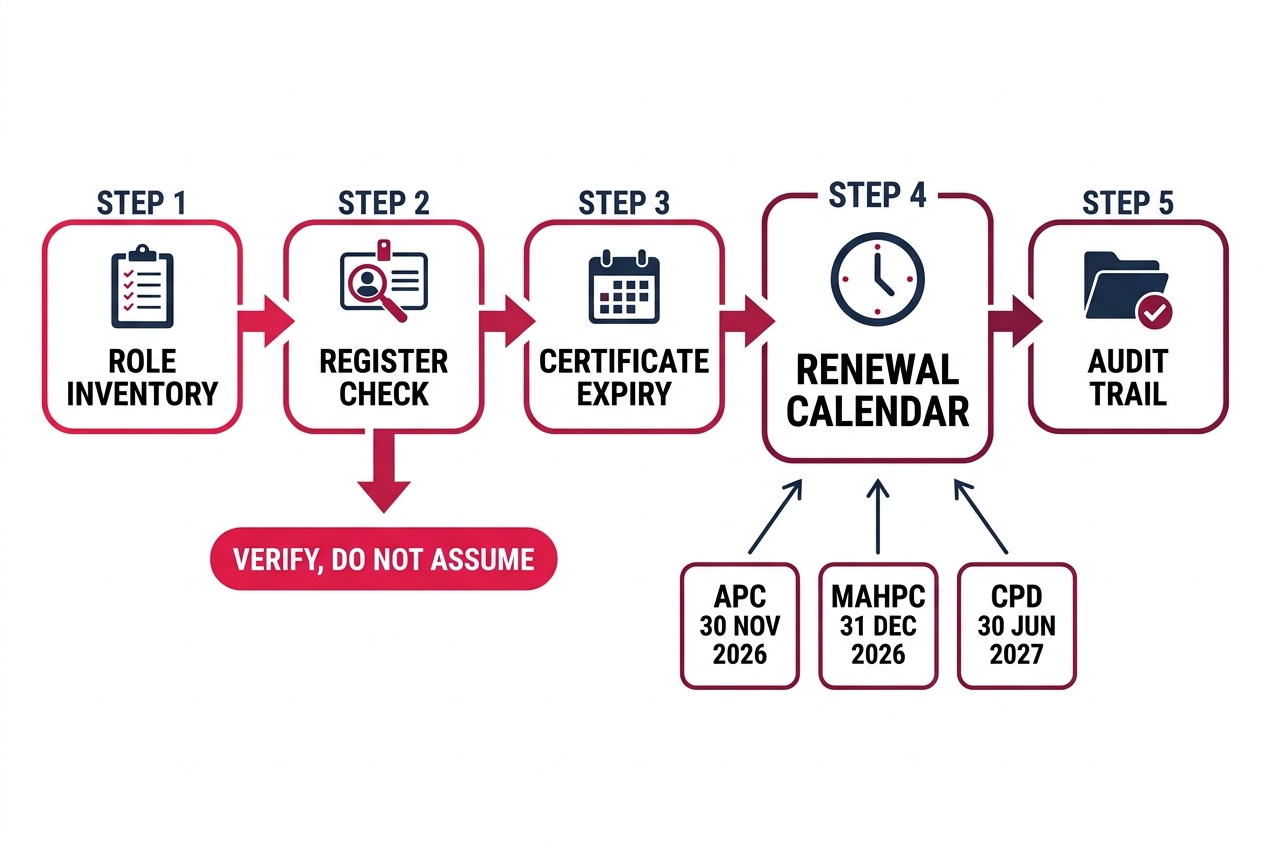
Quick answer: The 2027 Annual Practising Certificate window closes on 30 November 2026, the Act 774 allied-health transition period ends on 31 December 2026, and the current CPD cycle closes on 30 June 2027. Every one of them generates a different expiry date in the same staff file.
Malaysian professional regulation is not one deadline. It is a cluster of them, held by different regulators, on different cycles, for different categories of staff who all stand in the same treatment rooms.
| Who is in the room | Regulator | Instrument | Cycle |
|---|---|---|---|
| Medical practitioner | Malaysian Medical Council | Annual Practising Certificate | Annual; 2027 window closes 30 Nov 2026 |
| Dentist | Malaysian Dental Council | Annual Certificate of Practice | Annual, per holder |
| Nurse | Malaysian Nursing Board | Annual Practising Certificate | Annual, per holder |
| Pharmacist | Pharmacy Board | Annual Retention Certificate | Annual, per holder |
| Allied health practitioner | Malaysian Allied Health Professions Council | Registration plus practising certificate under Act 774 | Annual; transition period to 31 Dec 2026 |
| The facility itself | CKAPS and state health departments | Licence under Act 586 | Fixed term, renewed on application |
Two of those lines are active right now.
The first is the Malaysian Medical Council’s APC renewal, which closes on 30 November 2026 — four days from today. The application requires a professional indemnity certificate and evidence of at least 20 CPD points from the cycle running 1 July to 30 June, under Regulation 28 of the Medical Regulations 2017. After the cut-off, a late fee applies, and a late fee is not a grace period: the practitioner still cannot lawfully practise until the certificate is issued.
The second is quieter, and far less audited by clinic managers.
The 31 December 2026 deadline almost nobody has checked
Quick answer: The Ministry of Health has extended the transition period for registering allied health practitioners under the Allied Health Professions Act 2016 (Act 774) to 31 December 2026, which means every radiographer, laboratory technologist, physiotherapist, occupational therapist and dental technologist on your payroll should have their registration and practising certificate confirmed within the next five weeks.
The Ministry’s Allied Health Sciences Division publishes the extension notice, the registration schedule and the practising certificate manual on its MAHPC portal. Practitioners register with the Malaysian Allied Health Professions Council (MPKBM) and hold a practising certificate, in the same way a doctor holds an APC.
The reason this deadline goes unnoticed is structural. A clinic owner thinks of the doctor as the regulated person and everyone else as staff. But the second-largest category of people physically performing clinical tasks in a private clinic — taking the radiograph, running the laboratory analyser, doing the physiotherapy session, fabricating the crown — sits under Act 774, not the Medical Act.
Where this bites hardest is predictable by clinic type. In the Klang Valley, it is the high-volume diagnostic and imaging-heavy practices in Petaling Jaya, Subang Jaya and Cheras, plus the dental groups running in-house scanners and CAD/CAM workflows. In Penang, it is the George Town and Bayan Lepas practices serving a dense private-specialist cluster, where allied health staff frequently rotate between two or three clinics on a sessional basis. In Johor Bahru, it is the cross-border patient-facing clinics in Iskandar Puteri and Tebrau, where a single unregistered staff member on a weekend shift is the whole compliance story if an inspection lands.
The audit question is simple and it is not “are they qualified”. It is: can you produce, today, a certificate that is current?
Build the credential register in one afternoon
Quick answer: List every person who touches a patient or a patient specimen, map each to their regulator, record the certificate number and expiry date, and set a review date 60 days before each expiry.
This is not a project. It is a spreadsheet that becomes a management routine.
Step 1 — Inventory by task, not by job title. Walk the clinic and list every clinical act performed on the premises: consultation, procedure, injection, radiograph, scan, sample collection, laboratory testing, dispensing, physiotherapy, dressing, sterilisation of instruments. Job titles hide the problem; tasks do not.
Step 2 — Map each task to a regulator. Consultation maps to the Malaysian Medical Council. Dental procedures map to the Malaysian Dental Council. Nursing procedures map to the Malaysian Nursing Board. Imaging and laboratory work map to MPKBM under Act 774. Dispensing of poisons maps to the premises licence held under the Poisons Act 1952, administered by the Pharmacy Enforcement Division.
Step 3 — Record five fields per person. Full name as registered, registration number, certificate number, issue date, expiry date. Add the name of the person who verified it against the regulator’s own portal, and the date of verification. A photocopy is not verification; a portal lookup is.
Step 4 — Attach the scope, not just the status. A valid certificate says someone may practise. It does not always say they may operate a particular device or perform a particular procedure unsupervised. The iTero scanner in the Damansara Utama case is exactly this problem: the equipment existed, the training existed, the registration did not.
Step 5 — Set the review date 60 days before expiry. A register that is reviewed on the expiry date is a register that is always late.
Step 6 — Name one owner and one deputy. Registers without an owner are maintained until the first busy month and then abandoned.
What an inspection actually asks for
Quick answer: Inspectors ask for the certificate, the register, and the person who can explain both. If the answer to any of those is “the doctor keeps it”, the file is not ready.
The Damansara Utama inspection began as a routine compliance check by state health department enforcement officers, and escalated in a single conversation because the person on the floor could not produce a staff member’s annual certificate. Facility licensing under the Private Healthcare Facilities and Services Act 1998 (Act 586) is administered by CKAPS and enforced by state health departments, and the standards a licensed facility must maintain include ensuring that services are delivered by practitioners registered under the relevant law.
The practical ask is therefore always the same three items:
- the physical or digital certificate for each practitioner on duty at that hour;
- a register that shows who is on the roster and when their documents expire;
- an identified person, present or contactable, who can speak to both.
Complaints change the entry point but not the ask. A patient complaint, a competitor report, an insurer query or an employment dispute can all trigger the same document request, and none of them arrives with notice.
Storing the file without creating a PDPA problem
Quick answer: Certificate copies and identity documents are personal data under the Personal Data Protection Act 2010, so the register needs access control, a retention period and a processor check if it lives in a third-party system.
The instinct when a deadline approaches is to collect everything through a messaging group. Resist it. A folder of identity cards, certificates and employment letters circulating in a group chat is a data protection exposure created in the name of compliance.
Apply the baseline from the Personal Data Protection Department:
- Access control. One controlled location, with named administrators. Not a public link, not a shared drive with open permissions.
- Purpose limitation. Collect the certificate and the registration number, not the entire personnel file, and say in writing why you are collecting it.
- Retention. Define how long you keep copies after a staff member leaves, and follow it. Indefinite retention is a liability, not diligence.
- Processor terms. If the register sits in a practice-management or HR platform, confirm the data processing terms and where the data is hosted.
None of this is complicated, and all of it is easier before an inspection than after one.
The commercial exposure nobody prices in
Quick answer: Credential gaps surface commercially through insurer and TPA credentialing, claim scrutiny, corporate panel audits, and your own website — where a lapsed practitioner listed publicly is a compliance claim you are making in writing.
Three channels matter.
Panel and TPA credentialing. Corporate panel contracts and third-party administrators verify practitioner registration at onboarding and at renewal. A provider list that includes someone whose certificate lapsed is the kind of mismatch that surfaces as a rejected or clawed-back claim months later.
Insurer and indemnity continuity. Professional indemnity cover is written against a lawful practice. Cover that depends on a valid APC stops being the cover you thought you bought at exactly the moment you need it.
Your public practitioner page. If the clinic website lists doctors, dentists or specialists, that page is a public statement that each named person is registered and practising. A lapsed certificate turns a marketing asset into evidence, which is why the practitioner page should be generated from the credential register rather than maintained separately. Clinics rebuilding that page can see how clinic website design handles practitioner and facility information, and how healthcare digital marketing structures claims so they stay defensible after a staffing change.
That is also the argument for keeping the register inside the operating system rather than in a personal folder. LamaniHub holds practitioner records, rosters and credential expiry alongside the clinical and billing record, so the staff member who books the shift and the file that proves the certificate are the same system.
The action plan for the next five weeks
Quick answer: Close the APC file this week, build the register next week, and clear the Act 774 list before 31 December 2026.
This week, by 30 November 2026
- Confirm every medical practitioner has submitted the 2027 APC application with indemnity cover and CPD evidence attached.
- Identify anyone whose submission is incomplete, and decide the rota consequence now rather than in December.
- Check that no unregistered person is performing any clinical act at any hour the clinic is open, including lunch, weekends and public holidays.
Next week
- Complete the task-to-regulator inventory.
- Verify every certificate against the regulator’s own portal, and record who verified it and when.
- Fix the two or three gaps the inventory exposes.
Before 31 December 2026
- Confirm registration and practising certificate status for every allied health practitioner on the payroll, including sessionals and locums.
- Confirm the premises licence under Act 586 and the poisons licence are current, and that the licensee details match the current operator.
Standing routine
- Review the register 60 days before each expiry, monthly.
- Add credential verification to onboarding, with a signed acknowledgement that the staff member will not perform tasks outside their registration.
- Re-verify on every roster change, not only on renewal.
The bottom line
The Damansara Utama case cost a dentist 70,000 ringgit, two criminal convictions and a public record, for a lapse that lasted as long as a lunch break. The dentist was not accused of dishonesty or of harming a patient. She was convicted because the clinic could not demonstrate that the person operating clinical equipment was permitted to operate it.
That is the shift worth absorbing from November 2026. Credential compliance in a Malaysian private clinic is no longer a doctor-shaped problem with an annual form attached. It is a facility-wide documentation system covering every pair of hands in the treatment room, running on at least four regulators, with three deadlines inside the next seven months.
The clinics that treat that as an operating routine will spend December closing files. The clinics that treat it as an annual irritation will spend December discovering which of their staff cannot lawfully work.
This article is an operational briefing for clinic administrators and does not constitute legal advice. Practitioners and facilities should confirm their individual position directly with the relevant regulator.
Sources
- Malaysian Medical Council — Annual Practising Certificates: mmc.gov.my/annual-practicing-certificates-apc
- Ministry of Health Malaysia — Allied Health Sciences Division / MAHPC: hq.moh.gov.my/alliedhealth
- Pharmacy Enforcement Division, Ministry of Health Malaysia: pharmacy.gov.my
- Personal Data Protection Department, Malaysia: pdp.gov.my
- The Star (Nation), 16 November 2026 — report on the Sessions Court sentencing of a dentist for employing and permitting an unregistered person to practise: thestar.com.my/news/nation
Frequently asked questions
What exactly happened in the November 2026 dental case?
A Selangor Health Department enforcement team found an unregistered female staff member performing a dental scan with a digital intraoral scanner at a clinic in Damansara Utama. The dentist could not produce the staff member’s annual certificate of practice. She was charged and convicted under the Dental Act 2018 on two counts.
Could the clinic argue that the staff member acted alone?
The court did not accept that framing. The Dental Act creates an offence for the registered practitioner who employs or permits an unregistered person to practise, so the clinic’s staffing and supervision decisions were the subject of the case, not the staff member’s initiative.
Does the 31 December 2026 deadline apply to sessionals and part-timers?
The registration obligation attaches to the individual practitioner, not to the employment contract. A sessional radiographer or part-time physiotherapist working two shifts a month must still be registered and hold a current practising certificate.
What if a practitioner’s renewal is still being processed on the deadline?
Track submission and issuance as two separate dates, and treat the practitioner’s roster status as unresolved until the certificate is issued. Document the submission and any correspondence with the regulator.
Is a photocopy of a certificate sufficient evidence?
It is evidence that a document existed. Verification against the regulator’s public register is evidence that the registration is current. Clinics should do the second and record when it was done.
How often should the credential register be reviewed?
Monthly, with a specific check at 60 days before each expiry date. The register should also be re-verified on every roster change, because that is when an unregistered or lapsed practitioner most often appears in a treatment room.
Frequently Asked Questions
What was the dentist fined for in the November 2026 Malaysian dental case?
The Sessions Court in Petaling Jaya fined a 38-year-old dentist 70,000 ringgit over two charges under the Dental Act 2018: 30,000 ringgit for employing a person who was not a registered dental practitioner, and 40,000 ringgit for allowing that person to practise dentistry at her clinic. Each fine carried a default jail term.
Can a clinic owner be penalised when an unregistered staff member treats a patient?
Yes. The Dental Act 2018 places the duty on the registered practitioner and the facility, not only on the unregistered individual. In the November 2026 case the court rejected the argument that the offence was merely technical because the dentist was away from the clinic, and fined her on both charges.
When does the 2027 Annual Practising Certificate window close for doctors in Malaysia?
The Malaysian Medical Council window for the 2027 Annual Practising Certificate closes on 30 November 2026. Applications received afterwards attract a late fee, and a practitioner cannot lawfully practise until the certificate is issued.
What is the 31 December 2026 allied health registration deadline?
The Ministry of Health has extended the transition period for registering allied health practitioners under the Allied Health Professions Act 2016 (Act 774) to 31 December 2026. Clinic staff in regulated allied health roles should confirm their registration and practising certificate status with the Malaysian Allied Health Professions Council before that date.
Which clinic staff roles in Malaysia must hold a practising certificate?
At minimum: medical practitioners, dentists, nurses, pharmacists, and allied health practitioners registered under Act 774, including radiographers, medical laboratory technologists, physiotherapists, occupational therapists and dental technologists. Optometrists are separately regulated under the Optical Act 1991, and clinics that store or dispense poisons also need a premises licence from the Pharmacy Enforcement Division.
How should a clinic store copies of staff practising certificates under PDPA?
Treat certificate copies and identity documents as personal data under the Personal Data Protection Act 2010. Keep them in an access-controlled system with a defined retention period, limit access to named administrators, and avoid circulating certificate photographs through open messaging groups or shared public links.

Medical Market Intelligence Lead
Jessica
Jessica covers private healthcare operations, digital health innovation, and search visibility trends for GP, dental, and aesthetic practices across Southeast Asia.